
Low-Cost Field Autonomy Infrastructure
A solar-powered control mast and modular robot backpack architecture that lets farms run supervised robot fleets without a vendor-locked autonomy stack - costed, source-traced, and bounded by named risks.
- Published
- May 5, 2026
- Reading
- 32 min
- Author
- Christopher Lyon
- Filed
- White Paper
Abstract
Agricultural autonomy is gated by per-acre economics before it is gated by machine intelligence. A robot that drives itself is uneconomic where total cost of ownership exceeds manual labor, conventional equipment, or the value of saved inputs and improved timing - and that envelope tightens further on farms with weak connectivity, thin margins, limited service infrastructure, or jurisdictional friction. The commercial autonomy stack now forming around large OEMs solves the technical problem inside a proprietary boundary: dealer networks, correction subscriptions, telemetry plans, vendor-locked implements, and cloud platforms that assume reliable broadband. That boundary leaves several segments outside: small and cooperative farms, low-income regions where automation could materially raise yield, mixed-fleet operators retrofitting older equipment, and any farm where cloud connectivity is unaffordable, unreliable, or absent.
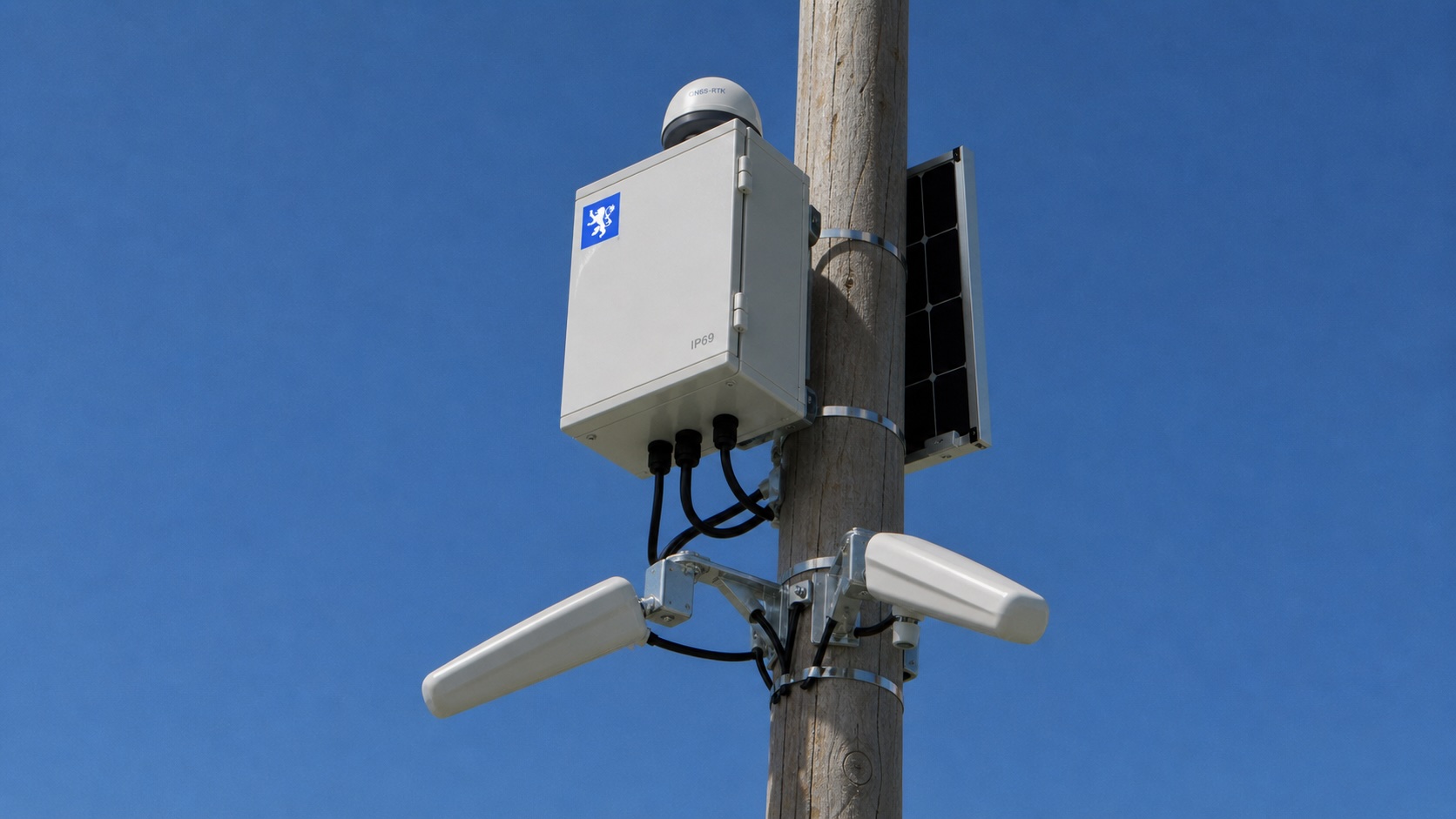
This paper proposes a low-cost, local-first infrastructure layer that allows supervised robot fleets to operate without a vendor-locked autonomy stack. The architecture has two elements. A field control mast - 10 to 12 meters, solar-powered, with a fixed RTK base, three sector radios, weatherproof edge compute, local web application, and optional satellite backhaul - provides positioning, communications, orchestration, and records. A modular robot backpack - RTK rover, directional radio, edge processor, robot adapter, optional vision and safety I/O - connects mobile machines to the mast and exposes a standard integration point. Both are open at the integration level so cooperatives, retrofit builders, agritech startups, and small farms can absorb them without subscription dependence.
A first-pass engineering-economic model, built from vendor and standards-body sources accessed on 2026-05-05, places mast hardware in the approximate range of $2,700 to $5,500 before installation and a single-robot backpack in the range of $550 to $1,500. Annualized infrastructure cost falls below $2 per acre once the system is amortized over 1,000 acres per year and below $1.50 per acre on a cooperative hub serving 3,000 acres. These numbers are not installed costs and do not constitute a field validation. They are sufficient to justify deeper engineering work, and they are bounded by named risks: radio performance on moving platforms, mast structural loading, RTK behavior under field dynamics, solar sizing across geographies, jurisdictional spectrum and machinery regulation, and the safety boundary between connectivity infrastructure and certified autonomous drive control.
The bet underlying this work is that the cheapest path to broader autonomy adoption is not a cheaper robot. It is a cheaper field - a local control network that any robot can plug into, that runs without a subscription, and that survives a missing cloud link.
Keywords
Agricultural robotics; field autonomy; RTK GNSS; precision agriculture; edge computing; rural connectivity; supervised autonomy; low-cost robotics; robot fleets; cooperative agriculture; ISOBUS; ISO 18497; agritech infrastructure.
The Problem
The headline story of agricultural autonomy is usually a machine: an autonomous tractor crossing a Midwest cornfield, a drone fanning across a Brazilian soybean stand, a laser weeder advancing through a California vegetable row. The supporting story - and the harder one - is that the farm itself is becoming a control system before any of those machines becomes broadly economic. Positioning, implement communication, prescription maps, selective actuation, telemetry, and field records are already part of the autonomy stack; they sit underneath the visible robot, and they are what makes the visible robot pay. That argument is developed in the prior Lyon Industries research piece on agricultural robotics.1Lyon, C. Agricultural Robotics: The Farm Is Becoming a Control System. Lyon Industries Research, 2026. https://lyon-industries.no/research/robotics-automation-agriculture
The question this paper takes up is what happens to that argument when the underlying control system is locked inside a proprietary OEM stack. In practice, that lock looks like a dealer-installed receiver tied to a paid correction subscription, a telematics radio that only speaks to one cloud platform, a task controller that only authorizes implements with a particular conformance certificate, and a fleet dashboard whose monthly fee scales with the number of machines. Every layer of that stack has a defensible reason for existing inside the manufacturer that produced it. Stacked together, the layers create an enabling-cost floor that is too high for several segments of agriculture: small and cooperative farms; specialty-crop operations that mix old and new equipment; low-income regions where the marginal value of automation is highest but the ability to absorb subscription cost is lowest; and any farm whose connectivity is too thin to support a continuous link back to the OEM's cloud.
The Food and Agriculture Organization's 2022 State of Food and Agriculture makes this gap explicit at policy level. Automation can lift productivity, resilience, resource-use efficiency, working conditions, and sustainability, but uneven access to finance, skills, infrastructure, energy, services, and appropriate technology can deepen inequality if automation is pushed without surrounding support.2Food and Agriculture Organization of the United Nations. The State of Food and Agriculture 2022: Leveraging automation to transform agrifood systems. 2022. https://www.fao.org/agrifood-economics/publications/detail/en/c/1613500/ The connectivity side of that argument is sharper still: the International Telecommunication Union reports roughly 2.6 billion people offline in 2024, with low-income countries at 27 percent population online versus 93 percent in high-income countries, and 1.8 billion of the offline population resident in rural areas.3International Telecommunication Union. Measuring digital development: Facts and Figures 2024. 2024. https://www.itu.int/itu-d/reports/statistics/facts-figures-2024/ The GSMA's 2025 connectivity report adds the usage gap: 96 percent of the global population lives in areas with mobile internet coverage, but 3.1 billion people in covered areas remain unconnected on cost, device, or skill grounds.4GSMA Intelligence. The State of Mobile Internet Connectivity 2025: Overview Report. 2025. https://www.gsmaintelligence.com/research/the-state-of-mobile-internet-connectivity-2025-overview-report Coverage is not connectivity, and connectivity is not robot-grade local network.
That sequence - coverage, connectivity, then field-grade local network - is the technical premise of the architecture proposed here. A farm does not need a continuous link to a cloud autonomy platform in order to run a supervised robot fleet. It needs a known position reference, a reliable local radio, an on-farm computer that holds maps and mission state, a way to record what the robots did, and an optional path to the cloud for sync, support, and updates when bandwidth and budget allow. If those primitives can be built cheaply enough, in the open, the autonomy adoption frontier moves outward - not because a new robot has been invented, but because the field has become inexpensive enough to instrument.
The Research Question
The primary research question is bounded:
Can a low-cost, local-first field autonomy infrastructure layer - built from a solar-powered control mast and modular robot backpacks - make supervised robot fleets economically viable for farms and cooperatives that lack reliable broadband, cannot absorb subscription-heavy proprietary autonomy stacks, or operate in markets where conventional OEM autonomy is structurally inaccessible?
The product hypothesis follows from that question. A farm-scale control mast plus modular robot backpack can reduce the enabling cost of autonomy by combining local RTK corrections, local radio backhaul, solar-powered field infrastructure, local edge orchestration, optional satellite cloud sync, and open adapters for mixed robot fleets - all priced and packaged so that one mast can amortize across multiple machines, multiple operators, or multiple farms in a cooperative configuration.
The scope is deliberately narrower than a market forecast. This paper does not predict adoption rates, does not size a market, and does not propose a specific commercial product line. It maps a research and engineering program, validates the order of magnitude on cost and value, identifies the named risks that would invalidate the architecture, and sketches the segments most likely to make the business case work first.
Background
The autonomy stack already exists; the proprietary version is the gap
The control system that supports a useful autonomous field operation is not a single product. It is a stack of public infrastructure, formal standards, vendor platforms, and farm-level practice. The accompanying research article on agricultural robotics describes that stack in detail.1Lyon, C. Agricultural Robotics: The Farm Is Becoming a Control System. Lyon Industries Research, 2026. https://lyon-industries.no/research/robotics-automation-agriculture The short summary matters here because the proposed architecture is a low-cost re-implementation of the same stack at field scale.
| Stack layer | Public anchor | Proprietary anchor | What it does for autonomy |
|---|---|---|---|
| Reference geodesy | NOAA Continuously Operating Reference Stations Network5NOAA National Geodetic Survey. Continuously Operating Reference Stations Network. https://geodesy.noaa.gov/CORS/ | OEM correction subscriptions, RTK base towers | Centimeter-grade absolute position |
| Tractor-implement communication | ISO 11783 (ISOBUS)6International Organization for Standardization. ISO 11783-2:2019 Tractors and machinery for agriculture and forestry - Serial control and communications data network - Part 2: Physical layer. https://www.iso.org/standard/71171.html | OEM display + task controller | Section control, variable-rate, prescription execution |
| Autonomous machinery safety | ISO 18497-1, -3, -4 (2024)7International Organization for Standardization. ISO 18497-1:2024 Agricultural machinery and tractors - Safety of partially automated, semi-autonomous and autonomous machinery - Part 1: Machine design principles and vocabulary. https://www.iso.org/standard/82684.html8International Organization for Standardization. ISO 18497-3:2024 Agricultural machinery and tractors - Safety of partially automated, semi-autonomous and autonomous machinery - Part 3: Autonomous operating zones. https://www.iso.org/standard/82687.html9International Organization for Standardization. ISO 18497-4:2024 Agricultural machinery and tractors - Safety of partially automated, semi-autonomous and autonomous machinery - Part 4: Verification methods and validation principles. https://www.iso.org/standard/82688.html | OEM safety case, dealer commissioning | Operating zones, residual risk, verification |
| UAS chemical application | FAA Part 137 (US)10Federal Aviation Administration. Dispensing Chemicals and Agricultural Products (Part 137) with UAS. https://www.faa.gov/uas/advancedoperations/dispensingchemicals | UAS service operator certificates | Legal envelope for spray drones |
| Field network | None currently public at farm scale | Cellular IoT plan, OEM telematics, OEM cloud | Telemetry, mission state, software updates |
Three observations follow. First, the public anchors at the geodesy and standards layers exist independently of any single manufacturer; they can be used by anyone who builds compliant hardware. Second, the field network layer has no equivalent public anchor - it is the only layer where the farm currently has to choose between an expensive proprietary subscription and no service at all. Third, the safety standard does not require autonomy hardware to be vendor-locked; it requires it to be designed, verified, and documented to a particular level of rigor. None of these layers, taken individually, prevents an open low-cost field autonomy infrastructure from existing. The barrier is that the layers have, until recently, been bundled by OEMs as a single take-it-or-leave-it package.
The connectivity gap is structural, not transitional
The temptation in any architecture discussion is to assume connectivity. ITU's 2024 figures argue against that assumption: in low-income countries, 73 percent of the population is offline; rural internet use globally remains below half of population; and roughly 1.8 billion people live offline in rural areas.3International Telecommunication Union. Measuring digital development: Facts and Figures 2024. 2024. https://www.itu.int/itu-d/reports/statistics/facts-figures-2024/ GSMA's 2025 overview adds the usage gap layer: even where mobile coverage exists, 3.1 billion people who live in covered areas do not use mobile internet, predominantly on affordability and device grounds.4GSMA Intelligence. The State of Mobile Internet Connectivity 2025: Overview Report. 2025. https://www.gsmaintelligence.com/research/the-state-of-mobile-internet-connectivity-2025-overview-report In the United States, USDA NASS's 2025 Technology Use survey reports that 85 percent of farms have internet access and 55 percent use broadband, but only 22 percent report any precision agriculture practice under the survey's broad definition.11USDA National Agricultural Statistics Service. Technology Use (Farm Computer Usage and Ownership). August 2025. https://www.nass.usda.gov/Publications/TodaysReports/reports/fmpc0825.pdf Coverage and access have improved; consistent, robot-grade, field-edge connectivity has not.
The architecture proposed here does not assume the gap closes on its own. It treats the farm-edge network as a piece of equipment that the farm itself owns - solar-powered, locally maintained, optionally synchronized to the cloud, fully operational without it.
The economic gate is per-acre, not per-machine
The peer-reviewed economics are clear that the right unit of analysis is per-acre value, not per-robot novelty. Lowenberg-DeBoer and coauthors review the field robot economics literature and find that profitable scenarios exist under specific assumptions, but that public economic evidence remains thinner than engineering progress, and that farm-level and system-level economic data are still scarce.12Lowenberg-DeBoer, J., Huang, I.Y., Grigoriadis, V., and Blackmore, S. "Economics of robots and automation in field crop production." Precision Agriculture 21, 278-299, 2020. https://doi.org/10.1007/s11119-019-09667-5 Vahdanjoo and coauthors compare an agricultural robot to conventional machinery in seeding and weeding and find that hourly cost was 40 to 57 percent lower for the robot, but that effective field capacity was lower because conventional machinery had larger working widths and higher speeds - so per-area economics depended heavily on working width, utilization, and operational context.13Vahdanjoo, M., Gislum, R., and Sorensen, C.A.G. "Operational, Economic, and Environmental Assessment of an Agricultural Robot in Seeding and Weeding Operations." AgriEngineering 5(1), 299-324, 2023. https://doi.org/10.3390/agriengineering5010020
USDA ERS's 2025 Farm Labor update sets the labor reference. Real wages for nonsupervisory crop and livestock workers rose faster in the most recent decade than over 1990 to 2024 as a whole; in 2024, average wages were $18.12 in 2024 dollars; H-2A certified positions grew more than sevenfold from FY2005 to FY2024, reaching roughly 385,000 certified positions in FY2024.14USDA Economic Research Service. Farm Labor. Updated 2025. https://ers.usda.gov/topics/farm-economy/farm-labor Labor scarcity is a credible mechanization driver. It is not, on its own, a sufficient business case for broad-acre autonomy where a high-capacity tractor already covers many acres per operator hour. The implication is that the autonomy value stack has to be plural - input savings, timing, supervision leverage, safety, compliance, and utilization - and the infrastructure cost layer has to be small enough that it does not consume the surplus before the value mechanisms are counted.
That is the gate this architecture has to clear.
The Proposed Architecture
The system is two pieces of hardware, one piece of software, and one set of integration contracts.
The control mast
The control mast is a fixed field infrastructure node. It serves as a single locus for positioning, communications, edge orchestration, and field records.
| Subsystem | Function |
|---|---|
| Mast structure (10-12 m) | Antenna height for sector radio reach and survey-grade GNSS antenna placement |
| Fixed GNSS RTK base receiver | Generates centimeter-grade correction data from a known reference position |
| Survey-class GNSS antenna | Provides stable, low-multipath signal capture for the base receiver |
| Three sector radios (5 GHz, 120°) | Provide point-to-multipoint field coverage for robot backpacks |
| Edge compute (industrial mini-PC or low-power ARM/x86) | Hosts mission state, RTK correction transport, telemetry aggregation, local web UI |
| Local web application | Operator interface accessible from tablet or laptop on the farm network |
| Solar array, MPPT controller, LiFePO4 battery | Provides off-grid power; sized for compute, radios, and optional backhaul |
| NEMA-rated cabinet | Houses electronics; protects against weather, dust, and pests |
| Optional satellite backhaul | Starlink Mini or equivalent for cloud sync, OTA updates, remote support |
| Grounding, lightning protection, surge arresters | Safety and equipment-protection baseline; not optional in any climate |
The design intent is local-first. Every operationally critical function - RTK correction, mission control, telemetry, work logs - runs on the mast. The cloud link, when present, carries sync data, software updates, support sessions, and aggregated reporting. When the link is absent, the farm continues to operate.
The robot backpack
The robot backpack is a modular mobile unit that turns an existing robot, small tractor, autonomous cart, or experimental platform into a participant in the field network.
| Subsystem | Function |
|---|---|
| GNSS RTK rover receiver | Consumes correction data from the mast to deliver centimeter-grade rover position |
| Dual-band GNSS antenna | Mounted on the robot frame; lever-arm-corrected to the robot's reference point |
| Directional 5 GHz radio (LiteBeam/NanoBeam class) | Maintains link to the nearest mast sector; bridge to the local network |
| Edge processor (Jetson Orin Nano Super or equivalent) | Hosts adapter logic, telemetry, optional vision, and mission execution |
| Microcontroller I/O (CAN/UART/GPIO bridge) | Talks to robot motor controllers, sensors, watchdogs, and emergency stops |
| Power conditioning (DC/DC, fusing, transient protection) | Adapts to robot battery systems while protecting payload electronics |
| IP-rated enclosure | Protects payload from dust, water, vibration; provides service access |
| Optional camera, IMU, safety I/O | For vision-assisted variants and safety-relevant integration paths |
The backpack is intentionally a retrofit rather than a chassis. The autonomy network adds value to many existing platforms - battery-electric carts, gas-powered ATVs, small-tractor implements, custom research robots - without requiring the farm to abandon its installed base.
Operating model
The control mast and the robot backpack share a small set of contracts:
- Position transport: RTCM corrections from the mast base to all backpack rovers, distributed locally over Wi-Fi (NTRIP caster on the mast or direct UDP/TCP) without leaving the farm network.
- Telemetry bus: MQTT or equivalent lightweight publish/subscribe topic for status, position, battery, mission step, and exception events.
- Mission state: A local mission planner on the mast issues bounded jobs; backpacks execute and report; a verified work log is the durable artifact.
- Operator interface: A local web application served from the mast renders maps, fleet state, mission planning, and reports. It runs in a normal browser on a tablet or laptop on the farm network.
- Cloud sync (optional): When backhaul is present, mission logs, software updates, support sessions, and aggregated reports cross to the cloud. The farm does not require this path to operate.
- Open integration surface: The backpack exposes documented hardware and software adapter points so that mixed robot fleets, cooperative operators, and agritech startups can build on top without renegotiating the platform.
Out of scope
The architecture is deliberately bounded.
It does not provide safety-certified drive control. ISO 18497-1, -3, and -4 set the principles, operating-zone definitions, and verification approach for partially automated, semi-autonomous, and autonomous agricultural machinery; an autonomous drive system requires its own safety case, its own validation, and its own jurisdictional compliance program.7International Organization for Standardization. ISO 18497-1:2024 Agricultural machinery and tractors - Safety of partially automated, semi-autonomous and autonomous machinery - Part 1: Machine design principles and vocabulary. https://www.iso.org/standard/82684.html8International Organization for Standardization. ISO 18497-3:2024 Agricultural machinery and tractors - Safety of partially automated, semi-autonomous and autonomous machinery - Part 3: Autonomous operating zones. https://www.iso.org/standard/82687.html9International Organization for Standardization. ISO 18497-4:2024 Agricultural machinery and tractors - Safety of partially automated, semi-autonomous and autonomous machinery - Part 4: Verification methods and validation principles. https://www.iso.org/standard/82688.html The mast and backpack contribute to that safety case - verified position, recorded telemetry, geofence enforcement, supervised mission execution - but do not replace the certified drive controller of an autonomous tractor.
It does not legalize UAS chemical application. In the United States, dispensing chemicals or agricultural products by UAS falls under FAA Part 137 with associated registration, pilot credentials, and exemption or certification paths.10Federal Aviation Administration. Dispensing Chemicals and Agricultural Products (Part 137) with UAS. https://www.faa.gov/uas/advancedoperations/dispensingchemicals Spray drone economics are real, but they are a separate regulatory product line from the ground-robot architecture proposed here.
It does not assume cloud connectivity. Where Starlink Mini, regional low-bit satellite, or terrestrial broadband is available and economically justified, the mast can use it. Where none is available, the mast continues to operate.
Methods
The analysis is engineering-economic and source-traceable. Three methodological commitments hold:
- BOMs are sourced. Each line in the bill of materials cites a vendor, manufacturer, or distributor source accessed on 2026-05-05. Source cards in the workspace record each price, capability claim, and authority tier; vendor prices are flagged provisional and must be re-checked before procurement.
- Costs are annualized, not list. Capital is converted to an annual line via a capital recovery factor at an 8 percent discount rate over a 5-year life, plus an 8 percent annual maintenance assumption, plus 12 months of any subscription. Per-acre infrastructure cost is the annualized cost divided by acres served per year.
- Value mechanisms are kept separate. Per-acre value is decomposed into input savings, labor leverage, timing value, and safety/compliance value. Each is sourced or marked as a hypothesis. Stacking is allowed only when the underlying mechanisms are independent and sourced.
The first viability gate is per-acre infrastructure cost versus defensible per-acre value. A segment is plausible only when infrastructure cost falls clearly below defensible value with margin for downtime, support, and field exceptions.
Bill of Materials
Costs below are listed-source snapshots accessed on 2026-05-05. They exclude installation labor, freight, taxes, import duties, civil works, permitting, and engineered foundations. They are not installed costs.
Control mast
| Subsystem | Baseline component | Unit estimate (USD) | Qty | Extended (USD) |
|---|---|---|---|---|
| Mast structure | 12 m / 40 ft telescoping mast (Channel Master, ROHN H40 class)15Channel Master / Home Depot. 40 ft Telescoping Outdoor Antenna Mast (CM-1850). https://www.homedepot.com/p/33216897916ROHN / DX Engineering. ROHN H40 Telescoping Mast. https://www.dxengineering.com/parts/ROH-H40 | 207 - 249 | 1 | 207 - 249 |
| Guying, anchors, hardware | Wires, anchors, clamps, brackets (estimate) | 150 - 350 | 1 | 150 - 350 |
| Grounding, lightning, surge | Ground rod, bonding, surge arresters, PoE protection (estimate) | 150 - 350 | 1 | 150 - 350 |
| Cabinet | NEMA 4X enclosure, fiberglass or steel (Polycase SB-51, Allied Moulded class)17Polycase. SB-51 NEMA 4X steel enclosure. https://www.polycase.com/sb-5118Allied Moulded distributor listing. 16x14x8 NEMA 4X fiberglass enclosure. https://www.pvcfittingsonline.com/amu1648-nema4x-fiberglass-enclosure.html | 209 - 291 | 1 | 209 - 291 |
| Solar panel | 200 W 12 V monocrystalline (Renogy)19Renogy. 200W 12V Monocrystalline Solar Panel. https://eu.renogy.com/200-watt-12-volt-monocrystalline-solar-panel/ | 191 - 310 | 1 | 191 - 310 |
| Charge controller | 20 A MPPT (Renogy Rover Li)20Renogy. Rover Li 20 Amp MPPT Solar Charge Controller. https://www.renogy.com/rover-20-amp-mppt-solar-charge-controller/ | 70 - 80 | 1 | 70 - 80 |
| Battery | 12.8 V 100 Ah LiFePO4 (Renogy)21Renogy. 12.8V 100Ah Lithium Iron Phosphate Battery. https://www.renogy.com/products/12-8v-100ah-lithium-iron-phosphate-battery | 308 - 540 | 1 | 308 - 540 |
| Power distribution | DC/DC, fuses, breakers, DIN rail, wiring (estimate) | 200 - 450 | 1 | 200 - 450 |
| GNSS base board | u-blox ZED-F9P-class RTK board (ArduSimple simpleRTK2B, SparkFun GPS-RTK2)22ArduSimple. simpleRTK2B Budget u-blox ZED-F9P board. https://www.ardusimple.com/product/simplertk2b/23SparkFun. GPS-RTK2 Board - ZED-F9P. https://www.sparkfun.com/products/15136 | 185 - 260 | 1 | 185 - 260 |
| GNSS antenna | Dual-band survey antenna (ArduSimple Budget Survey)24ArduSimple. Budget Survey Multiband GNSS Antenna. https://www.ardusimple.com/product/survey-gnss-multiband-antenna/ | 95 - 170 | 1 | 95 - 170 |
| GNSS mount, cabling | 5/8 in mount, coax, weatherproofing (estimate) | 50 - 150 | 1 | 50 - 150 |
| Sector antennas | 5 GHz 120° sector, 16-19 dBi (Ubiquiti AM-5G16, AM-5G19)25Ubiquiti. airMAX 5 GHz, 16/17 dBi Sector Antenna (AM-5G16). https://store.ui.com/us/en/products/am-5g126Ubiquiti. airMAX 5 GHz, 19/20 dBi Sector Antenna (AM-5G19). https://store.ui.com/us/en/products/am-5g2 | 79 - 139 | 3 | 237 - 417 |
| Sector radios | Rocket AC Lite or Rocket Prism 5AC (Ubiquiti)27Ubiquiti. airMAX Rocket 5AC Lite BaseStation. https://store.ui.com/us/en/category/all-wireless/products/r5ac-lite28Ubiquiti. airMAX Rocket Prism 5AC Radio. https://store.ui.com/us/en/category/all-wireless/products/rocket-5ac-prism | 135 - 249 | 3 | 405 - 747 |
| Local network | PoE switch, router, cabling (estimate) | 180 - 350 | 1 | 180 - 350 |
| Edge compute | N100-class mini-PC, Pi-class node, or Jetson Orin Nano Super29NVIDIA. Jetson Developer Kits / Jetson Orin Nano Super Developer Kit. https://developer.nvidia.com/embedded/jetson-developer-kits | 150 - 350 | 1 | 150 - 350 |
| Storage | Industrial SSD or microSD (estimate) | 40 - 120 | 1 | 40 - 120 |
| Optional satellite | Starlink Mini hardware (US listing)30Starlink. Roam with Starlink / Starlink Mini. https://www.starlink.com/us/roam | 0 - 299 | 0-1 | 0 - 299 |
| Variant | Estimated hardware total (USD) |
|---|---|
| Local-only mast (low-cost configuration) | 2,700 - 3,700 |
| Local mast with stronger radio, compute, and power margin | 3,700 - 5,500 |
| Satellite-sync mast | add 299 hardware plus monthly service |
Starlink's US Roam page lists Starlink Mini hardware at $299 and Roam plans starting at $50/month for 50 GB and $165/month unlimited.30Starlink. Roam with Starlink / Starlink Mini. https://www.starlink.com/us/roam Annual service runs $600 to $1,980; at 200 acres served per year that adds $3.00 to $9.90 per acre, while at 1,000 acres it falls to $0.60 to $1.98 per acre. Satellite is therefore plausible at larger acreages and cooperative configurations and structurally hostile to small-farm economics if treated as mandatory.
Robot backpack
| Subsystem | Baseline component | Unit estimate (USD) | Qty | Extended (USD) |
|---|---|---|---|---|
| GNSS rover board | u-blox ZED-F9P RTK board22ArduSimple. simpleRTK2B Budget u-blox ZED-F9P board. https://www.ardusimple.com/product/simplertk2b/23SparkFun. GPS-RTK2 Board - ZED-F9P. https://www.sparkfun.com/products/15136 | 185 - 260 | 1 | 185 - 260 |
| GNSS antenna | Dual-band survey antenna24ArduSimple. Budget Survey Multiband GNSS Antenna. https://www.ardusimple.com/product/survey-gnss-multiband-antenna/ | 95 - 170 | 1 | 95 - 170 |
| Directional radio | LiteBeam 5AC or NanoBeam 5AC31Ubiquiti. airMAX LiteBeam 5AC. https://store.ui.com/us/en/products/litebeam-5ac32Ubiquiti. airMAX NanoBeam 5AC. https://store.ui.com/us/en/products/nanobeam-5ac | 65 - 99 | 1 | 65 - 99 |
| Edge processor | Jetson Orin Nano Super, Pi-class SBC, or industrial ARM/x8629NVIDIA. Jetson Developer Kits / Jetson Orin Nano Super Developer Kit. https://developer.nvidia.com/embedded/jetson-developer-kits | 80 - 249 | 1 | 80 - 249 |
| Microcontroller I/O | CAN/UART/GPIO bridge, watchdog (estimate) | 30 - 120 | 1 | 30 - 120 |
| Camera / vision input | USB or MIPI camera, optional depth (estimate) | 0 - 250 | 0-1 | 0 - 250 |
| IMU | 6/9-axis IMU or GNSS/INS upgrade (estimate) | 0 - 200 | 0-1 | 0 - 200 |
| Enclosure | IP65/IP67 housing with cable glands (estimate) | 50 - 180 | 1 | 50 - 180 |
| Power regulation | DC/DC, fusing, reverse-polarity, transient (estimate) | 60 - 180 | 1 | 60 - 180 |
| Harness, mounts | Brackets, coax, Ethernet, robot interface (estimate) | 80 - 250 | 1 | 80 - 250 |
| Safety interface | E-stop relay input, heartbeat, interlock adapter (estimate) | 0 - 200 | 0-1 | 0 - 200 |
| Variant | Estimated hardware total (USD) | Use case |
|---|---|---|
| Telemetry / RTK backpack | 550 - 900 | Position, telemetry, local network, basic mission state |
| Vision / control backpack | 850 - 1,500 | Jetson-class compute, camera input, robot adapter logic |
| Developer kit backpack | 1,200 - 2,000 | Rugged enclosure, debug ports, IMU/camera/safety I/O |
The component-level numbers are plausible at module level. They are not installed costs. A production backpack must add design-for-manufacturing cost, certification costs (FCC, CE, agricultural EMI), ruggedization, vibration testing, and support inventory.
What this BOM does not cover
The BOM excludes: structural engineering for wind and ice loading; site civil works (concrete pad, conduit, grounding mat); permitting and inspection; installation labor; freight to remote regions; import duties and VAT; recurring spectrum or correction-service fees if used; and any safety-rated drive control on the robot side. These are real costs and they are individually capable of doubling an installed-mast figure if mishandled. They are tracked separately because they vary by jurisdiction, terrain, and operator.
Infrastructure Cost Model
The first viability gate is annualized infrastructure cost per acre. The model uses a capital recovery factor at 8 percent over 5 years, an 8 percent maintenance allowance, and 12 months of any monthly subscription. Acres served per year is the only utilization variable; supervision, downtime, and exception cost are deferred to subsequent value-side analysis.
| Scenario | Capex (USD) | Annualized cost (USD) | Acres / year | Infrastructure cost / acre (USD) |
|---|---|---|---|---|
| Local mast, 4 telemetry backpacks, 200 acres | 6,000 | 1,983 | 200 | 9.91 |
| Local mast, 4 telemetry backpacks, 1,000 acres | 6,000 | 1,983 | 1,000 | 1.98 |
| Satellite mast, 4 vision backpacks, 1,000 acres | 9,000 | 3,574 | 1,000 | 3.57 |
| Cooperative hub, 8 backpacks, 3,000 acres | 11,700 | 4,466 | 3,000 | 1.49 |
| Import-duty market, 4 telemetry backpacks, 500 acres | 7,500 | 2,478 | 500 | 4.96 |
Three observations follow. First, low utilization is the dominant invalidator. The same hardware that costs $9.91 per acre at 200 acres per year falls to $1.98 per acre at 1,000 acres per year, and a cooperative-hub configuration drops below $1.50 per acre at 3,000 acres per year. Second, satellite backhaul is plausible at larger acreages but cannot be assumed for small-farm economics. The satellite-sync mast in the table above costs $3.57 per acre at 1,000 acres but would cost $17.87 per acre at 200 acres - a difference that would consume most of the available value envelope on its own. Third, import duties have a flat-percentage effect on capex; in the modeled import-duty scenario, a 25 percent duty raises the per-acre infrastructure line by 25 percent before any local installation premium is counted.
These figures are not forecasts. They are the cost gate. A segment remains plausible only when infrastructure cost per acre is clearly below defensible value per acre with explicit margin for downtime, supervision time, and field exceptions.
Value Mechanisms
Per-acre value comes from at least four mechanisms. Each is sourced or labeled as a hypothesis. Stacking is allowed only when the mechanisms are independent.
Input savings
Selective actuation is the strongest near-term value mechanism with public evidence behind it. John Deere reports that customers using See & Spray covered more than one million acres in 2024 and saw 59 percent average herbicide savings, with an Iowa State University study cited at 76 percent average product savings and $15.70 per acre economic savings.33John Deere. See & Spray Customers See 59% Average Herbicide Savings in 2024. 18 September 2024. https://www.deere.com/en/news/all-news/see-spray-herbicide-savings/ Carbon Robotics' LaserWeeder G2 product line markets chemical-free selective weeding via machine vision and lasers, with widths spanning specialty-crop and row-crop configurations.34Carbon Robotics. LaserWeeder G2 product line. https://carbonrobotics.com/laserweeder-g2 DJI Agriculture reports more than 300,000 agricultural drones operating worldwide and more than 500 million hectares treated by mid-2024 across spraying, spreading, and mapping operations.35DJI Agriculture. Agriculture Drone Industry Insight Report 2023/2024. 2024. https://www.dji.com/pr/media-center/announcements/agricultural-drone-industry-insight-report-2023-2024-en
The mast and backpack architecture does not perform selective actuation. It enables it. The same RTK rover, telemetry bus, and edge compute that makes a low-cost guidance robot possible can drive the perception and actuation logic of a small-scale selective sprayer or laser weeder when the agronomy and the implement justify the capital. This is the strongest single argument for putting the field network in place before the actuation hardware: every additional acre of selective work over the same network drops infrastructure amortization further.
Labor leverage
USDA ERS's Farm Labor data sets the labor reference: average nonsupervisory crop and livestock wages of $18.12 in 2024 dollars; H-2A certified positions growing more than sevenfold since FY2005 to roughly 385,000 positions in FY2024.14USDA Economic Research Service. Farm Labor. Updated 2025. https://ers.usda.gov/topics/farm-economy/farm-labor Labor scarcity is a credible mechanization driver. It is not, on its own, a sufficient case for broad-acre supervised autonomy where a high-capacity tractor already covers many acres per operator hour. Vahdanjoo and coauthors' robot-versus-conventional comparison makes the field-capacity point concretely: hourly cost was 40 to 57 percent lower for the robot, but per-area cost depended on width, speed, and utilization, and the conventional rig retained a structural advantage in pure throughput.13Vahdanjoo, M., Gislum, R., and Sorensen, C.A.G. "Operational, Economic, and Environmental Assessment of an Agricultural Robot in Seeding and Weeding Operations." AgriEngineering 5(1), 299-324, 2023. https://doi.org/10.3390/agriengineering5010020 The right framing is supervision ratio. One operator running four to eight backpack-equipped machines over longer windows - without per-machine cellular plans, dealer-installed correction subscriptions, or proprietary fleet dashboards - is a cleaner labor-leverage argument than a one-for-one wage swap.
Timing and uplift
Timing is hard to price in advance and easier to price after a missed window. Lowenberg-DeBoer and coauthors note that public economic evidence for field robots is thinner than the engineering literature, and that profitable scenarios depend on system-level assumptions including timing value.12Lowenberg-DeBoer, J., Huang, I.Y., Grigoriadis, V., and Blackmore, S. "Economics of robots and automation in field crop production." Precision Agriculture 21, 278-299, 2020. https://doi.org/10.1007/s11119-019-09667-5 A working hypothesis: in cooperative smallholder configurations, the durable value mechanism is yield uplift from better-timed operations, not labor substitution from a wage swap that does not exist in the local labor market in the first place. That hypothesis is unverified at present and is flagged as a research item, not a claim.
Safety, compliance, and verified work
ISO 18497-1, -3, and -4 establish safety principles, autonomous operating zones, and verification methods for autonomous agricultural machinery.7International Organization for Standardization. ISO 18497-1:2024 Agricultural machinery and tractors - Safety of partially automated, semi-autonomous and autonomous machinery - Part 1: Machine design principles and vocabulary. https://www.iso.org/standard/82684.html8International Organization for Standardization. ISO 18497-3:2024 Agricultural machinery and tractors - Safety of partially automated, semi-autonomous and autonomous machinery - Part 3: Autonomous operating zones. https://www.iso.org/standard/82687.html9International Organization for Standardization. ISO 18497-4:2024 Agricultural machinery and tractors - Safety of partially automated, semi-autonomous and autonomous machinery - Part 4: Verification methods and validation principles. https://www.iso.org/standard/82688.html An autonomous job has to define its operating domain, fault behavior, supervision method, and residual risk. An open infrastructure layer can contribute to that case in ways that proprietary stacks usually cost-load: verified position, recorded telemetry, geofenced operating zones, time-stamped mission state, and a durable work log. The compliance value of that record - for chemical application audits, insurance, sustainability claims, and agronomic diagnosis - is currently underpriced. It will not stay underpriced.
Segment Viability
The same hardware does not produce the same business case in every segment. The question is which segments justify deeper engineering, regulatory, and field-trial work first.
| Segment | Dominant value mechanism | Infrastructure-cost regime | First-pass verdict |
|---|---|---|---|
| US / EU broad-acre row crop | Input savings, supervision leverage, utilization | Low cost / acre at typical acreages | Plausible; hardware must compete with mature OEM stacks on integration, not novelty |
| US / EU specialty crop | Labor leverage, chemical exposure reduction, compliance | Moderate cost / acre; per-machine vision more likely | Strong; supervised fleets in greenhouses, orchards, vineyards are a near-term candidate |
| Remote, connectivity-denied farm | Local-first operation; satellite optional | Cost / acre dominated by amortization | Strong fit by construction; the architecture is designed for this segment |
| Cooperative smallholder hub | Shared capex; yield uplift; service-provider model | Lowest cost / acre when acreage and machine count amortize together | Strong; the cooperative form is structurally favored in this model |
| Developing-region low-income farm | Yield uplift; cooperative finance; repairability | Sensitive to import duties, freight, and service availability | Conditionally plausible; depends on local service infrastructure and regulatory access |
| Regulation-constrained market (UAS, BVLOS, autonomy zones) | Compliance value, audit logs, autonomous operating zones | Low cost / acre but with non-negligible regulatory overhead | Plausible only where the regulator has defined an envelope under ISO 18497-3-style operating zones8International Organization for Standardization. ISO 18497-3:2024 Agricultural machinery and tractors - Safety of partially automated, semi-autonomous and autonomous machinery - Part 3: Autonomous operating zones. https://www.iso.org/standard/82687.html |
The first cohort to build for is therefore the intersection of the segments that need this most and tolerate it best: connectivity-denied specialty-crop farms, cooperative smallholder hubs in regions with workable spectrum and machinery rules, and small-to-mid US/EU farms that want a retrofit path that does not lock them into a single OEM. That intersection is small enough to engineer for without overreaching the evidence and large enough to be commercially serious.
Risks And Invalidators
The architecture is not free of failure modes. The named risks are the ones that would invalidate the cost envelope or the operational thesis. They are listed below in roughly the order they would surface during a real engineering program.
- Radio link performance on moving robots. Ubiquiti airMAX is a credible PtMP topology at fixed-link ranges, but a directional client antenna on a turning robot is not a settled design. Antenna pattern, multipath under crop canopy, dual-radio diversity, and lower-band telemetry backup all need link-budget validation and field trial. The architecture's assumption of three-sector coverage is the best first guess, not a verified result.
- Mast structural and lightning engineering. A 40-foot telescoping antenna mast loaded with three sector antennas, a solar panel, a Starlink Mini, a survey GNSS antenna, and a cabinet is a different structural object from a TV mast. Wind, ice, and lightning engineering - guying patterns, foundation, grounding, surge protection - must meet local code and must be specified by a qualified structural engineer in the deployment jurisdiction. The BOM treats these as line items; the installed program must treat them as load-bearing.
- RTK behavior under field dynamics. Centimeter-grade rover position depends on antenna placement, multipath mitigation, baseline length to base, correction transport, and recovery from RTK float and loss. The model assumes RTK-fixed performance is achievable on the robot frame; the engineering program must validate that under realistic vibration, occlusion, and mounting conditions.
- Solar sizing across geographies and seasons. A 200 W panel and 100 Ah LiFePO4 battery is a plausible baseline for low-power local-only operation. Three radios, a Jetson-class edge node, and a Starlink Mini will require a larger array and battery in northern latitudes and high-cloud regions. Solar autonomy days, battery temperature derating, and seasonal irradiance models must be built per deployment region.
- Spectrum and machinery regulation. Country-specific rules on 5 GHz operation, autonomous machinery, UAS spraying, and on-farm radio installations vary widely. The architecture relies on jurisdictions where unlicensed 5 GHz PtMP is permitted at the modeled power levels and where ISO 18497-style autonomous operating zones are recognized in some form. Several markets will require licensed alternatives or a different topology entirely.
- Safety architecture for supervised autonomy. The mast and backpack contribute telemetry, position, geofencing, and recorded mission state to a safety case. They do not constitute one. Any robot that takes a drive command in this system must implement its own ISO 18497-aligned safety stack - including the e-stop chain, fault behavior, and verification - before the architecture can be deployed beyond research and supervised demonstrations.7International Organization for Standardization. ISO 18497-1:2024 Agricultural machinery and tractors - Safety of partially automated, semi-autonomous and autonomous machinery - Part 1: Machine design principles and vocabulary. https://www.iso.org/standard/82684.html9International Organization for Standardization. ISO 18497-4:2024 Agricultural machinery and tractors - Safety of partially automated, semi-autonomous and autonomous machinery - Part 4: Verification methods and validation principles. https://www.iso.org/standard/82688.html
- Service economics in the field. Agriculture is seasonal. A robot down for two weeks in a spraying or planting window is a failed crop operation, not a software inconvenience. The architecture's open posture lowers parts cost and reduces vendor lock-in, but it raises the bar on local technician availability, calibration tooling, parts inventory, and operator training. A serious deployment program must budget for the service tail.
- Cybersecurity and update policy. A solar-powered, internet-optional, edge-compute mast that controls field machinery is a target. The architecture assumes a secured update channel, signed firmware, network segmentation, and a clear policy for OTA updates and remote-support sessions. None of that is hard to design, but all of it is easy to skip in early prototypes and impossible to add cleanly later.
- Data rights and portability. Farm data has value. Where the architecture aggregates positions, work logs, and yield-adjacent records, the question of who owns and can access that data - operator, cooperative, supplier, regulator - is a governance problem that must be answered before commercial deployment. The default posture is operator-owned, locally stored, and exportable in open formats; that default has to survive contact with commercial partners.
- Open-source posture versus support obligation. An open architecture lowers the price barrier; it also creates support, liability, and maintenance questions that proprietary vendors absorb on behalf of their customers. The go-to-market answer is likely to be a tiered offering: open hardware and software at the platform level, paid support and integration services at the deployment level. That tiering must be designed in from the start, not retrofitted under pressure.
Limitations
This paper is a research and engineering brief, not a field validation. Specifically:
- The bill of materials is a vendor-source snapshot. Prices change. Procurement reality must be re-checked before any commercial commitment.
- The economic model is a first-pass viability gate. It does not include installation cost, civil works, country-specific freight and duties, downtime sensitivity, supervision-ratio modeling, or subscription sensitivity beyond Starlink Roam plans. Each of those extensions is a tracked next step in the workspace.
- The architecture has not been built or field-tested. Radio link performance, RTK rover behavior, mast structural performance, solar autonomy, and safety integration must all be validated through a real engineering program before any of the cost figures above are treated as installed costs.
- Several value mechanisms - particularly cooperative yield uplift in low-income regions, and compliance value as an enterprise agritech case - are stated as hypotheses. They require independent peer-reviewed or regulator-grade evidence before they can carry commercial weight.
- The paper takes no position on jurisdiction-specific legality. Every deployment market requires its own review for spectrum, machinery safety, UAS rules where relevant, and data sovereignty.
The point of this paper is not to claim a finished product. It is to fix the problem statement, the architecture, the order of magnitude, and the named risks so that a real engineering program can begin without re-litigating the premise.
The Next Build
Three claims summarize the position taken here.
First, the binding constraint on broader agricultural autonomy adoption is not robot intelligence. It is the per-acre cost of the underlying control system that any robot - autonomous or supervised - has to plug into. That cost is currently bundled inside proprietary OEM stacks and priced for farms that can absorb subscription dependence and reliable broadband. The intersection of that pricing model with the segments that would benefit most from automation is small.
Second, the cheapest path to widening that intersection is a low-cost, local-first field network. A 10-to-12-meter solar-powered control mast carrying RTK, three sector radios, an edge computer, and a local web application - combined with a modular robot backpack that turns existing platforms into participants - produces an annualized infrastructure cost below $2 per acre at 1,000 acres per year and below $1.50 per acre on a cooperative configuration serving 3,000 acres. Those numbers are not installed costs and are not field-validated, but they clear the first viability gate by a margin large enough to justify the engineering work that comes next.
Third, the value case is plural. Selective input savings carry the strongest near-term evidence, with Deere See & Spray's reported herbicide-savings figures as the public anchor.33John Deere. See & Spray Customers See 59% Average Herbicide Savings in 2024. 18 September 2024. https://www.deere.com/en/news/all-news/see-spray-herbicide-savings/ Labor leverage is real but not sufficient on its own at broad-acre scale; the durable supervision-ratio argument depends on a working open field network. Timing, yield uplift, and compliance value are credible secondary mechanisms that need their own evidence before they can be stacked. The field network does not realize any of these mechanisms by itself; it makes them addressable to small and cooperative farms that the proprietary stack does not currently serve.
The bet underlying the architecture is that the right next product is not a cheaper robot. It is a cheaper field. A farm-scale autonomy network priced and packaged as infrastructure - owned by the operator, optionally connected to the cloud, fully functional without it - is the layer that lets every other piece of the autonomy stack become economically legible at the segments where the technology currently does not arrive at all.
The next steps follow directly. Engineering: validate the radio link budget under realistic crop-canopy and moving-robot conditions; specify the mast structural and lightning case to local code; size solar by deployment geography; build and characterize the RTK rover stack on representative platforms. Economics: extend the model with installation cost, supervision-ratio sensitivity, downtime sensitivity, and a country regulatory matrix. Product: define the open-source software boundary - map server, telemetry bus, mission planner, robot adapter SDK, log and report engine, local authentication, optional cloud sync - and the integration contracts (ROS 2, MAVLink, NMEA/UBX/RTCM, MQTT, ISOBUS boundary). Deployment: identify three lighthouse partners across the segments named under Segment Viability and run supervised field trials on instrumented platforms with explicit invalidator gates.
The first agricultural robots arrived as guidance. The second arrived as selective actuation. The next inflection is not a more capable machine. It is a field that can host one without a subscription.
References
Footnotes
-
Lyon, C. Agricultural Robotics: The Farm Is Becoming a Control System. Lyon Industries Research, 2026. https://lyon-industries.no/research/robotics-automation-agriculture ↩ ↩2
-
Food and Agriculture Organization of the United Nations. The State of Food and Agriculture 2022: Leveraging automation to transform agrifood systems. 2022. https://www.fao.org/agrifood-economics/publications/detail/en/c/1613500/ ↩
-
International Telecommunication Union. Measuring digital development: Facts and Figures 2024. 2024. https://www.itu.int/itu-d/reports/statistics/facts-figures-2024/ ↩ ↩2
-
GSMA Intelligence. The State of Mobile Internet Connectivity 2025: Overview Report. 2025. https://www.gsmaintelligence.com/research/the-state-of-mobile-internet-connectivity-2025-overview-report ↩ ↩2
-
NOAA National Geodetic Survey. Continuously Operating Reference Stations Network. https://geodesy.noaa.gov/CORS/ ↩
-
International Organization for Standardization. ISO 11783-2:2019 Tractors and machinery for agriculture and forestry - Serial control and communications data network - Part 2: Physical layer. https://www.iso.org/standard/71171.html ↩
-
International Organization for Standardization. ISO 18497-1:2024 Agricultural machinery and tractors - Safety of partially automated, semi-autonomous and autonomous machinery - Part 1: Machine design principles and vocabulary. https://www.iso.org/standard/82684.html ↩ ↩2 ↩3 ↩4
-
International Organization for Standardization. ISO 18497-3:2024 Agricultural machinery and tractors - Safety of partially automated, semi-autonomous and autonomous machinery - Part 3: Autonomous operating zones. https://www.iso.org/standard/82687.html ↩ ↩2 ↩3 ↩4
-
International Organization for Standardization. ISO 18497-4:2024 Agricultural machinery and tractors - Safety of partially automated, semi-autonomous and autonomous machinery - Part 4: Verification methods and validation principles. https://www.iso.org/standard/82688.html ↩ ↩2 ↩3 ↩4
-
Federal Aviation Administration. Dispensing Chemicals and Agricultural Products (Part 137) with UAS. https://www.faa.gov/uas/advanced_operations/dispensing_chemicals ↩ ↩2
-
USDA National Agricultural Statistics Service. Technology Use (Farm Computer Usage and Ownership). August 2025. https://www.nass.usda.gov/Publications/Todays_Reports/reports/fmpc0825.pdf ↩
-
Lowenberg-DeBoer, J., Huang, I.Y., Grigoriadis, V., and Blackmore, S. "Economics of robots and automation in field crop production." Precision Agriculture 21, 278-299, 2020. https://doi.org/10.1007/s11119-019-09667-5 ↩ ↩2
-
Vahdanjoo, M., Gislum, R., and Sorensen, C.A.G. "Operational, Economic, and Environmental Assessment of an Agricultural Robot in Seeding and Weeding Operations." AgriEngineering 5(1), 299-324, 2023. https://doi.org/10.3390/agriengineering5010020 ↩ ↩2
-
USDA Economic Research Service. Farm Labor. Updated 2025. https://ers.usda.gov/topics/farm-economy/farm-labor ↩ ↩2
-
Channel Master / Home Depot. 40 ft Telescoping Outdoor Antenna Mast (CM-1850). https://www.homedepot.com/p/332168979 ↩
-
ROHN / DX Engineering. ROHN H40 Telescoping Mast. https://www.dxengineering.com/parts/ROH-H40 ↩
-
Polycase. SB-51 NEMA 4X steel enclosure. https://www.polycase.com/sb-51 ↩
-
Allied Moulded distributor listing. 16x14x8 NEMA 4X fiberglass enclosure. https://www.pvcfittingsonline.com/amu1648-nema4x-fiberglass-enclosure.html ↩
-
Renogy. 200W 12V Monocrystalline Solar Panel. https://eu.renogy.com/200-watt-12-volt-monocrystalline-solar-panel/ ↩
-
Renogy. Rover Li 20 Amp MPPT Solar Charge Controller. https://www.renogy.com/rover-20-amp-mppt-solar-charge-controller/ ↩
-
Renogy. 12.8V 100Ah Lithium Iron Phosphate Battery. https://www.renogy.com/products/12-8v-100ah-lithium-iron-phosphate-battery ↩
-
ArduSimple. simpleRTK2B Budget u-blox ZED-F9P board. https://www.ardusimple.com/product/simplertk2b/ ↩ ↩2
-
SparkFun. GPS-RTK2 Board - ZED-F9P. https://www.sparkfun.com/products/15136 ↩ ↩2
-
ArduSimple. Budget Survey Multiband GNSS Antenna. https://www.ardusimple.com/product/survey-gnss-multiband-antenna/ ↩ ↩2
-
Ubiquiti. airMAX 5 GHz, 16/17 dBi Sector Antenna (AM-5G16). https://store.ui.com/us/en/products/am-5g1 ↩
-
Ubiquiti. airMAX 5 GHz, 19/20 dBi Sector Antenna (AM-5G19). https://store.ui.com/us/en/products/am-5g2 ↩
-
Ubiquiti. airMAX Rocket 5AC Lite BaseStation. https://store.ui.com/us/en/category/all-wireless/products/r5ac-lite ↩
-
Ubiquiti. airMAX Rocket Prism 5AC Radio. https://store.ui.com/us/en/category/all-wireless/products/rocket-5ac-prism ↩
-
NVIDIA. Jetson Developer Kits / Jetson Orin Nano Super Developer Kit. https://developer.nvidia.com/embedded/jetson-developer-kits ↩ ↩2
-
Starlink. Roam with Starlink / Starlink Mini. https://www.starlink.com/us/roam ↩ ↩2
-
Ubiquiti. airMAX LiteBeam 5AC. https://store.ui.com/us/en/products/litebeam-5ac ↩
-
Ubiquiti. airMAX NanoBeam 5AC. https://store.ui.com/us/en/products/nanobeam-5ac ↩
-
John Deere. See & Spray Customers See 59% Average Herbicide Savings in 2024. 18 September 2024. https://www.deere.com/en/news/all-news/see-spray-herbicide-savings/ ↩ ↩2
-
Carbon Robotics. LaserWeeder G2 product line. https://carbonrobotics.com/laserweeder-g2 ↩
-
DJI Agriculture. Agriculture Drone Industry Insight Report 2023/2024. 2024. https://www.dji.com/pr/media-center/announcements/agricultural-drone-industry-insight-report-2023-2024-en ↩