
Agricultural Robotics: The Farm Is Becoming a Control System
A research map of agricultural automation from greenhouse cells and spray drones to autonomous tractors, RTK guidance, ISOBUS, and robot fleets: what already pays, what still breaks, and what infrastructure has to exist before autonomy becomes normal farm capacity.
- Published
- May 5, 2026
- Reading
- 25 min
- Author
- Christopher Lyon
- Filed
- Research
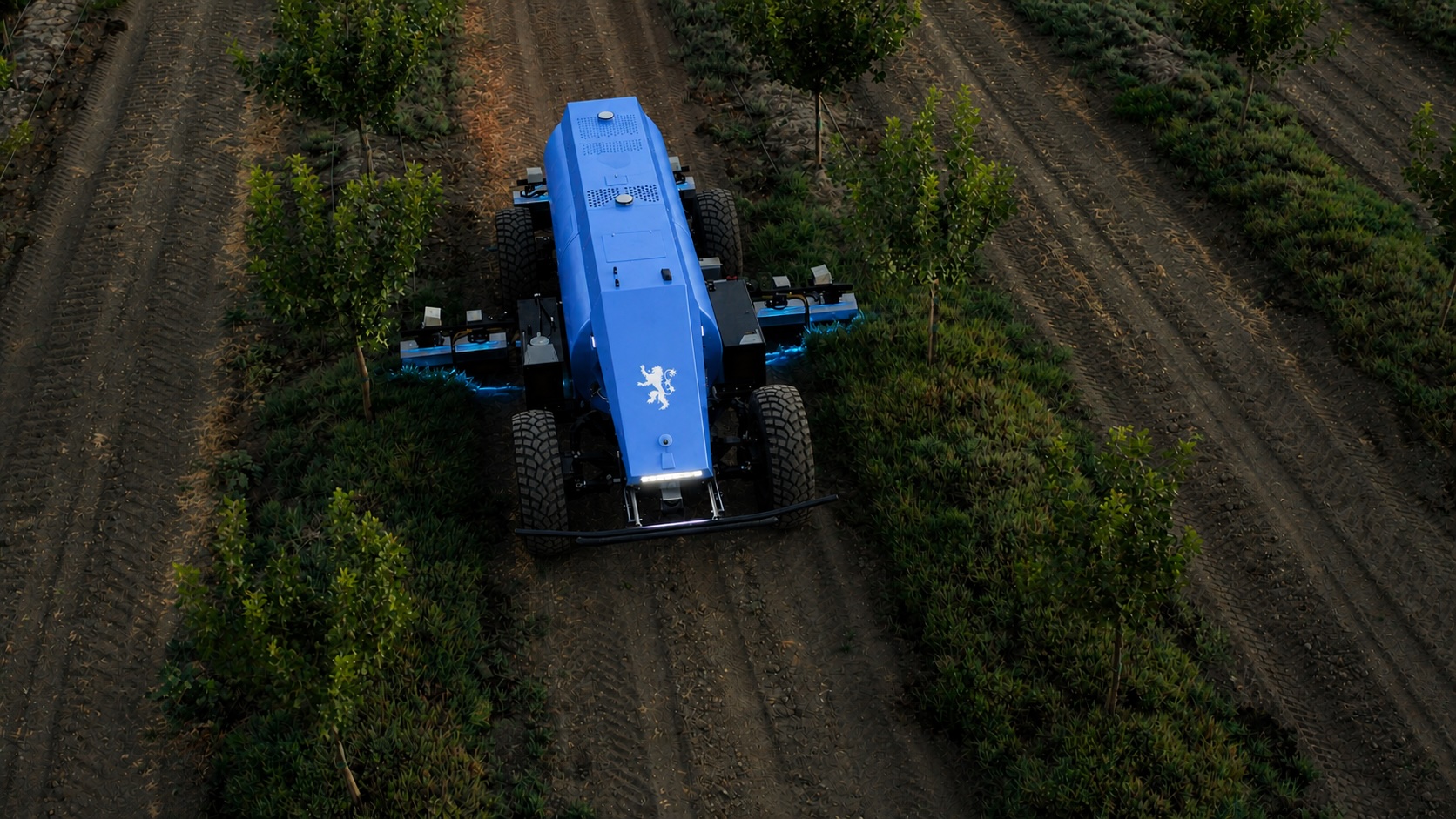
Agricultural robotics is usually sold as a machine story: the autonomous tractor, the drone sprayer, the robot picker, the greenhouse arm. That framing is too narrow. The farm is becoming a control system before it becomes a robot fleet.
The important change is not that one machine can drive itself across a field. It is that positioning, implement control, machine vision, agronomic maps, chemical placement, greenhouse climate control, safety cases, service networks, and farm records are being pulled into one operating layer. Guidance was the first agricultural robot. Selective spraying and seed-specific input placement are the first high-return autonomy applications. Greenhouses are the best autonomy cells. Harvesting is still the hardest biological manipulation problem. The next decade belongs to supervised autonomy and verified field execution, not to a sudden disappearance of human farmers.
Abstract
This paper maps agricultural robotics and automation from controlled greenhouse cells to large-scale land agriculture. It covers autonomous guided vehicles, sprayers, tractors, GPS and RTK guidance, ISOBUS implement communication, drone spraying, selective actuation, laser weeding, greenhouse AI, harvest robotics, the major corporate stacks, adoption evidence, economics, and the infrastructure needed to make autonomy normal.
The central finding is that agriculture automation has not advanced evenly. Positioning and guidance are mature. Implement control and variable-rate application are commercially established but unevenly adopted. Selective spraying, fertilizer placement, and drone services are moving quickly because the economic signal is visible per acre. Greenhouse autonomy is technically attractive because the environment is bounded and instrumented, but robotic manipulation still struggles with plants. Broad-acre autonomous tractors are emerging as supervised machines, not independent agents. Specialty-crop harvesting remains difficult because perception and manipulation must operate inside biological clutter at commercial speed.
The missing opportunity is not another farm dashboard. The missing layer is verified autonomous work: mixed-fleet tasking, safety evidence, field logs, agronomic audit, per-acre economics, and service infrastructure that lets a farmer trust a machine job the way they trust a human-operated job.
Research Question And Scope
The working question is:
What parts of agricultural robotics and automation are already economically real, what parts remain engineering demonstrations, and what infrastructure is required for autonomous agriculture to become normal farm capacity rather than isolated machinery?
The scope runs from small controlled cells to open fields:
- greenhouse automation, climate control, fertigation, scouting, spraying, and harvest cells
- autonomous guided vehicles, carts, tractors, sprayers, and robotic implements
- GPS, RTK, CORS, ISOBUS, conformance testing, and mixed-fleet infrastructure
- drone spraying and crop monitoring
- selective actuation: spot spraying, laser weeding, and seed-specific fertilizer placement
- specialty-crop harvesting and manipulation
- economic value: labor, inputs, timing, quality, utilization, and compliance
- corporate strategy: Deere, CNH/Raven, AGCO/PTx Trimble, DJI, Carbon Robotics, and research ecosystems such as Wageningen
- the five-to-ten-year vision and what is missing from it
This is not a market-size deck. It is a research map for readers who want to understand where the machine, the software, the farm operation, and the business case actually meet.
The Thesis
The farm is becoming a control system before it becomes a robot fleet.
That distinction matters because most useful autonomy in agriculture arrives first as layers:
| Layer | Examples | What it changes | Maturity |
|---|---|---|---|
| Positioning | GPS guidance, RTK, CORS/NTRIP, autosteer | path accuracy, overlap, fatigue, repeatability | high |
| Implement control | ISOBUS, section control, variable rate, prescription maps | machine-to-implement coordination | high but uneven |
| Sensing | cameras, yield monitors, soil maps, canopy data, greenhouse sensors | diagnosis and prescription | medium to high |
| Selective actuation | spot spray, laser weeding, seed-specific fertilizer, drone spraying | input cost and chemical exposure | high in bounded use |
| Supervised autonomy | autonomous tillage, robotic carts, AGVs, remote fleet monitoring | labor leverage and longer work windows | emerging |
| Biological manipulation | picking, pruning, grafting, crop handling | labor substitution in crop-specific tasks | difficult and crop-specific |
| Controlled-cell autonomy | greenhouse AI, robotic scouting, climate and irrigation control | resource efficiency and production consistency | strong testbed |
The first two layers are easy to underestimate because they do not look like robots. They are the reason later robots can exist. A tractor that follows a centimeter-level path, talks to an implement, opens only the correct spray sections, and records what happened is already a partial robot. The autonomy story starts there.
FAO's 2022 State of Food and Agriculture frames agricultural automation broadly: machinery and digital equipment can support diagnosis, decision-making, and the performance of agricultural operations, with possible gains in productivity, resilience, resource-use efficiency, product quality, and working conditions.1FAO. The State of Food and Agriculture 2022: Leveraging automation to transform agrifood systems. 2022. https://www.fao.org/3/cb9479en/cb9479en.pdf The same report also warns that uneven access to connectivity, finance, skills, energy, and services can deepen inequality if automation is pushed without the surrounding infrastructure.1FAO. The State of Food and Agriculture 2022: Leveraging automation to transform agrifood systems. 2022. https://www.fao.org/3/cb9479en/cb9479en.pdf
That warning is the right baseline. Robots do not arrive alone. They arrive with correction signals, standards, dealers, financing, software subscriptions, chemical labels, insurance rules, service technicians, and data governance. The machine is the visible part of a much larger operating system.
A Short Timeline
Agricultural autonomy did not start with a driverless tractor. It developed as a sequence of control layers.
| Period | Main development | Why it mattered |
|---|---|---|
| 1990s | GPS receivers, yield monitors, early mapping | field operations became data-referenced |
| 2000s | autosteer, RTK guidance, section control, variable-rate application | overlap fell, operator fatigue fell, field operations became repeatable |
| 2010s | drones, machine vision, cloud farm platforms, precision retrofit kits | sensing became cheaper and field records became more connected |
| late 2010s | autonomous greenhouse challenges, robotic weeding, crop scouting | bounded autonomy moved from lab to production-adjacent trials |
| early 2020s | camera-based selective spraying, drone spraying services, laser weeding, OEM autonomy acquisitions | selective actuation became commercially serious |
| mid 2020s | autonomous tillage kits, mixed-fleet precision platforms, larger drone fleets, supervised autonomy | autonomy shifts from demonstration to operations management |
| 2030 horizon | supervised fleets, verified machine jobs, crop-specific harvest robots, robot-ready greenhouses and orchards | the constraint becomes integration and economics, not just machine capability |
The adoption data shows the same sequence. USDA ERS reported in 2023 that automated guidance systems had expanded sharply and were used on well over half of acreage planted to major U.S. field crops such as corn, cotton, rice, sorghum, soybeans, and winter wheat, while other precision tools such as yield maps, soil maps, and variable-rate technology remained more uneven.2McFadden, J., Njuki, E., and Griffin, T. USDA Economic Research Service. Precision Agriculture in the Digital Era: Recent Adoption on U.S. Farms. EIB-248, 2023. https://www.ers.usda.gov/publications/pub-details/?pubid=105893 USDA NASS's 2025 farm technology survey reports broad digital access - 85 percent of farms had internet access, 82 percent used smartphones, and 55 percent used broadband - but only 22 percent reported precision agriculture practices under the survey's broad definition.3USDA National Agricultural Statistics Service. Technology Use (Farm Computer Usage and Ownership). August 2025. https://www.nass.usda.gov/Publications/TodaysReports/reports/fmpc0825.pdf
The pattern is clear: basic digital access is widespread, acreage-level guidance is mature in large row crops, and deeper automation remains uneven.
Controlled Cells: Why Greenhouses Matter
Greenhouses are the most important small-scale autonomy cell in agriculture because they compress the problem. Climate, irrigation, CO2, fertigation, lighting, pests, labor, yield, and energy are all measurable in a bounded environment. The roof and walls reduce weather chaos. The crop is still biological, but the operating envelope is narrower than an open field.
That is why Wageningen University & Research's Autonomous Greenhouse Challenge matters. In the first challenge, teams remotely controlled 96 square-meter cucumber greenhouse compartments using sensor data and AI strategies, while a human grower reference served as comparison. The teams set climate and irrigation decisions remotely. The winning AI strategy outperformed the reference on production, though resource use and strategy quality mattered.4Elings, A., Righini, I., de Zwart, H.F., Hemming, S., and Petropoulou, A. "Remote control of greenhouse cucumber production with artificial intelligence." Acta Horticulturae 1294, 69-76, 2020. https://doi.org/10.17660/ActaHortic.2020.1294.9 Wageningen also published the 2018 challenge dataset, which is valuable because it exposes the operational categories behind the result: climate, crop, irrigation, production, and resource data.5Hemming, S., de Zwart, H.F., Elings, A., Righini, I., and Petropoulou, A. Autonomous Greenhouse Challenge, First Edition (2018). Wageningen University & Research dataset, 2019. https://doi.org/10.4121/uuid:e4987a7b-04dd-4c89-9b18-883aad30ba9a
Greenhouse automation already includes climate computers, fertigation control, irrigation scheduling, energy screens, CO2 enrichment, crop monitoring, conveyor systems, and nursery automation. Robotics adds scouting, spraying, transport, picking, pruning, and plant handling. Reviews of greenhouse robots show the attraction clearly: protected cropping still contains repetitive, labor-intensive, and hazardous tasks even after climate and irrigation automation, so it is a natural target for mobile robots and manipulators.6Bagagiolo, G., Matranga, G., Cavallo, E., and Pampuro, N. "Greenhouse Robots: Ultimate Solutions to Improve Automation in Protected Cropping Systems - A Review." Sustainability 14(11), 6436, 2022. https://doi.org/10.3390/su14116436
The constraint is manipulation. A greenhouse tomato cluster, cucumber canopy, or strawberry table is easier than an unstructured orchard in rain and wind, but it is still a biological object. Plants occlude themselves. Fruit bruises. Leaves move. Disease changes appearance. A gripper that works in one crop architecture may fail in another. A robot cell therefore needs crop architecture, not just robot hardware: row spacing, trellis design, lighting, camera access, end-effector access, hygiene, and a workflow that lets the human grower override the system.
The best way to understand greenhouse automation is not as a "robot greenhouse." It is a closed-loop production cell:
| Cell layer | Greenhouse example | Automation objective |
|---|---|---|
| Measurement | temperature, humidity, CO2, radiation, substrate moisture, EC, pH, camera scouting | know the state of the crop and environment |
| Decision | climate model, irrigation model, pest detection, yield forecast | choose setpoints and interventions |
| Actuation | vents, heating, screens, lamps, dosing pumps, sprayers, robots | change the environment or plant condition |
| Verification | harvest weight, fruit quality, resource use, disease incidence | prove whether the decision worked |
This is the template that broad-acre farms are moving toward, but open fields have fewer walls, weaker connectivity, more weather, and much larger working areas.
Field Autonomy: Guidance Was The First Robot
In broad-acre farming, the first useful robot was not a robot body. It was guidance.
Guidance matters because field operations are spatial businesses. A planter, sprayer, spreader, or cultivator is valuable only if it acts in the right place. Centimeter-scale positioning reduces overlap, gaps, crop damage, compaction from unnecessary passes, operator fatigue, and the difficulty of night work. It also creates repeatable paths for later operations. Strip-till, controlled traffic farming, mechanical weeding, and selective spraying all depend on knowing where the machine is relative to the crop and field boundary.
The hidden infrastructure is substantial:
- satellite navigation and correction services
- public reference stations such as NOAA's Continuously Operating Reference Stations network
- private RTK base stations and subscription correction networks
- field boundaries, AB lines, guidance tracks, and prescription maps
- displays and task controllers
- implement communication standards
- dealer setup, calibration, and support
NOAA's CORS network is a good example of invisible public infrastructure. It provides continuously operating GNSS reference data that supports precise three-dimensional positioning, and it is one part of the broader correction ecosystem used by surveying, construction, and precision agriculture.7NOAA National Geodetic Survey. Continuously Operating Reference Stations Network. https://geodesy.noaa.gov/CORS/ ISO 11783, better known through the ISOBUS ecosystem, standardizes serial control and communication between tractors, implements, sensors, actuators, displays, and storage devices.8ISO. ISO 11783-2:2019 Tractors and machinery for agriculture and forestry - Serial control and communications data network - Part 2: Physical layer. https://www.iso.org/standard/71171.html The Agricultural Industry Electronics Foundation coordinates conformance activity and compatibility databases so equipment from different manufacturers can work together more reliably.9Association of Equipment Manufacturers / Agricultural Industry Electronics Foundation. Agricultural Industry Electronics Foundation and ISOBUS conformance overview. https://www.aem.org/safety-product-leadership/aef-agricultural-industry-electronics-foundation
Those are not side details. Autonomy without positioning and implement communication is just a machine with sensors. A working autonomous job needs the tractor, implement, map, controller, safety envelope, and farm record to agree.
The same point explains why retrofits and mixed-fleet systems matter. Not every farm will replace its fleet with one OEM's most recent autonomous platform. Existing tractors and implements stay in service for years. AGCO's 2024 PTx Trimble joint venture is strategically important because it targets precision agriculture across mixed fleets rather than only new AGCO equipment.10AGCO. AGCO and Trimble Close Joint Venture, Form PTx Trimble. 1 April 2024. https://investors.agcocorp.com/news-releases/news-release-details/agco-and-trimble-close-joint-venture-form-ptx-trimble CNH's 2021 acquisition of Raven Industries had the same logic from another direction: major OEMs are buying control, autonomy, and precision capability because the machine stack is becoming the business stack.11CNH Industrial. CNH Industrial completes the acquisition of Raven Industries. 30 November 2021. https://investors.cnh.com/news/news-details/2021/CNH-Industrial-completes-the-acquisition-of-Raven-Industries-11-30-2021/default.aspx
Spraying And Weeding: The First High-ROI Autonomy
Selective actuation is the strongest near-term economic case because it turns perception into a visible input saving.
The logic is simple. If a camera can distinguish crop, weed, soil, residue, or seed position well enough, the machine does not need to treat the whole acre the same way. It can spray a weed, skip clean soil, place starter fertilizer near the seed, fire a laser at a target plant, or send a drone only where the task is useful.
John Deere's See & Spray is the obvious large-OEM example. Deere reported that customers using See & Spray covered more than one million acres in 2024 and saw 59 percent average herbicide savings; the same release cites an Iowa State University study with average product savings of 76 percent and economic savings of $15.70 per acre.12John Deere. See & Spray Customers See 59% Average Herbicide Savings in 2024. 18 September 2024. https://www.deere.com/en/news/all-news/see-spray-herbicide-savings/ Those are vendor-reported and product-context claims, not universal farm economics. They are still important because they show why selective spraying attracts capital: the saving is per acre, measurable, and tied to a chemical cost line.
Deere's ExactShot works on the same economic principle in planting. The company describes a sensor-and-robotics system that places starter fertilizer on individual seeds as they go into the soil, and says it can reduce starter fertilizer use by more than 60 percent in the targeted operation.13John Deere. Deere Debuts New Planting Technology and Electric Excavator During CES 2023. 5 January 2023. https://www.deere.com/en/news/all-news/deere-debuts-new-planting-technology-and-electric-excavator-ces-2023/ Carbon Robotics takes a different actuation path: tractor-pulled laser weeders use machine vision and lasers to kill weeds without herbicide, with product widths ranging from small specialty-crop configurations to broad implements.14Carbon Robotics. LaserWeeder G2 product line. https://carbonrobotics.com/laserweeder-g2 DJI's agriculture drone reports show how quickly aerial application has scaled globally; DJI reported more than 300,000 agricultural drones operating worldwide and more than 500 million hectares treated by June 2024.15DJI Agriculture. Agriculture Drone Industry Insight Report 2023/2024. 2024. https://www.dji.com/pr/media-center/announcements/agricultural-drone-industry-insight-report-2023-2024-en
In the United States, drone spraying is not only a technical matter. Dispensing chemicals and agricultural products by UAS can bring the operation under FAA Part 137 rules, including registration, pilot credentials, and exemptions or certifications depending on the operation.16FAA. Dispensing Chemicals and Agricultural Products (Part 137) with UAS. https://www.faa.gov/uas/advancedoperations/dispensingchemicals Chemical labels, state rules, drift, payload limits, battery logistics, and insurance shape the business as much as the aircraft.
This is why spraying and weeding are the best autonomy case study. The task can be bounded. The sensor target is visible. The economic value is direct. The regulation is real. The service model can be per acre. The failure is measurable.
Interactive assumption audit: why selective actuation pays first
The workspace includes a small calculator that tests spot-actuation economics. Under a conservative scenario with a $45 per acre input bill, 40 percent savings, $6 per acre variable service cost, and $120,000 annualized fixed cost, break-even is roughly 10,000 acres. At a 59 percent saving on a $55 per acre input bill with the same service cost and fixed cost, break-even falls to about 4,537 acres. At high weed pressure, a larger input bill and higher saving can bring break-even below 4,000 acres. These are illustrative assumptions, not product forecasts. The purpose is to show why input-saving autonomy scales with treated acres and input price.
Tractors, AGVs, And Supervised Autonomy
The next layer is supervised autonomy: machines that perform bounded jobs while a human monitors, authorizes, moves, refuels, repairs, and handles exceptions.
John Deere's 2025 next-generation perception system for autonomous tillage frames the current state clearly: selected tractors and tillage implements can use perception and autonomy hardware to operate with remote monitoring, targeted at labor shortages and narrow work windows.17John Deere. Next Generation Perception System Brings Autonomy to Tillage. 27 February 2025. https://www.deere.com/en/news/all-news/next-generation-perception-system/ The practical word is "tillage." A field operation with a known boundary, known implement, limited bystanders, and a predictable mechanical task is a better autonomy target than a mixed traffic road, a crowded yard, or a harvest operation where the crop itself is the object being manipulated.
Autonomous guided vehicles in agriculture fall into several categories:
| Vehicle type | Typical job | Why it is easier | Why it remains constrained |
|---|---|---|---|
| autonomous tractor | tillage, spraying, mowing, hauling in controlled field contexts | known field boundary, repeatable passes, existing implement standards | safety, obstacles, road movement, supervision, mixed-fleet integration |
| robotic cart or AGV | harvest assist, bin movement, greenhouse transport | fixed routes or bounded fields, human-machine collaboration | worker safety, localization, crop-row access, charging |
| drone | scouting, spraying, spreading, imaging | no soil contact, fast deployment, service model | payload, battery, regulation, drift, weather |
| small field robot | seeding, weeding, scouting, crop monitoring | low compaction, electric drive, modularity | field capacity, service, autonomy uptime, economics |
| greenhouse robot | scouting, spraying, transport, picking | bounded environment, dense sensors, repeatable layout | manipulation, hygiene, crop architecture |
The economic lesson is that labor savings alone are not enough in many broad-acre tasks. USDA ERS data shows why labor is a real driver: farm labor has become more dependent on H-2A positions, which increased more than sevenfold from fiscal year 2005 to fiscal year 2024, and average nonsupervisory crop and livestock wages reached $18.12 per hour in 2024 dollars.18USDA Economic Research Service. Farm Labor. Updated 2025. https://ers.usda.gov/topics/farm-economy/farm-labor But a high-capacity tractor already covers many acres per operator hour. If the autonomous system is slower, needs a remote supervisor, and adds a service cost per acre, the wage line alone may not close the case.
The real supervised-autonomy business case is a bundle:
- one operator supervises more machines
- the operation runs longer windows with less fatigue
- expensive capital covers more acres per season
- timing improves because work happens when weather and soil windows are short
- overlap and input waste fall
- the job record becomes better evidence for compliance, insurance, and agronomy
Interactive calculator note: labor leverage is weaker than it looks
The workspace calculator uses a loaded wage of $22.65 per hour, based on USDA ERS 2024 wage data plus a 25 percent burden assumption. In an illustrative 5,000-acre job, a one-robot-per-operator setup can be worse than manual work if the robot covers fewer acres per hour. A three-robot supervision ratio creates labor savings, but a $2 per acre autonomy service cost can still overwhelm the wage saving. This does not mean autonomy fails. It means the broad-acre case needs timing, utilization, quality, safety, and input benefits as well as labor leverage.
Harvesting: Still The Hard Problem
Harvesting looks like the obvious robot application because labor is scarce and expensive in specialty crops. Technically, it is one of the hardest.
Fruit and vegetable harvesting combines perception, manipulation, mobility, speed, and crop-specific judgement. The robot must find the target under leaves and branches, decide whether it is ripe, reach it without damaging the plant or neighboring fruit, detach it cleanly, handle it gently, and do that fast enough to compete with human crews. Weather, lighting, cultivar, trellis, disease, dust, and fruit variability all change the problem.
Peer-reviewed reviews converge on this point. Zhou and coauthors describe fruit-harvesting robots as a field with major progress in perception, end-effectors, manipulators, and platforms, but persistent challenges around occlusion, recognition, detachment, damage avoidance, and commercial speed.19Zhou, H., Wang, X., Au, W., Kang, H., and Chen, C. "Intelligent robots for fruit harvesting: recent developments and future challenges." Precision Agriculture 23, 1856-1907, 2022. https://doi.org/10.1007/s11119-022-09913-3 Droukas and coauthors reach a similar conclusion across robotic harvesting systems: enabling technologies are advancing, but robust, fast, crop-specific integration remains the central challenge.20Droukas, L. et al. "A Survey of Robotic Harvesting Systems and Enabling Technologies." Journal of Intelligent & Robotic Systems 107, 21, 2023. https://doi.org/10.1007/s10846-022-01793-z
This explains the uneven market. A camera-based sprayer can make a binary weed/no-weed decision and actuate a nozzle in milliseconds. A harvester must handle a living object whose value can be destroyed by the actuation itself. A greenhouse cucumber robot, strawberry tabletop picker, apple harvester, tomato truss cutter, and asparagus robot are not one general machine. They are crop-specific systems wrapped around crop-specific architecture.
The entrepreneurial lesson is not "do not build harvest robots." It is "do not build harvest robots as if the crop architecture is fixed." The machine, crop variety, trellis, planting density, lighting, crew workflow, and postharvest handling all have to be designed together.
The Economic Picture
Agricultural robotics saves money through six mechanisms.
| Mechanism | Example | Strongest when | Weakness |
|---|---|---|---|
| Input reduction | spot spray, precision fertilizer, section control | input price is high and the machine can skip unnecessary treatment | savings are crop, pressure, and season dependent |
| Labor leverage | supervised tractors, drone services, greenhouse robots | one operator can supervise many machines or cells | weak if field capacity falls or exceptions consume attention |
| Timing value | autonomous tillage, spraying windows, planting windows | weather windows are short and delays reduce yield | hard to price until missed operations are measured |
| Quality value | uniform placement, lower overlap, better greenhouse climate | quality affects yield, grade, disease, or resource use | requires good agronomic attribution |
| Compliance value | chemical records, geofenced application, worker exposure reduction | regulation, audit, residue, or safety risk is high | often undervalued until something fails |
| Utilization | expensive machines cover more acres per season | capital is underused because operators are scarce or hours are limited | depends on uptime, service, and logistics |
The economics are therefore not "robot replaces worker." In many farms, especially broad-acre farms, the operator wage is only one line. The stronger economics often come from input reduction, timing, utilization, and proof of work.
Lowenberg-DeBoer and coauthors make the caution explicit in their economics review of field robots: public economic evidence is thinner than engineering progress, profitable scenarios exist under assumptions, and more farm-level and system-level economics are needed.21Lowenberg-DeBoer, J., Huang, I.Y., Grigoriadis, V., and Blackmore, S. "Economics of robots and automation in field crop production." Precision Agriculture 21, 278-299, 2020. https://doi.org/10.1007/s11119-019-09667-5 Vahdanjoo and coauthors show why field capacity matters. In their assessment of an agricultural robot for seeding and weeding, the robot had lower hourly cost and lower diesel and CO2 emissions, but its lower effective field capacity meant per-area economics depended heavily on width, speed, and operational context.22Vahdanjoo, M., Gislum, R., and Sorensen, C.A.G. "Operational, Economic, and Environmental Assessment of an Agricultural Robot in Seeding and Weeding Operations." AgriEngineering 5(1), 299-324, 2023. https://doi.org/10.3390/agriengineering5010020
That result should be pinned to the top of every robotics pitch. A low hourly cost robot can still be an expensive per-acre tool if it covers too few acres per hour. A high-capacity conventional rig can be hard to beat unless the robot creates additional savings through input reduction, soil benefits, timing, or utilization.
The workspace calculator reaches the same directional result:
Spot actuation, vendor-average scenario:
input cost/ac = $55
saving = 59%
service cost/ac = $6
annualized fixed cost = $120,000
net/ac before fixed = $26
break-even = 4,537 acres

Hourly cost versus field capacity:
large conventional rig = $180/h at 22 ac/h = about $8/ac
small low-cost robot = $80/h at 7 ac/h with $1/ac credit = about $10/ac
small robot with selective weeding credit = $80/h at 7 ac/h with $8/ac credit = about $3/ac
The conclusion is blunt: the robot has to earn its place per acre, per kilogram, per compartment, or per job. Autonomy that produces a measurable input saving can pay early. Autonomy that merely removes the driver from a high-capacity machine has a harder case unless it also improves timing, utilization, safety, or quality.
Core Companies And Strategic Positions
Agricultural robotics is consolidating around firms that control machines, implements, data, service networks, and retrofit paths.
| Actor | Strategic position | Why it matters |
|---|---|---|
| John Deere | integrated OEM autonomy, perception, See & Spray, ExactShot, autonomous tillage | controls tractors, implements, dealer network, machine data, and high-value row-crop workflows |
| CNH Industrial / Raven | precision agriculture, autonomy, application control, machine integration | Raven acquisition brought guidance, control, and autonomy capabilities into a major OEM |
| AGCO / PTx Trimble | mixed-fleet precision agriculture and retrofit platform | targets the installed base, not just new equipment sales |
| DJI Agriculture | drone spraying, spreading, mapping, global service ecosystem | aerial autonomy scales through service providers and fleet operation rather than tractors |
| Carbon Robotics | machine-vision laser weeding | chemical-free selective actuation in high-value crops and row-crop-adjacent systems |
| Wageningen ecosystem | autonomous greenhouse research, datasets, crop-control competitions | provides a research testbed for closed-loop production cells |
| Standards and infrastructure bodies | ISO, AEF, NOAA, FAA | define the compatibility, positioning, and regulatory floor that machinery depends on |
The corporate trend is not subtle. OEMs are buying or building perception, control, and autonomy because the machine sale is becoming a platform sale. Retrofit and mixed-fleet systems remain strategically important because farms are heterogeneous. Drone companies scale through service networks. Specialty robotics companies win where they can make a crop-specific task economically clear.
Infrastructure Required
The infrastructure needed for autonomous agriculture is larger than the machine.
| Infrastructure | What it enables | What is missing |
|---|---|---|
| GNSS correction | repeatable paths, autosteer, controlled traffic, implement placement | affordable and reliable correction for smaller farms and weak-signal regions |
| Connectivity | remote monitoring, fleet updates, cloud maps, support | rural broadband and field-edge coverage are still uneven |
| ISOBUS and conformance | tractor-implement communication, mixed equipment operation | fewer compatibility surprises and more transparent certification |
| Safety standards | partially automated, semi-autonomous, and autonomous machinery deployment | practical safety cases for mixed human-machine field work |
| Dealer and service networks | uptime, calibration, repair, training | autonomy-specific technicians and diagnostics |
| Agronomic data models | prescription maps, yield attribution, input savings, disease risk | trusted links between machine actions and agronomic outcomes |
| Regulation and insurance | drone spraying, chemical application, road movement, liability | standardized event records and risk pricing |
| Financing | equipment adoption, service models, per-acre pricing | outcome-based finance tied to verified savings |
ISO 18497-1:2024 is important because it addresses safety principles, verification, manufacturer information, and residual risk for partially automated, semi-autonomous, and autonomous agricultural machinery and tractors.23ISO. ISO 18497-1:2024 Agricultural machinery and tractors - Safety of partially automated, semi-autonomous and autonomous machinery - Part 1: Machine design principles and vocabulary. https://www.iso.org/standard/82684.html Safety is not a bolt-on. An autonomous job has to define the operating domain, hazards, fallback state, supervision method, and residual risk.
Data governance also matters. MacPherson and coauthors argue that digitalization can support sustainability goals, but only if infrastructure, skills, data governance, and power asymmetries are addressed.24MacPherson, J. et al. "Future agricultural systems and the role of digitalization for achieving sustainability goals." Agronomy for Sustainable Development 42, 70, 2022. https://doi.org/10.1007/s13593-022-00792-6 Martin and coauthors show that robots transform farm work rather than simply removing it; supervision, skills, identity, and organization change with the technology.25Martin, T. et al. "Robots and transformations of work in farm: a systematic review of the literature and a research agenda." Agronomy for Sustainable Development 42, 66, 2022. https://doi.org/10.1007/s13593-022-00796-2 Farmers do not just buy autonomy. They reorganize work around it.
Five-To-Ten-Year Vision
The credible five-to-ten-year vision is not a fully autonomous farm with no people. It is a farm where more work is delegated to supervised systems and more machine actions are verified.
What is likely:
- Selective application becomes normal in high-value use cases. Spot spraying, precision fertilizer placement, drone application, and laser weeding will spread where input savings and weed pressure justify the cost.
- Autonomous tillage and bounded field operations expand. The early production model is supervised autonomy on known fields with remote monitoring, not unsupervised free-range machinery.
- Greenhouse control closes more loops. AI climate and irrigation control will keep improving, and greenhouse robots will expand from scouting and spraying into crop-specific harvest support.
- Drones become agricultural service infrastructure. Fleet operators will treat spraying, mapping, spreading, and scouting as services, especially where terrain, labor, or crop structure makes ground machines awkward.
- Harvest robots improve crop by crop. Progress will be real but uneven, strongest where crop architecture is robot-ready and the value of labor substitution is high.
- Mixed-fleet platforms matter. Farms will not standardize instantly on one OEM, so retrofit guidance, task controllers, maps, and compatibility layers remain central.
- Autonomy becomes auditable. The machine record will matter for chemical compliance, insurance, sustainability claims, and agronomic diagnosis.
What is missing:
- A mixed-fleet autonomous work order layer. Farmers need to define, authorize, monitor, and verify jobs across tractors, sprayers, drones, carts, and implements from different vendors.
- Low-cost correction and connectivity bundles. Small and medium farms need reliable RTK, field-edge connectivity, support, and training that does not assume enterprise-scale acreage.
- Safety evidence that insurance can price. Autonomous machines need event logs, geofences, fault records, remote-stop evidence, and standardized incident data.
- Robot-ready crop architecture. Greenhouses, orchards, vineyards, and specialty crop fields need varieties, trellises, spacing, lighting, and handling workflows designed for machine access.
- Per-acre proof of economic value. Robots should leave behind a job dossier: treated acres, skipped acres, chemical saved, fuel used, exceptions, operator interventions, and agronomic outcome.
- Service technicians for autonomy. The bottleneck is not only AI talent. It is local people who can calibrate cameras, repair actuators, debug ISOBUS issues, and keep a robot earning in season.
- Data rights and portability. Farmers need useful machine records without being trapped inside one vendor's closed operating system.
The entrepreneurial opportunity sits in these missing layers. The highest-value product may not be the next autonomous tractor. It may be the operating evidence layer that makes a fleet of existing machines trustworthy, insurable, and economically legible.
What A Serious Builder Should Take Away
The best robotics opportunities in agriculture share four traits.
First, the operating domain is bounded. Greenhouse compartments, table-top berries, orchards with structured rows, known field boundaries, and repeatable passes all reduce exception load.
Second, the value is measurable. Herbicide saved, fertilizer skipped, labor hours reduced, acres covered, yield protected, fuel saved, chemical exposure reduced, or job records produced.
Third, the machine fits the farm workflow. A robot that needs perfect connectivity, constant specialist support, and a complete workflow redesign will struggle unless the crop value is very high.
Fourth, the product includes service. Agriculture is seasonal. A robot down for two weeks during a spraying or harvesting window is not a software inconvenience. It is a failed crop operation.
The wrong path is to pitch general autonomy into an unstructured biological environment and hope the economics appear later. The better path is to pick a bounded operation, connect the robot action to a farm cost line, design the crop or workflow around the machine, and produce an auditable record of the job.
Conclusion
Agricultural robotics is no longer a speculative field, but the useful parts are more specific than the headline suggests.
Guidance and implement control are mature. Selective spraying and precision placement are commercially serious because they save inputs per acre. Drones are becoming service infrastructure. Greenhouses are becoming closed-loop cells. Autonomous tractors are entering bounded supervised work. Harvesting robots remain crop-specific because biological manipulation is hard. The economics depend less on whether a machine is called a robot and more on whether it can produce measurable value inside a real farm operation.
The farm of the next decade will still have people in it. The change is that those people will supervise more machines, trust more machine records, and design more crop systems around automation. The winners will be the companies and infrastructure builders that make autonomous work verifiable, serviceable, and economically legible.
The farm is becoming a control system. The robot fleet comes after that.
Last revised 2026-05-05. Citations below trace the load-bearing claims to public authorities, formal standards, peer-reviewed sources, research datasets, or company-primary sources. Working materials, source cards, diagrams, and the economics sandbox live in the post's _workspace/ folder and are excluded from the public page.
Footnotes
-
FAO. The State of Food and Agriculture 2022: Leveraging automation to transform agrifood systems. 2022. https://www.fao.org/3/cb9479en/cb9479en.pdf ↩ ↩2
-
McFadden, J., Njuki, E., and Griffin, T. USDA Economic Research Service. Precision Agriculture in the Digital Era: Recent Adoption on U.S. Farms. EIB-248, 2023. https://www.ers.usda.gov/publications/pub-details/?pubid=105893 ↩
-
USDA National Agricultural Statistics Service. Technology Use (Farm Computer Usage and Ownership). August 2025. https://www.nass.usda.gov/Publications/Todays_Reports/reports/fmpc0825.pdf ↩
-
Elings, A., Righini, I., de Zwart, H.F., Hemming, S., and Petropoulou, A. "Remote control of greenhouse cucumber production with artificial intelligence." Acta Horticulturae 1294, 69-76, 2020. https://doi.org/10.17660/ActaHortic.2020.1294.9 ↩
-
Hemming, S., de Zwart, H.F., Elings, A., Righini, I., and Petropoulou, A. Autonomous Greenhouse Challenge, First Edition (2018). Wageningen University & Research dataset, 2019. https://doi.org/10.4121/uuid:e4987a7b-04dd-4c89-9b18-883aad30ba9a ↩
-
Bagagiolo, G., Matranga, G., Cavallo, E., and Pampuro, N. "Greenhouse Robots: Ultimate Solutions to Improve Automation in Protected Cropping Systems - A Review." Sustainability 14(11), 6436, 2022. https://doi.org/10.3390/su14116436 ↩
-
NOAA National Geodetic Survey. Continuously Operating Reference Stations Network. https://geodesy.noaa.gov/CORS/ ↩
-
ISO. ISO 11783-2:2019 Tractors and machinery for agriculture and forestry - Serial control and communications data network - Part 2: Physical layer. https://www.iso.org/standard/71171.html ↩
-
Association of Equipment Manufacturers / Agricultural Industry Electronics Foundation. Agricultural Industry Electronics Foundation and ISOBUS conformance overview. https://www.aem.org/safety-product-leadership/aef-agricultural-industry-electronics-foundation ↩
-
AGCO. AGCO and Trimble Close Joint Venture, Form PTx Trimble. 1 April 2024. https://investors.agcocorp.com/news-releases/news-release-details/agco-and-trimble-close-joint-venture-form-ptx-trimble ↩
-
CNH Industrial. CNH Industrial completes the acquisition of Raven Industries. 30 November 2021. https://investors.cnh.com/news/news-details/2021/CNH-Industrial-completes-the-acquisition-of-Raven-Industries-11-30-2021/default.aspx ↩
-
John Deere. See & Spray Customers See 59% Average Herbicide Savings in 2024. 18 September 2024. https://www.deere.com/en/news/all-news/see-spray-herbicide-savings/ ↩
-
John Deere. Deere Debuts New Planting Technology and Electric Excavator During CES 2023. 5 January 2023. https://www.deere.com/en/news/all-news/deere-debuts-new-planting-technology-and-electric-excavator-ces-2023/ ↩
-
Carbon Robotics. LaserWeeder G2 product line. https://carbonrobotics.com/laserweeder-g2 ↩
-
DJI Agriculture. Agriculture Drone Industry Insight Report 2023/2024. 2024. https://www.dji.com/pr/media-center/announcements/agricultural-drone-industry-insight-report-2023-2024-en ↩
-
FAA. Dispensing Chemicals and Agricultural Products (Part 137) with UAS. https://www.faa.gov/uas/advanced_operations/dispensing_chemicals ↩
-
John Deere. Next Generation Perception System Brings Autonomy to Tillage. 27 February 2025. https://www.deere.com/en/news/all-news/next-generation-perception-system/ ↩
-
USDA Economic Research Service. Farm Labor. Updated 2025. https://ers.usda.gov/topics/farm-economy/farm-labor ↩
-
Zhou, H., Wang, X., Au, W., Kang, H., and Chen, C. "Intelligent robots for fruit harvesting: recent developments and future challenges." Precision Agriculture 23, 1856-1907, 2022. https://doi.org/10.1007/s11119-022-09913-3 ↩
-
Droukas, L. et al. "A Survey of Robotic Harvesting Systems and Enabling Technologies." Journal of Intelligent & Robotic Systems 107, 21, 2023. https://doi.org/10.1007/s10846-022-01793-z ↩
-
Lowenberg-DeBoer, J., Huang, I.Y., Grigoriadis, V., and Blackmore, S. "Economics of robots and automation in field crop production." Precision Agriculture 21, 278-299, 2020. https://doi.org/10.1007/s11119-019-09667-5 ↩
-
Vahdanjoo, M., Gislum, R., and Sorensen, C.A.G. "Operational, Economic, and Environmental Assessment of an Agricultural Robot in Seeding and Weeding Operations." AgriEngineering 5(1), 299-324, 2023. https://doi.org/10.3390/agriengineering5010020 ↩
-
ISO. ISO 18497-1:2024 Agricultural machinery and tractors - Safety of partially automated, semi-autonomous and autonomous machinery - Part 1: Machine design principles and vocabulary. https://www.iso.org/standard/82684.html ↩
-
MacPherson, J. et al. "Future agricultural systems and the role of digitalization for achieving sustainability goals." Agronomy for Sustainable Development 42, 70, 2022. https://doi.org/10.1007/s13593-022-00792-6 ↩
-
Martin, T. et al. "Robots and transformations of work in farm: a systematic review of the literature and a research agenda." Agronomy for Sustainable Development 42, 66, 2022. https://doi.org/10.1007/s13593-022-00796-2 ↩