
01
The control problem
A camera can make robot control feel direct while hiding the exact failures that matter: occlusion, stale frames, depth ambiguity, mode confusion, link delay, and unsafe restart.
The former prototype converted image movement into values labelled as metres, treated handedness probability as tracking confidence, and held the last target after dropout. It had no clutch, independent stop path, command acknowledgement, robot feedback, force sensing, collision planner, or replayable safety decision.
The replacement narrows the claim. The camera estimates a hand skeleton. A calibration frame converts relative geometry into dimensionless X, Y, depth-cue, roll, and grip intent. Those values remain untrusted until a supervisor admits them. Metric motion belongs to a robot-specific gateway with a measured calibration and hazard analysis.
Safety premise
The browser must be allowed to fail without creating hazardous motion.
Browser crash, model failure, camera loss, and network loss are normal design inputs. A real stop circuit and final motion limits cannot depend on the same software, machine, or link.
02
Put the safety boundary near the robot
The testbed deliberately separates a convenient input device from the controls that would make a deployed manipulator safe. Only the first two stages exist in this website. The transport, robot gateway, and independent stop path are interface requirements for a separate edge-control system.
01
Vision input
A local MediaPipe model estimates 21 landmarks. Calibration maps image geometry into normalized rate intent; it does not infer metric distance.
Untrusted
02
Command supervisor
A monotonic sample passes calibration, hand-presence, geometry, age, hold-to-run, reacquisition, slew, and workspace checks.
Tested in browser
03
Transport contract
A deployment adapter must authenticate the session and reject expired, duplicated, reordered, or out-of-envelope intent frames.
Specified / not connected
04
Robot-side gateway
A controller beside the robot owns kinematics, collision, force, speed, tool, and task limits. That controller is not implemented by this website.
Production target
05
Independent stop path
Protective stop and emergency stop must not share the camera, browser, network, or application failure path.
Required / outside browser
Boundary rule: the vision model, browser, and wide-area network are command sources. None is credited as a safety function in the current design.
03
The rebuilt control bench
The route accepts only local camera inference. Camera access is explicit: the pinned model and WASM runtime load from the same origin, inference runs in a worker, and frames are not uploaded or retained by the application. Admitted camera rates advance a bounded Cartesian setpoint before inverse kinematics and simulated plant feedback are evaluated.
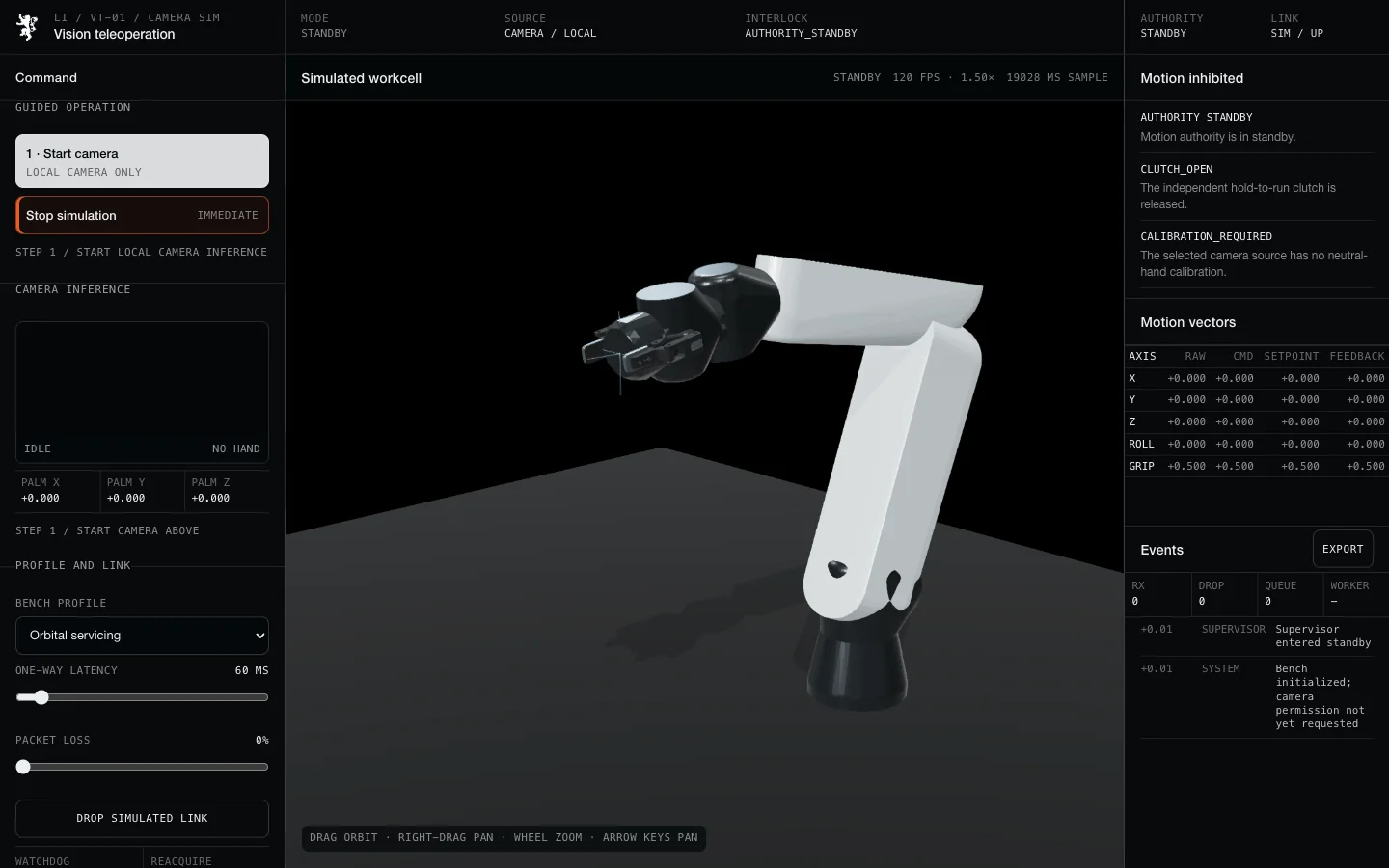
- Landmark runtime
- MediaPipe Tasks Vision 0.10.35 / local assets
- Model
- Hand Landmarker full float16 v1 / pinned hash
- Inference
- Dedicated browser worker / camera stays on device
- Command units
- Normalized rates and grip request / no metric claim
- Supervisor tests
- 8 deterministic tests / passing 10 July 2026
- Physical robot link
- Not implemented
Three profile presets change simulator watchdog, reacquisition, command slew, workspace, injected latency, and packet loss. They are bench inputs, not standard limits. A deployment must replace them with task-specific budgets and verified stop behavior.
Estimator invalidator
The current model does not cover the workwear and contact cases.
The MediaPipe model card puts gloves and occluded hands outside intended use and does not position the model for life-critical decisions. Space, subsea, and nuclear tasks commonly introduce gloves, tools, self-occlusion, poor views, and costly contact. The model must remain replaceable and cannot carry the safety case.
04
The command is an expiring request
Position targets can preserve dangerous intent after the operator or link disappears. The rebuilt bench emits a normalized rate request with an explicit validity decision. A failed gate makes every motion rate zero and marks the command invalid. The downstream controller still chooses the task-specific safe action.
{
  "schema": "li.teleop.intent/1",
  "sessionId": "local-sim-…",
  "sequence": 1842,
  "capturedAtMonotonicMs": 91342.5,
  "expiresAfterMs": 140,
  "source": "camera",
  "intent": {
    "linearRate": [0.18, -0.04, 0.00],
    "rollRate": 0.07,
    "grip": 0.61
  },
  "gates": {
    "calibrated": true,
    "handVisible": true,
    "geometryValid": true,
    "clutchHeld": true
  }
}
Deployment addition
A real transport must also bind operator identity, authorization, configuration/model hash, clock basis, signature, acknowledgement, and replay protection. Those fields are documented in the production workspace and are not simulated as security proof in the public route.
05
Supervisor states and recovery
Motion authority, input quality, and stop state are separate. “Tracking” is not “armed,” and “armed” is not “moving.” The operator must deliberately close hold-to-run while every automatic gate remains valid.
| State | Invariant | Exit condition |
|---|---|---|
| Standby | Output is invalid and all motion rates are zero. | Valid source, calibration, live link, then deliberate two-step arm. |
| Reacquiring | A returning hand cannot immediately move the simulated plant. | Tracking remains valid for the selected profile's dwell time. |
| Armed / hold | Authority exists, but motion rates stay zero until hold-to-run is closed. | Operator holds the clutch and every sample gate passes. |
| Active / limited | Only fresh, bounded, slew-limited rate intent is admitted. | Any failed gate returns to hold without retaining a stale rate. |
| Emergency stop | The simulated stop is latched and output remains invalid. | A deliberate reset returns to standby; a new two-step arm is required. |
“Hold” is only the simulator’s zero-rate behavior. It is not a universal physical safe state. A collision in orbit, a retained subsea load, and a tool inside a radiation field can require different responses: controlled stop, maintain-grasp, retreat, park, release, or torque-off.
06
One input method, three qualification paths
There is no certificate called “space, subsea, and nuclear compliant.” The complete robot, task, operating environment, communications path, operator, and safety case determine which standards and evidence apply.
| Domain | First constraint | Architecture response | Qualification route |
|---|---|---|---|
| Orbital servicing | Delay changes the control problem. Direct continuous rate control stops making sense when command age exceeds the task budget. | Keep safety and contact response local; move delayed operations toward supervised goals, preview, and robot-side autonomy. | Tailor NASA-STD-3001, NASA software assurance, or ECSS human-factors, software, safety, verification, and security requirements to the mission. |
| Subsea intervention | Visibility, tether/link degradation, vehicle motion, tool loads, and remote-operations-centre handoff change what a safe hold means. | Keep vehicle and manipulator limits subsea or topside-local, record command acceptance, and prove the complete ROV interface and operator workflow. | Use IMCA R004/R006/R025, the applicable NORSOK, API/ISO subsea interfaces, vessel/class rules, and customer acceptance basis. |
| Nuclear remote handling | Contact force, retained loads, contamination, radiation, recovery access, and human-system mode errors can dominate camera tracking quality. | Keep the ML/browser path non-safety-classified behind independent controls where possible. Add qualified force feedback when the manipulator class requires it. | ISO 17874 is the direct remote-manipulator family. IEC nuclear I&C, human-factors, cyber, QA, and environmental standards apply only when the system scope invokes them. |
Nuclear claim boundary
Vision-only control is not an electrical master-slave replacement.
ISO 17874-3 treats force reflection as an essential feature of the covered electrical master-slave manipulators. This bench has no force-feedback device and cannot claim that equivalence or conformance.
07
What the current tests prove
Tests are reported with their scope. A passing pure-function fixture proves a branch of supervisor behavior. It does not prove browser timing, camera accuracy, robot stopping, or field suitability.
| Evidence | Result | Scope and limit |
|---|---|---|
| Hand mapping fixtures | Pass | Neutral calibration, normalized saturation, invalid landmark geometry. No accuracy or glove/lighting claim. |
| Supervisor fixtures | Pass | Stale-frame inhibit, latched stop priority, reacquisition dwell, command slew, and workspace guard. |
| Browser interaction | In verification | Camera permission, worker/model load, simulation, keyboard clutch, stop/reset, telemetry export, responsive layout. |
| Hardware in the loop | Not run | No robot, ROS 2/vendor adapter, force/torque sensor, physical stop circuit, or measured end-to-end stop time. |
| Field qualification | Not started | No mission, subsea spread, nuclear cell, customer asset, operator study, environmental test, or certification assessment. |
Test baseline: Node 23.9.0 / eight deterministic tests / 10 July 2026. Browser and production-build results are added only after the route is exercised.
08
The route from tested bench to deployed system
“Production” starts when the robot and task are named. Until then, the useful output is a versioned command contract, safety architecture, hazard log, and test harness that can be tailored without pretending the browser has been certified.
| Gate | Evidence required before acceptance |
|---|---|
| Task and hazard basis | Named robot, tool, load, environment, communications topology, safe-state analysis, foreseeable misuse, and accepted residual risk. |
| Robot-side controls | Validated kinematic, collision, speed, force/torque, workspace, grasp, stop, restart, and authorization behavior independent of the browser. |
| Trace capture and fault injection | Versioned traces for occlusion, gloves, extra hands, frozen frames, clock skew, delay, jitter, loss, reordering, spoofing, restart, and takeover failure. |
| Hardware in the loop | Measured motion-to-photon, pose-to-command, command age, jitter, stop time, safe-state entry, command acknowledgement, and recovery on the selected hardware. |
| Human factors | Representative operators complete defined tasks without hidden mode changes, unsafe workload, ambiguous authority, or unobserved command rejection. |
| Domain acceptance | Mission/customer-tailored standards crosswalk, cyber assessment, environmental/EMC evidence, operating procedures, training, maintenance, and signed acceptance. |
Current verdict / parked
Tested bench retained as evidence. No active qualification program.
Evidence retained: standards-informed testbed, bounded hand-pose command intent, local model execution, tested supervisor branches, and simulated fault injection. This does not establish production, mission, field, human-rated, space-qualified, class-approved, nuclear-grade, SIL/PL-rated, or standards-compliant readiness.
09
Primary references
- Google AI Edge: Hand Landmarker for Web
Local model setup, video inference, output semantics, configuration, and the main-thread blocking warning addressed by the worker architecture.
- MediaPipe: Hand Tracking model card
Intended use, Apache-2.0 license, training/evaluation limits, glove and occlusion exclusions, and the life-critical decision boundary.
- ISO 12100:2010
Machinery risk assessment and risk reduction for the complete system.
- ISO 10218-2:2025
Industrial robot application and cell integration. Applicability depends on the selected robot and deployment.
- IEC 62443-4-1:2018
Secure product-development lifecycle for an industrial control component.
- NASA-STD-3001 Volume 2 Revision E (2025)
Human-system integration requirements including visible mode, health, recording, override, safe takeover, stop, and authorized restart.
- ECSS-E-ST-40C Revision 1 (2025)
Software engineering requirements for a tailored European space project.
- IMCA R004 Revision 6 (2024)
ROV system code of practice, including remote-operations-centre guidance.
- ISO 17874-3:2011
Electrical master-slave manipulators for nuclear remote handling, including the force-reflection boundary relevant to this concept.
- IEC 61513:2026
Nuclear power plant I&C systems important to safety; conditional on the function and plant classification.
Standards review completed 10 July 2026. The standards register distinguishes design inputs from conditional, contractual, and certification requirements.