
Workshop Report: The Frontline Intake Layer
A product-market fit paper for Workshop Report: why industrial reporting fails at the moment of observation, where existing HSE and quality systems already win, and what a voice-first intake layer must prove before it deserves a pilot.
- Published
- Jul 7, 2026
- Reading
- 12 min
- Author
- Christopher Lyon
- Filed
- White Paper
Abstract
Industrial companies do not lack reporting systems. They already have HSE, quality, maintenance, ERP, and customer audit systems. The weak point is earlier.
The weak point is the moment when a worker sees a small deviation, near miss, tool problem, material delay, quality issue, or recurring bottleneck and has to decide whether to stop work, remove gloves, find a terminal, open a form, type enough context, and hope the report reaches the right owner.
Most low-severity observations die there.
Workshop Report should not try to replace Landax, EQS, Mellora, avvik.com, SAP, Maximo, EcoOnline, or customer-built systems. That market already has credible products. The better thesis is narrower:
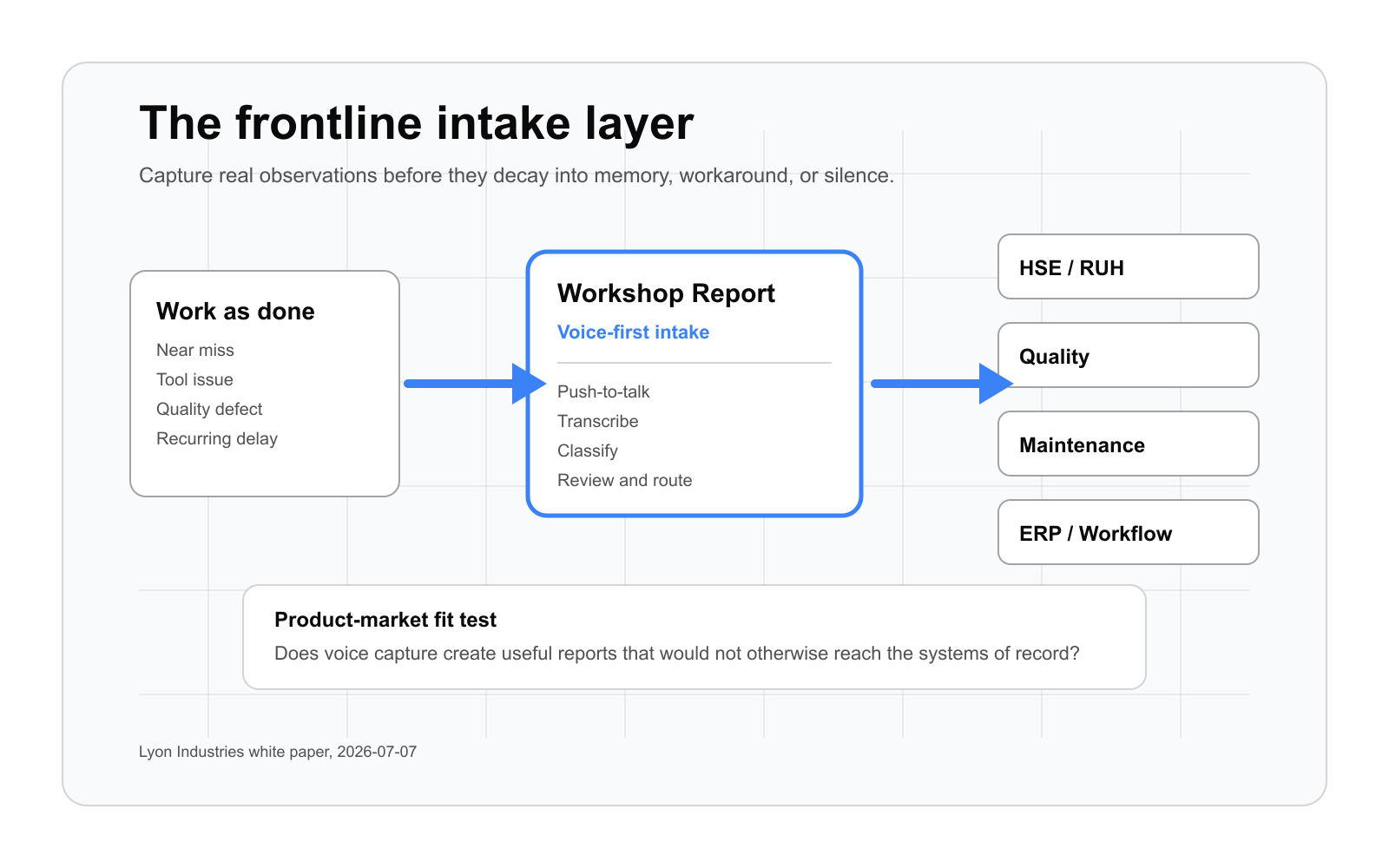
Workshop Report is a responsible, voice-first intake layer for frontline observations, designed to capture better raw operational evidence and route it into the systems companies already trust.
That is the product-market fit test. If customers see Workshop Report as another HSE database, the product is weak. If they see it as the missing intake layer that makes their existing systems less blind, the product becomes worth a pilot.
The Decision This Paper Informs
The immediate decision is not whether to build a full compliance platform.
The decision is whether Workshop Report deserves a disciplined validation project: customer interviews, site visits, speech/noise tests, privacy review, integration discovery, and two or three design-partner pilots.
The recommendation is yes, with strict boundaries:
| Boundary | Decision |
|---|---|
| Category | Intake and triage layer, not system of record. |
| First market | Norwegian industrial workshops and service yards with existing HSE, quality, or maintenance systems. |
| First workflow | Push-to-talk observation capture, supervisor review, structured routing. |
| Privacy stance | No passive listening. No hidden audio. No individual productivity scoring. Minimal raw-audio retention. |
| Technical stance | Vendor-neutral speech layer. Do not depend on one transcription vendor. |
| Commercial stance | Paid or serious design-partner pilots, not broad free usage. |
This is a good Lyon Industries venture question because it combines frontline operations, organisational behavior, compliance, AI, industrial UX, and product-market fit. The value is not "AI can write reports." The value is whether better capture changes what the organisation can see.
The Organisational Gap
Most management systems describe work as it should happen.
Real work is messier. Tools are missing. Parts arrive late. Labels are unclear. A machine makes a new sound. A near miss happens without injury. A workaround becomes normal. A small quality defect gets fixed locally and never reaches the process owner.
Safety literature often calls this the gap between work-as-imagined and work-as-done. EUROCONTROL's Hindsight work describes the terms as part of modern safety and resilience thinking: work-as-imagined is the planned or assumed version of work; work-as-done is what actually happens in context.1EUROCONTROL. Hindsight 25: Work-as-Imagined and Work-as-Done. 2017. https://www.eurocontrol.int/sites/default/files/publication/files/hindsight25.pdf
That gap is not a slogan. It is a data problem.
If the reporting system only receives polished incidents, formal deviations, and management-selected KPIs, it does not see the small weak signals that explain why work is adapting. Near-miss research makes the same point from a safety angle: worker reports can expose causes of injury risk and help safety management act before harm occurs.2NIOSH / CDC Stacks. The Use of Workers' Near-Miss Reports to Improve Organizational Management of Safety. https://stacks.cdc.gov/view/cdc/215344
The problem is that organisations often design the reporting path around the office version of work:
| Office assumption | Frontline condition |
|---|---|
| The worker has time to write. | The worker is between tasks, wearing gloves, or managing a line stop. |
| The form is clear. | The worker may not know which category the observation belongs in. |
| The system is nearby. | The nearest terminal may be off the floor or shared. |
| Reporting is neutral. | The worker may worry that reporting creates blame or extra work. |
| Context can be added later. | Location, sound, sequence, and tool state decay quickly from memory. |
Workshop Report should own that gap. Not the whole enterprise system. The gap.
Why Existing Systems Are Not The Enemy
The competitive landscape is already populated by serious tools.
EG Landax presents itself as a quality and compliance platform for deviations, compliance, and configurable modules across industries.3EG. EG Landax quality management software. Accessed 2026-07-07. https://egsoftware.com/global/hseq-and-asset-management/eg-landax EQS/Extend positions EQS around internal control, quality, deviation handling, documents, competency, risk, reporting, offline registration, and integrations.4Extend Norway. EQS quality management system. Accessed 2026-07-07. https://www.extendnorway.com/ Mellora markets HSEQ reporting with a few keystrokes, including quick reports, checklists, inspections, and back-office handling.5Mellora. Digital tools for safety and quality. Accessed 2026-07-07. https://mellora.no/en/ avvik.com offers mobile/web registration and follow-up for observations, HSE events, RUH, environmental incidents, customer complaints, supplier deviations, and improvement proposals.6avvik.com. Software for improvement. Accessed 2026-07-07. https://www.avvik.com/avvikweb/no/index.html
That matters because the first product decision is negative:
Do not claim that Workshop Report makes industrial reporting digital. That is already solved.
The more defensible claim is:
Workshop Report makes reporting easier at the moment when the observation is still fresh, then routes the result into the customer's existing system.
The wedge is narrow, but it is real. Existing systems are optimized for management control, case handling, documentation, audits, workflows, and dashboards. Workshop Report should be optimized for high-friction capture:
| Layer | Existing systems | Workshop Report wedge |
|---|---|---|
| System of record | Strong | Do not compete. Integrate. |
| Case workflow | Strong | Send clean structured inputs. |
| Audit evidence | Strong | Preserve source context and review trail. |
| Frontline capture | Mixed | Own the voice-first intake moment. |
| Speech in noisy work | Usually not the core product | Benchmark and specialize. |
| Routing from messy language | Usually form-driven | Classify, tag, and queue for review. |
The product-market fit question is therefore simple: will HSE, quality, maintenance, and operations leaders pay for more complete, earlier, and better-routed observations without replacing their core system?
The Legal And Trust Constraint
Voice capture in the workplace is sensitive.
Datatilsynet's guidance on audio recording in working life, last changed on 2026-06-05, is a hard constraint. It says audio recording is an intrusive measure, that employment has an imbalance of power, and that employer consent is not well suited as a legal basis for recording employees.7Datatilsynet. Spesielt om lydopptak i arbeidslivet. Last changed 2026-06-05. https://www.datatilsynet.no/personvern-pa-ulike-omrader/overvaking-og-sporing/lydopptak/spesielt-om-lydopptak-i-arbeidslivet/
Arbeidstilsynet's material on control and monitoring also matters. Workplace control measures must have a factual basis, must not be disproportionate, and must be discussed, explained, and evaluated.8Arbeidstilsynet. Kontroll og overvaking. Accessed 2026-07-07. https://www.arbeidstilsynet.no/arbeidstid-og-organisering/kontroll-og-overvakning/
That does not kill Workshop Report. It defines the product.
A credible first version must be designed as worker-initiated reporting, not ambient surveillance:
| Product rule | Reason |
|---|---|
| Push-to-talk only | The worker intentionally starts the report. |
| Visible recording state | No ambiguity about when audio is captured. |
| No passive listening | Avoids the monitoring product category. |
| No hidden audio | Avoids the trust failure before the pilot starts. |
| No individual productivity scoring | Keeps the product about safety, quality, and improvement. |
| Minimal raw-audio retention | Reduces privacy risk and review burden. |
| Supervisor review before export | Prevents AI text from becoming an unchecked compliance record. |
| Employee representative package | Makes deployment something the workforce can inspect. |
This is not just legal hygiene. It is product strategy.
If workers believe the tool is a management microphone, the product fails. If workers believe it helps them get real issues seen without paperwork drag, adoption becomes plausible.
The Product Thesis
Workshop Report should be built around one operating loop:
- A worker sees something worth capturing.
- They press to talk.
- The system transcribes the note.
- The system extracts likely category, asset, location, severity, and missing context.
- The worker confirms or adds one or two fields.
- A supervisor reviews the report.
- The report routes to the existing system or owner.
- The organisation sees patterns that were previously invisible.
The product is not the transcription. The product is the loop.
The loop has to be faster than typing, trusted enough for workers, structured enough for supervisors, and compatible enough for buyers.
What Product-Market Fit Would Look Like
The first proof should not be annual recurring revenue. It should be repeated buyer behavior in a narrow use case.
Workshop Report is moving toward product-market fit if five things happen:
| Signal | What it means |
|---|---|
| Workers voluntarily report low-severity observations | The intake mode reduces friction instead of adding a new task. |
| Supervisors accept the review queue | The output is useful enough to process, not another messy inbox. |
| HSE or quality leaders can name missing signals | Buyers see value beyond novelty. |
| The customer wants data routed into an existing system | The product is correctly positioned as an intake layer. |
| A pilot converts into a paid site subscription | The operational value survives after the demo. |
The false positives are equally important:
| False signal | Why it is weak |
|---|---|
| "The AI summary is impressive." | Nice summaries do not prove adoption or routing value. |
| "Management likes the dashboard." | Dashboards can be fed by poor data. |
| "The app works in the office." | The product lives or dies in noise, gloves, pressure, and time constraints. |
| "The customer wants a full HSE system." | That pulls Workshop Report into a crowded replacement market. |
| "Workers use it because the pilot requires it." | Mandatory use does not prove fit. |
The strongest early metric is not total reports. It is the number of useful reports that would probably not have existed without voice-first capture.
The Validation Plan
Oppstartstilskudd 1 is relevant because Innovasjon Norge describes it as support for innovative startups with demanding technology development and significant market potential, used to clarify whether there is a willing-to-pay market. The page lists a maximum of NOK 150,000 and a current processing time of three to four weeks.9Innovasjon Norge. Oppstartstilskudd 1. Accessed 2026-07-07. https://www.innovasjonnorge.no/tjeneste/oppstartstilskudd-1
That fits the stage. The grant should support market clarification, not vanity buildout.
The first validation sprint should answer seven questions:
| Question | Method | Pass condition |
|---|---|---|
| Does the reporting moment actually fail? | 20 interviews and 5 site visits. | Workers and supervisors describe the same capture gap. |
| Which reports are lost? | Shadowing, incident review, supervisor interviews. | Clear first categories emerge: near miss, deviation, tooling, maintenance, delay, quality. |
| Does voice beat typing? | Prototype tasks in realistic conditions. | Faster capture with acceptable user trust. |
| Does speech work in noise? | Benchmark workshop audio with multiple STT providers. | Enough accuracy after prompt, vocabulary, mic, and review design. |
| Is the privacy model acceptable? | DPA/DPIA review, employee representative review. | Push-to-talk design survives review. |
| Which systems matter first? | Customer integration discovery. | Top one or two routing targets appear repeatedly. |
| Will buyers pay? | Pilot offers, not abstract survey questions. | Two paid pilots or three serious LOIs with site access. |
The pilot should be deliberately small:
| Pilot element | Scope |
|---|---|
| Duration | 6 to 8 weeks. |
| Users | One team, one site, one supervisor queue. |
| Capture modes | Phone push-to-talk first; watch/headset later. |
| Categories | 5 to 8 fixed categories, not open-ended taxonomy sprawl. |
| Routing | Email, CSV, webhook, Power Automate, or one customer API. |
| Human review | Mandatory before external system writeback. |
| Output | Pilot report with adoption, accuracy, routing, privacy, and conversion recommendation. |
This also matches the prior Lyon Industries research on decision paralysis in large organisations: do not let every stakeholder redefine the decision. Classify the decision, set the evidence threshold, and close the loop.
The Speech Layer Must Be Vendor-Neutral
The original idea should not depend on one transcription vendor.
Wispr Flow is interesting because it is designed around high-quality dictation, but its quickstart documentation currently says the API service is not being offered to new partners and that access is limited to an exclusive partner set.10Wispr Flow. Quickstart. Accessed 2026-07-07. https://api-docs.wisprflow.ai/quickstart That makes it a possible future partner, not a product dependency.
The architecture should benchmark multiple paths:
| Speech path | Why it matters |
|---|---|
| Wispr Flow | Strong dictation UX if access becomes available. |
| OpenAI realtime transcription | Streaming transcript deltas for live speech-to-text workflows.11OpenAI. Realtime transcription. Accessed 2026-07-07. https://developers.openai.com/api/docs/guides/realtime-transcription |
| Azure Speech | Enterprise speech-to-text with real-time and batch transcription options.12Microsoft Learn. Speech-to-text documentation. Accessed 2026-07-07. https://learn.microsoft.com/en-us/azure/ai-services/speech-service/index-speech-to-text |
| Deepgram | Streaming and pre-recorded audio transcription APIs.13Deepgram. Deepgram API overview. Accessed 2026-07-07. https://developers.deepgram.com/reference/deepgram-api-overview |
| Local Whisper-class models | Data-residency and offline-sensitive pilots. |
The benchmark should use real or simulated workshop audio, not clean office speech. Norwegian, English, dialects, technical terms, asset names, tool names, and background noise all matter.
Business Model
Do not begin with value-share. Begin with a buying motion a plant manager, HSE leader, or operations manager can understand.
| Stage | Offer | Price logic |
|---|---|---|
| Validation | Paid design-partner pilot | NOK 25,000 to 50,000 for a serious 6 to 8 week pilot. |
| First subscription | Site subscription | NOK 5,000 to 20,000 per site per month, depending on users and integrations. |
| Enterprise | Security, residency, integrations | Priced separately after the workflow proves itself. |
The customer is not buying speech-to-text. They are buying fewer lost weak signals, faster routing, better context, and less reporting friction.
Risks And Invalidators
Every serious white paper should say what would make it wrong.
Workshop Report should be killed, narrowed, or parked if these invalidators show up:
| Invalidator | Meaning |
|---|---|
| Workers see it as monitoring | Trust failure; no product-market fit. |
| Speech accuracy fails in realistic environments | The input mode is not ready. |
| Supervisors reject the review burden | The product creates admin work instead of reducing it. |
| Buyers only want a full HSE replacement | The wedge is wrong or the market is too crowded. |
| Existing mobile forms are already enough | Voice does not create enough marginal value. |
| Privacy review requires heavy constraints that remove usefulness | Deployment risk exceeds benefit. |
| Integrations are too customer-specific at pilot scale | Services burden overwhelms software economics. |
The biggest strategic risk is category drift. If Workshop Report becomes "yet another deviation app," it will fight incumbents on feature breadth. If it stays as the intake layer, it can partner with or feed those systems.
What To Build First
Build the smallest version that tests the real loop:
| Component | First version |
|---|---|
| Capture | Mobile push-to-talk. |
| Transcript | Provider-swappable speech API. |
| Structure | Fixed taxonomy plus missing-context prompts. |
| Review | Supervisor queue with edit and approve. |
| Routing | Email/CSV/webhook first; one deeper integration only after repeated demand. |
| Evidence | Timestamp, category, asset/location, transcript, reviewed summary, routing state. |
| Trust | Visible recording, no passive capture, retention controls, worker-facing explanation. |
Do not build a broad dashboard first. Build the intake loop.
The dashboard only matters after the system has better data than the current process.
Recommendation
Workshop Report is a venture worth validating because it attacks a real organisational gap: the distance between work as planned and work as reported.
The market is not empty. That is a feature, not only a threat. Existing systems prove that HSE, quality, deviation, and operational reporting budgets exist. They also define where Workshop Report should not compete.
The first product should be a narrow, trusted, voice-first intake layer for industrial observations. It should route into existing systems, protect workers from surveillance dynamics, and prove that it captures useful reports that would otherwise disappear.
The next action is a 90-day validation program:
- Interview 20 industrial decision-makers and frontline users.
- Visit 5 sites.
- Benchmark speech on realistic workshop audio.
- Run privacy and employee-representative review.
- Identify the top two routing targets.
- Secure two paid pilots or three serious LOIs with site access.
If that program proves pull, build the MVP. If it does not, the useful output is still a strong market map for Lyon Industries: where industrial reporting breaks, which systems already own the record layer, and which parts of the frontline observation loop remain unsolved.
Footnotes
-
EUROCONTROL. Hindsight 25: Work-as-Imagined and Work-as-Done. 2017. https://www.eurocontrol.int/sites/default/files/publication/files/hindsight25.pdf ↩
-
NIOSH / CDC Stacks. The Use of Workers' Near-Miss Reports to Improve Organizational Management of Safety. https://stacks.cdc.gov/view/cdc/215344 ↩
-
EG. EG Landax quality management software. Accessed 2026-07-07. https://egsoftware.com/global/hseq-and-asset-management/eg-landax ↩
-
Extend Norway. EQS quality management system. Accessed 2026-07-07. https://www.extendnorway.com/ ↩
-
Mellora. Digital tools for safety and quality. Accessed 2026-07-07. https://mellora.no/en/ ↩
-
avvik.com. Software for improvement. Accessed 2026-07-07. https://www.avvik.com/avvikweb/no/index.html ↩
-
Datatilsynet. Spesielt om lydopptak i arbeidslivet. Last changed 2026-06-05. https://www.datatilsynet.no/personvern-pa-ulike-omrader/overvaking-og-sporing/lydopptak/spesielt-om-lydopptak-i-arbeidslivet/ ↩
-
Arbeidstilsynet. Kontroll og overvaking. Accessed 2026-07-07. https://www.arbeidstilsynet.no/arbeidstid-og-organisering/kontroll-og-overvakning/ ↩
-
Innovasjon Norge. Oppstartstilskudd 1. Accessed 2026-07-07. https://www.innovasjonnorge.no/tjeneste/oppstartstilskudd-1 ↩
-
Wispr Flow. Quickstart. Accessed 2026-07-07. https://api-docs.wisprflow.ai/quickstart ↩
-
OpenAI. Realtime transcription. Accessed 2026-07-07. https://developers.openai.com/api/docs/guides/realtime-transcription ↩
-
Microsoft Learn. Speech-to-text documentation. Accessed 2026-07-07. https://learn.microsoft.com/en-us/azure/ai-services/speech-service/index-speech-to-text ↩
-
Deepgram. Deepgram API overview. Accessed 2026-07-07. https://developers.deepgram.com/reference/deepgram-api-overview ↩