
01
The real question is local and time-bound
Someone considering a night outside needs to know whether aurora is plausible here, what is driving that assessment, and whether the sky will be dark enough to see anything.
NOAA publishes the necessary pieces, but they answer different questions. Its OVATION product forecasts aurora location and intensity roughly 30–90 minutes ahead. Planetary Kp describes global geomagnetic disturbance. Solar-wind data shows the upstream magnetic and plasma conditions feeding the model. None of those alone knows the observer's cloud, horizon, moonlight or local darkness.
Aurora Wall does one bounded job: turn those public inputs into a persistent, location-aware reading without hiding the path from source to conclusion. Quiet output is useful output. In the live capture below, the correct answer is NOTHING FORECAST OVERHEAD, even though the solar-wind and Kp panels remain active.
Operator decision
Prepare, keep watching, or stand down—then verify outside. The wall informs that decision; it cannot make the observation.
02
It serves observers first, then teaching and shared inquiry
NASA's Aurorasaurus demonstrates why public observation matters: verified ground reports can become useful data for scientists who model aurora. Aurora Wall sits one step before that contribution. It helps a person understand when and why to look; it does not collect or submit their report.
| User | Decision | What the wall must provide |
|---|---|---|
| Aurora observer or photographer | Prepare now, keep watching, or stand down. | Local model probability, darkness, trend and the reason the call changed. |
| Teacher, student or science centre | Explain the Sun-to-ground chain on one screen. | Named sources, visible time windows and a clear distinction between forecast and sighting. |
| Citizen scientist | When to look before making a ground report. | Forecast context that remains separate from the observation they may contribute. |
| Technical team | Keep ambient geomagnetic context visible. | Feed health and source age, with no claim that the wall is an operational warning system. |
Scientists may use the display for orientation or teaching, but the source JSON, calibrated instruments and validated analysis pipelines remain the scientific record.
03
Five stages connect the Sun to a local call
NOAA's OVATION model uses solar-wind velocity and interplanetary magnetic-field measurements at L1, about 1.6 million kilometres upstream, to estimate auroral intensity. Aurora Wall does not recreate that model. It consumes NOAA's grid, samples it at the configured coordinates and combines the result with separate global and local context.
01
Solar wind at L1
NOAA propagation to Earth → Bz, speed, density and lead time
Upstream measurement; not a local sighting
02
OVATION grid
Bilinear sample at observer coordinates → Local model probability and polar oval
30–90 minute model forecast
03
Planetary Kp
Current value + 72-hour ladder → Global activity and NOAA G scale
Planetary context; not local visibility
04
UTC time + coordinates
Solar-position calculation → Sun elevation and next 24 hours of darkness
No cloud, moon or light-pollution input
05
All four paths
Local assessment rules → NIL, FAINT, POSSIBLE or LIKELY
A reasoned model call; never an observation
Observer coordinates are stored locally. They parameterize grid sampling and solar geometry; they are not sent to Lyon Industries.
04
Every panel answers a different part of the decision
The two large values support a glance across the room: local OVATION probability and current Kp. The closer reading explains them through the polar oval, six-hour Bz history, solar-wind measurements, observed and predicted Kp bars, darkness curve, and per-feed age.
| Signal | Useful for | Does not prove |
|---|---|---|
| OVATION | Where auroral intensity is forecast and its value at the observer grid cell. | A sighting, cloud-aware forecast or guarantee. |
| Bz | Whether the interplanetary magnetic field is northward or southward over the displayed window. | A direct measurement of visible aurora. |
| Planetary Kp | The magnitude of global geomagnetic disturbance and NOAA storm level. | Whether the observer's sky is clear or dark. |
| Darkness | Whether solar elevation permits viewing now and over the next 24 hours. | Cloud, moonlight, local horizon or light pollution. |
The animated curtain is a data-bound explanation, not a camera feed. Curtain strength follows the local model value, drift follows measured solar-wind speed, red fraction follows storm level, and the background follows solar elevation. When the inputs do not support a display, the sky stays dark.
05
The proof is an ordinary quiet run on a real terminal
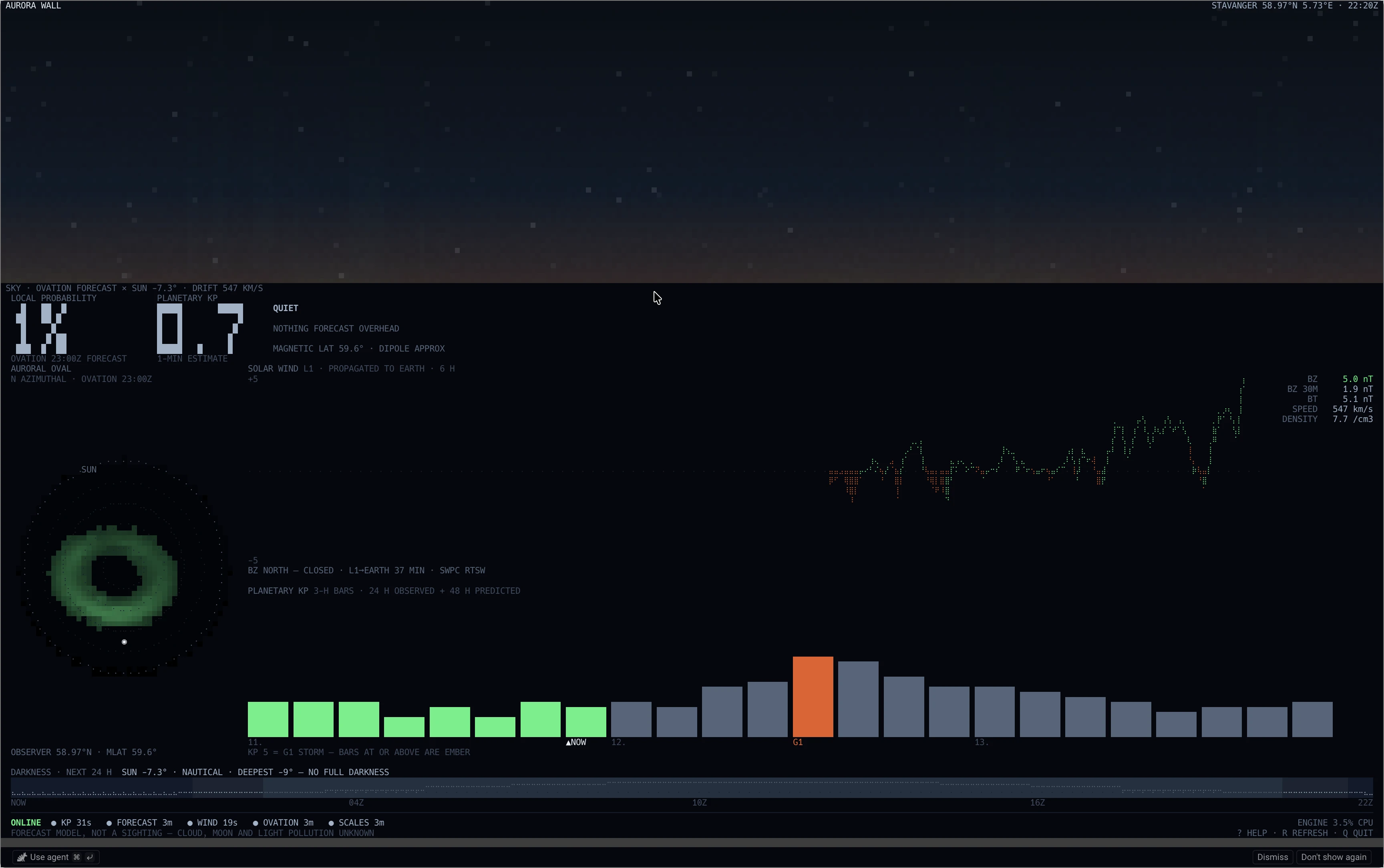
The capture also shows the operating constraint that shaped the product: at a very wide terminal, data must remain positionally stable and values at the right edge must align without touching the frame.
06
Terminal geometry became part of the R&D
The first compositor was deterministic in memory but still allowed visible frame movement in some terminals. Painting the bottom-right cell with DEC autowrap enabled can leave the terminal in a pending-wrap state; a later cursor command may reflow the alternate screen. The fix disables autowrap while the wall owns the screen, restores it on exit, and clears transient content before a full repaint after resize.
The same review found smaller geometry defects. Solar-wind values now anchor to one right edge. Kp bar caps use stable half-cell blocks instead of font-dependent eighths. The polar graticule carries a measured horizontal correction for common terminal Braille metrics while leaving the OVATION field itself unchanged.
enter alternate screen
→ disable autowrap and hide cursor
→ paint synchronized cell deltas
→ on resize: clear, resize grid, repaint once
→ restore terminal modes on every exit path
Observed failure / corrected 12 July 2026
A pure layout function is not enough.
The display is only stable when the terminal mode, glyph metrics and edge behavior are part of the testable rendering contract.
07
Norway's space context does not make this launch instrumentation
Andøya Space supports sounding rockets, ground-based scientific instruments and space education in the Arctic. That makes a legible public space-weather display relevant in classrooms, visitor environments and technical common areas. It does not make Aurora Wall suitable for an Andøya launch decision.
A launch operator needs mission weather, range authority, telemetry, tracking, communications analysis and validated operational products. Aurora Wall contains none of those interfaces. It also does not assess ionospheric scintillation, GNSS integrity, HF availability or spacecraft risk, even though geomagnetic conditions can matter to those domains.
Allowed claim
Open-source, location-aware aurora forecast display for observation, explanation and ambient space-weather awareness. Not launch control, a professional warning service or a scientific measurement instrument.
08
Open source turns the display into inspectable teaching material
The repository includes the feed parsers, local derivations, renderer, bundled snapshot and tests. There are no runtime dependencies. A reader can trace a screen value back to its source field, alter the assessment thresholds, render a deterministic frame, or reuse the small ANSI compositor.
Offline behavior is deliberate. Responses are cached locally; stale or bundled data remains visible with its source and age. The wall changes to WATCH, DEGRADED or OFFLINE rather than presenting old data as current.
git clone https://github.com/lyon-industries/aurora-wall.git
cd aurora-wall
npm install
npm test
npm run typecheck
npm run build
npm install --global .
aurora-wall09
What the current evidence supports
| Evidence | Result | Scope and limit |
|---|---|---|
| Live Mac Terminal capture | Pass | 3456×2168 frame, Stavanger, 12 July 2026 at 22:20 UTC; NOAA feeds online and quiet conditions shown honestly. |
| Deterministic compositor | Pass | Identical data, time and dimensions produce identical cells and colour buffers. |
| Geometry envelope | Pass | Frames from 40×12 through 220×60 render without an out-of-bounds failure. |
| Terminal stability | Pass | Autowrap is controlled, resize forces a clean repaint, and terminal modes restore on exit. |
| Code gate | Pass | 23 tests, TypeScript typecheck and production compilation on 12 July 2026. |
| Scientific or operational qualification | Not claimed | No camera validation, cloud input, launch telemetry, GNSS-risk model or research-grade calibration. |
The next release gate is soak testing across additional terminal emulators and comparing local calls with dated ground observations. That work can test usability and calibration; it cannot remove cloud and horizon uncertainty without new inputs.
10
Primary sources and public proof
- NOAA SWPC: Aurora 30-minute forecast
OVATION usage, 30–90 minute lead time, L1 input boundary, viewing limits and public JSON grid.
- NOAA SWPC: Planetary K-index
Kp storm classification, affected user groups and the distinction between planetary disturbance and local observation.
- NOAA SWPC: Solar-wind observations
Magnetic-field and plasma datasets, spacecraft sources, caveats and public data availability.
- NASA Science: Aurorasaurus
The public-observation workflow and the role verified ground reports can play in aurora research.
- Andøya Space: What we do
Official description of Arctic sounding-rocket, scientific-instrumentation and space-education work used only to establish the Norwegian context.
- Aurora Wall source repository
MIT-licensed implementation, tests, bundled snapshot, live capture and exact build described on this page.
Sources and public repository checked 12 July 2026. The live capture is owned by Lyon Industries and records public NOAA data rendered on a local Mac.
11
The wall series tests persistent technical displays
Starlink Wall asks what should remain visible when an internet link matters. Aurora Wall asks the same design question of a public forecast: which signals help a person decide, which are context, and which claims must stay outside the frame?