
Regional AI Hubs Need Real Robotics Problems
A research summary on how universities can build applied artificial intelligence hubs around government, academia, and industry by turning robotics data from offshore, agriculture, logistics, manufacturing, and public infrastructure into tested field systems.
- Published
- May 10, 2026
- Reading
- 14 min
- Author
- Christopher Lyon
- Filed
- Research
Most artificial intelligence hubs fail because they begin too far away from the work.
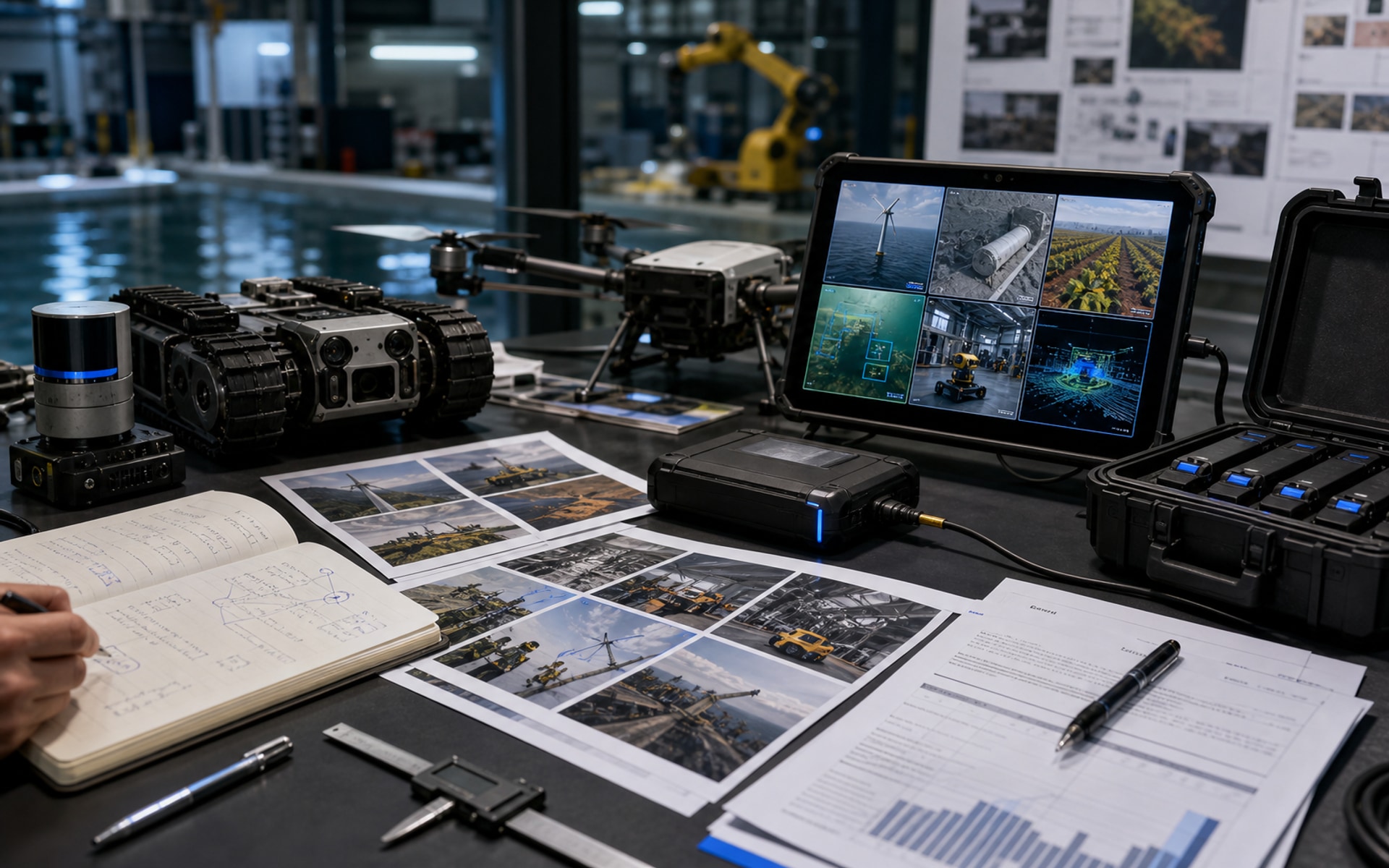
The useful starting point is not a general promise to make a region more innovative. It is a specific machine, dataset, operator, and workflow. A robot inspects an offshore asset and produces hours of video. A drone surveys fields, roads, roofs, power lines, or coastal infrastructure. A warehouse fleet records exceptions faster than supervisors can interpret them. A manufacturing cell sees quality drift before anyone has a clean label for it. An agricultural robot sees weeds, crops, soil, weather, and machine state, but the data still has to become a decision a farmer can trust.
That is where a regional AI hub can matter. The hub should not be a showroom for artificial intelligence. It should be an applied engineering system for turning robotics data into usable proof: labelled data, evaluation methods, operator tools, field trials, safety cases, maintenance feedback, and adoption paths.
The right frame is government, academia, and industry. Academia supplies research capacity, students, evaluation discipline, and method. Industry supplies machines, sites, data, constraints, and adoption pressure. Government supplies legitimacy, funding instruments, public-sector demand, procurement pathways, and the long time horizon that hard infrastructure needs.
The Model Is Already Visible
The academic language for this is old enough to be useful. Etzkowitz and Leydesdorff's Triple Helix model describes innovation as an interaction between universities, industry, and government rather than a one-way transfer from laboratory to market.1Etzkowitz, H. and Leydesdorff, L. "The Dynamics of Innovation: From National Systems and Mode 2 to a Triple Helix of University-Industry-Government Relations." Research Policy, 2000. https://doi.org/10.1016/S0048-7333(99)00055-4 For robotics, the model is practical rather than decorative. A robot in a field, warehouse, factory, harbour, hospital corridor, or offshore worksite creates evidence that all three sides need.
Universities can build perception models, data pipelines, evaluation harnesses, simulation environments, and human-in-the-loop tools. Companies can expose the work that makes the problem real: dirty sensors, bad lighting, intermittent connectivity, machine downtime, safety ownership, support burden, and cost. Government can make the hub legitimate enough to convene competitors, fund pre-commercial testing, protect public interest, and create demand where public infrastructure is the proof site.
Norway already has instruments that fit this shape. The Research Council's Centres for Research-based Innovation scheme is built around long-term cooperation between research groups and research-active companies, normally over a maximum period of eight years.2The Research Council of Norway. "The Centres for Research-based Innovation scheme." https://www.forskningsradet.no/en/financing/what/sfi/ The national AI-centre programme added another layer: the call set out NOK 850 million for four to six centres, with five-year duration, interdisciplinary work, public and private user partners, and expectations around societal benefit, innovation, competence building, and collaboration across sectors. The final results show six approved centres and NOK 1.17 billion awarded.3The Research Council of Norway. "Research Centres for Artificial Intelligence (AI Centres)." https://www.forskningsradet.no/en/call-for-proposals/2025/research-centres-for-artificial-intelligence-ai-centres/
The same proof-before-scale logic appears in European Digital Innovation Hubs. The European Commission describes EDIHs as one-stop shops that help companies and public-sector organisations improve processes, products, and services using digital technologies, with services including technical expertise, testing, "test before invest," financing advice, training, and skills development.4European Commission. "European Digital Innovation Hubs." https://digital-strategy.ec.europa.eu/en/policies/edihs The Norwegian Catapult model uses a similar industrial testing pattern. SINTEF describes catapult centres as testing centres where industrial companies can test new technology and solutions, helping move ideas from concept to market faster and more cost-effectively.5SINTEF. "Manufacturing Technology Norwegian Catapult Centre." https://www.sintef.no/en/projects/2018/manufacturing-technology-norwegian-catapult-centre/
The conclusion is simple. A regional AI hub should be judged by whether it makes robotic systems cheaper, safer, and faster to test against real work.
Robotics Is The Demand Signal
Robotics is a useful anchor because it punishes vague AI work. A chatbot can impress in a meeting and fail quietly later. A robot fails in public: it misses the defect, misreads the crop, blocks the aisle, stops the line, drains the battery, scares the operator, or creates a maintenance problem nobody budgeted for.
That does not mean the hub should pick one robotics niche and ignore the rest. Offshore inspection and agriculture are strong examples in Rogaland, but the same data-processing problems appear across logistics, manufacturing, maritime operations, aquaculture, drones, public infrastructure, health-adjacent service robotics, construction, and energy systems.
| Robotics domain | Data-processing problem | Useful first proof |
|---|---|---|
| Offshore and maritime inspection | ROV video, drone footage, sonar, defect records, maintenance history | Triage anomalies with cited evidence and operator review |
| Agriculture and aquaculture | Crop images, livestock or fish monitoring, soil, weather, machine telemetry | Convert sensor streams into validated field decisions |
| Logistics and warehousing | Fleet telemetry, pick exceptions, congestion, battery state, route history | Explain exceptions and reduce avoidable downtime |
| Manufacturing robotics | Vision inspection, robot-cell logs, quality drift, stoppages | Tie anomalies to maintenance or process adjustments |
| Public infrastructure | Drone surveys, road and bridge imagery, utility records, geospatial layers | Detect changes and rank inspection priorities |
| Health-adjacent service robotics | Task logs, safety events, human handover points, environment maps | Prove bounded assistive workflows before scale-up |
| Construction and field autonomy | Site scans, progress photos, equipment telemetry, planning data | Compare planned work to observed site state |
The common layer is not a magic model. It is the engineering around the model: data rights, sensor calibration, annotation, retrieval, model confidence, operator interface, audit logs, edge deployment, exception handling, and field validation. Those are the places where a university-led hub can turn research into something an operator can test.
Stavanger As A Test Case
Stavanger is a good example because it is not a blank innovation map. The region already has industrial density, public-sector relevance, and a technical university environment within reach.
The City of Stavanger describes the region as Norway's energy capital and links that position to oil and gas knowledge, engineering competence, project management, renewables, technology, drones, and clusters.6City of Stavanger. "The energy capital." https://www.stavanger.kommune.no/en/stavanger-business-region/whats-on-in-stavanger/the-energy-capital/ The same business-region material points to expertise in digitalisation, automation, robotics, artificial intelligence, battery technology, defence, drones, aquaculture, agriculture, renewable energy, start-up programmes, clusters, and venture capital.7City of Stavanger. "Do business." https://www.stavanger.kommune.no/en/stavanger-business-region/do-business/ In 2026, the city also framed robotics and AI as a cross-sector regional capability, with companies across health, oil and gas, manufacturing, maritime industries, and other sectors using AI and robotics.8City of Stavanger. "Robotics and artifical intelligence." https://www.stavanger.kommune.no/en/stavanger-business-region/whats-on-in-stavanger/robotics-and-artifical-intelligence/
Rogaland's agricultural base matters because robotics is not only an offshore story. Store norske leksikon describes agriculture as having a prominent position in Rogaland nationally, with Jaeren accounting for around half of the county's agricultural area.9Store norske leksikon. "Rogaland." https://snl.no/Rogaland A robotics hub in Stavanger does not have to invent its use-case landscape. It has offshore operations, maritime activity, drones, manufacturing, agriculture, aquaculture, public services, infrastructure, and technical companies close enough to create real proof sites.
The University of Stavanger also has existing AI activity. A UiS event page describes Stavanger AI Laboratory as the university's research hub bringing together 18 research groups across AI topics, led by Alvaro Fernandez-Quilez.10University of Stavanger. "CuttingEdgeAI: KI i helsevesenet." https://www.uis.no/nb/forskning/arrangementer/stavanger-ai-lab/teknologi-og-naturvitenskap/cuttingedgeai-ki-i UiS is also part of the national NORA AI network; NORA is described as a Norwegian collaboration among universities, university colleges, and research institutes in AI, machine learning, and robotics, with a research school, industry network, and start-up support.11University of Bergen. "Collaboration." UiB AI. https://www.uib.no/en/ai/167329/collaboration
That existing base changes the question. Stavanger does not need an AI hub because it lacks AI or robotics. It needs a hub if it can convert scattered capability into applied regional infrastructure.
The Shared Data Layer
A robotics AI hub is a data-processing hub before it is a robot lab.
The work is often less glamorous than the demo. Someone has to collect field data without breaking operations. Someone has to decide which labels matter. Someone has to compare model output against operator judgement. Someone has to connect video, telemetry, maintenance records, geospatial data, weather, procedures, and safety constraints. Someone has to write the tool that lets an engineer or supervisor act on the result.
| Shared layer | Why it matters | Example proof |
|---|---|---|
| Image and video processing | Many robotic systems see more than humans can review | Ranked inspection clips with defect evidence and confidence |
| Time-series telemetry | Robots fail through drift, heat, load, battery, vibration, and repeated exceptions | Early warning tied to maintenance action |
| Geospatial and environmental data | Field robots operate in weather, terrain, traffic, farms, ports, and public space | Map overlays that explain why a model changed its recommendation |
| Operator annotations | Expert judgement is often trapped in memory, spreadsheets, or informal notes | Annotation workflow that improves the next model run |
| Procedure and maintenance retrieval | Robotics work depends on manuals, permits, parts, and safety procedures | Cited answers from controlled documents, not hallucinated advice |
| Simulation and replay | Teams need to test before putting machines back into the field | Replay harness for failures and near misses |
| Audit and data rights | Industrial and public-sector data cannot be treated as disposable training material | Access logs, dataset cards, and deletion boundaries before pilot scale |
This is where applied engineers matter. A hub does not need more abstract enthusiasm for AI. It needs people who can sit between a researcher, a field operator, a robot vendor, a public agency, and a business owner, then reduce the problem to a test that survives contact with the machine.
How The Money Can Work
The funding model has to be blended from the beginning. A university-only hub becomes academic overhead. A company-only hub becomes vendor delivery. A government-only hub risks subsidy without adoption.
The strongest pattern is a stack:
| Funding layer | Role |
|---|---|
| Research Council AI centres and related calls | Anchor national research capacity, PhDs, postdocs, governance, and long-duration methods |
| SFI-style centre funding | Bind research groups to long-term company and public-sector partners |
| Industrial PhD and Public Sector PhD schemes | Put doctoral candidates inside companies and public agencies while keeping university supervision |
| Innovation Project for the Industrial Sector | Fund company-led R&D where industrial partners need new knowledge and solutions |
| EDIH and Catapult-style services | Let SMEs and public actors test before investing in full systems |
| County, municipality, and regional development funds | Pay for convening, shared infrastructure, skills programmes, and public-benefit pilots |
| Company membership and in-kind contribution | Provide data, machines, domain experts, staff time, pilots, and market discipline |
| Technology transfer and incubator support | Convert validated prototypes into start-ups, licensing, services, or internal products |
The Industrial PhD scheme is useful because it forces relevance. The Research Council describes it as a company-university doctoral project that strengthens research-based innovation and long-term competence in Norwegian business, with the candidate employed by the company and a research question relevant to the company's R&D needs.12The Research Council of Norway. "Industrial PhD Scheme - Doctoral Projects in Industry 2026." https://www.forskningsradet.no/en/call-for-proposals/2026/industrial-phd-scheme-doctoral-projects-industry-2026/ The Public Sector PhD scheme does similar work for public agencies, tying doctoral work to public-sector needs and collaboration with a degree-conferring institution.13The Research Council of Norway. "Public Sector PhD Project - Doctoral Project in the Public Sector 2026." https://www.forskningsradet.no/en/call-for-proposals/2026/public-sector-phd-doctoral-project-public-sector-2026/
The Innovation Project for the Industrial Sector is the next scale step. The 2026 industry and services call is aimed at research-driven innovation and transitions in the industrial sector, with funding for companies and research organisations across health, ICT, manufacturing, construction, property, services, processing, and related industries.14The Research Council of Norway. "Innovation Project for the Industrial Sector: Industry and services 2026." https://www.forskningsradet.no/en/call-for-proposals/2026/innovation-project-for-the-industrial-sector-industry-and-services-2026/
For a robotics AI hub, these instruments should become an operating rhythm:
- An industrial firm, public agency, municipality, farmer, logistics operator, robot vendor, or infrastructure owner brings a concrete robotic workflow problem.
- The hub scopes the data, machine boundary, safety owner, evaluation criteria, operator interface, and adoption path.
- A small proof is run on real or replayed field data.
- If the proof works, it is matched to a funding instrument: Industrial PhD, Public Sector PhD, Innovation Project, SFI, EDIH service, Catapult test, regional development funding, or private contract.
- If adoption works, the result becomes a deployed workflow, product module, training package, dataset, start-up, licensing path, or repeatable service.
That is how public funding becomes a growth bed rather than an event budget.
The Operating Design
The hub needs a structure that protects both academic independence and industry usefulness.
The core should be a use-case board, not a prestige board. It should include university researchers, industrial operators, robot companies, logistics and manufacturing users, agricultural and aquaculture operators, public-sector infrastructure owners, legal and data-protection expertise, start-up and technology-transfer capacity, and student representation. Its job is to choose problems that are real enough to test and general enough to teach.
Five units matter.
| Unit | Function |
|---|---|
| Data trust and evaluation office | Contracts, rights, privacy, security, dataset documentation, benchmark design, and access control |
| Robotics data lab | Perception, telemetry, retrieval, annotation, simulation, replay, and model evaluation for field robotics |
| Field proofbed network | Sector pilots with offshore, maritime, agriculture, aquaculture, logistics, manufacturing, drones, and public-sector partners |
| Embedded engineering programme | Student projects, fellowships, industrial PhDs, public-sector PhDs, and engineers-in-residence placed close to real operations |
| Commercialisation path | Technology transfer, incubator connection, procurement advice, licensing, start-up formation, and partner adoption |
Validé is relevant because the region already has a technology-transfer and start-up pathway. Validé describes itself as a non-profit innovation company and technology transfer office that moves research and knowledge from university and research environments into business and society.15Valide. "The mandate and social mission of Valide TTO." https://www.valide.no/en/tto The detail matters less than the function. A hub needs somewhere for validated prototypes to go after the pilot.
The strongest early projects would not be the flashiest. They would be ones where success is measurable:
| Project type | Useful first metric |
|---|---|
| Offshore or maritime inspection triage | Precision and recall on annotated defect or anomaly classes |
| Agricultural perception workflow | Field validation against farmer, agronomist, or machine-operator labels |
| Logistics fleet exception analysis | Reduction in unresolved stops, route exceptions, or avoidable downtime |
| Manufacturing robot-cell monitoring | Time from anomaly detection to useful maintenance or process action |
| Drone survey processing | Correct change detection with geospatial evidence and review trail |
| Aquaculture camera and sensor monitoring | Verified events per operator hour and false-alarm rate |
| Public infrastructure inspection | Prioritised findings accepted by responsible asset owners |
| Robotics document assistant | Correct cited answers from controlled manuals, permits, and procedures |
The hub should measure adoption, not activity. Papers matter. So do prototypes. But the decisive metrics are repeat use, staff trained, workflows changed, external co-funding, PhDs embedded, start-ups formed, licenses signed, public-sector services improved, and companies that keep using the tool after the subsidy ends.
What Universities Should Not Do
There are predictable failure modes.
The first is building a general AI showroom. The hub fills with demos that look current but are not tied to anyone's machine, data, operator, budget, or safety case.
The second is treating robotics as a prop. A robot on a stage does not prove field value. The proof is whether the system handles bad data, boring edge cases, operator review, maintenance, uptime, and handover.
The third is letting vendors define the agenda. Robot and AI vendors can be useful partners, but the university cannot become their regional sales surface. A public-interest hub has to benchmark tools, preserve independence, and publish methods where possible.
The fourth is ignoring data rights and safety until the pilot works. That is backwards. A hub dealing with inspection footage, farm data, warehouse movement, industrial telemetry, public infrastructure, or health-adjacent robots needs governance before technical ambition.
The fifth is rewarding only academic outputs. Universities are right to protect research quality, but applied hubs need a wider evidence base: validated datasets, open evaluation methods, reproducible pilots, trained people, adoption by partners, and responsible commercialisation.
The sixth is underfunding integration. Most failures will not come from the model alone. They will come from connectors, labels, permissions, operator interfaces, field support, procurement, maintenance ownership, and nobody being paid to finish the last unglamorous 20 percent.
The Governance Question
A robotics AI hub has to decide what it is accountable to.
The answer should be threefold:
| Accountability | Practical meaning |
|---|---|
| Scientific accountability | Methods, evaluation, uncertainty, publication, peer review, and reproducibility where possible |
| Industrial accountability | Systems tested against real constraints, with adoption paths, uptime expectations, and economic relevance |
| Public accountability | Safety, transparency, rights, local benefit, public-sector legitimacy, and honest communication about limits |
Government is not just a cheque writer in this model. It owns public infrastructure, regulates safety-relevant domains, sets procurement norms, protects legitimacy, and can create demand for responsible testing. Academia is not just a paper factory. It owns evaluation discipline, talent formation, and method. Industry is not just a sponsor. It owns the machines, costs, and consequences.
When all three sides do their job, the hub becomes a practical place to answer hard questions: does the model work on field data, does the operator trust it, does the machine keep running, does the safety case survive review, and does anyone keep paying after the pilot?
Bottom Line
A useful regional AI hub is not a building. It is a machine for converting robotics problems into tested technology, trained people, shared infrastructure, and adopted workflows.
For universities and academic organisations, the lesson is direct. Start with the region's real robotic work. Use government, academia, and industry as the operating structure. Require private partners to bring machines, data, staff time, pilots, and market discipline. Use state instruments for long-duration research and competence building. Use test-before-invest infrastructure to lower risk for smaller organisations. Measure adoption as seriously as publication.
Stavanger is a strong example because the ingredients already exist: a technical university environment, an AI lab, national AI networks, an energy and offshore base, robotics and automation activity, agriculture, aquaculture, public-sector needs, start-up infrastructure, and regional interest in robotics across multiple sectors.
The practical conclusion is conservative. A hub should not promise regional transformation because it has AI in the name. It should earn that claim one robotic workflow at a time.
Footnotes
-
Etzkowitz, H. and Leydesdorff, L. "The Dynamics of Innovation: From National Systems and Mode 2 to a Triple Helix of University-Industry-Government Relations." Research Policy, 2000. https://doi.org/10.1016/S0048-7333(99)00055-4 ↩
-
The Research Council of Norway. "The Centres for Research-based Innovation scheme." https://www.forskningsradet.no/en/financing/what/sfi/ ↩
-
The Research Council of Norway. "Research Centres for Artificial Intelligence (AI Centres)." https://www.forskningsradet.no/en/call-for-proposals/2025/research-centres-for-artificial-intelligence-ai-centres/ ↩
-
European Commission. "European Digital Innovation Hubs." https://digital-strategy.ec.europa.eu/en/policies/edihs ↩
-
SINTEF. "Manufacturing Technology Norwegian Catapult Centre." https://www.sintef.no/en/projects/2018/manufacturing-technology-norwegian-catapult-centre/ ↩
-
City of Stavanger. "The energy capital." https://www.stavanger.kommune.no/en/stavanger-business-region/whats-on-in-stavanger/the-energy-capital/ ↩
-
City of Stavanger. "Do business." https://www.stavanger.kommune.no/en/stavanger-business-region/do-business/ ↩
-
City of Stavanger. "Robotics and artifical intelligence." https://www.stavanger.kommune.no/en/stavanger-business-region/whats-on-in-stavanger/robotics-and-artifical-intelligence/ ↩
-
Store norske leksikon. "Rogaland." https://snl.no/Rogaland ↩
-
University of Stavanger. "CuttingEdgeAI: KI i helsevesenet." https://www.uis.no/nb/forskning/arrangementer/stavanger-ai-lab/teknologi-og-naturvitenskap/cuttingedgeai-ki-i ↩
-
University of Bergen. "Collaboration." UiB AI. https://www.uib.no/en/ai/167329/collaboration ↩
-
The Research Council of Norway. "Industrial PhD Scheme - Doctoral Projects in Industry 2026." https://www.forskningsradet.no/en/call-for-proposals/2026/industrial-phd-scheme-doctoral-projects-industry-2026/ ↩
-
The Research Council of Norway. "Public Sector PhD Project - Doctoral Project in the Public Sector 2026." https://www.forskningsradet.no/en/call-for-proposals/2026/public-sector-phd-doctoral-project-public-sector-2026/ ↩
-
The Research Council of Norway. "Innovation Project for the Industrial Sector: Industry and services 2026." https://www.forskningsradet.no/en/call-for-proposals/2026/innovation-project-for-the-industrial-sector-industry-and-services-2026/ ↩
-
Valide. "The mandate and social mission of Valide TTO." https://www.valide.no/en/tto ↩