
Humanoid Robotics: The Factory Is The First Home
A source-dense research brief on humanoid robotics progress: what changed in hardware and AI, which deployments are real, where economics close first, why safety remains the gating system, and what timelines are defensible.
- Published
- May 7, 2026
- Reading
- 25 min
- Author
- Christopher Lyon
- Filed
- Research
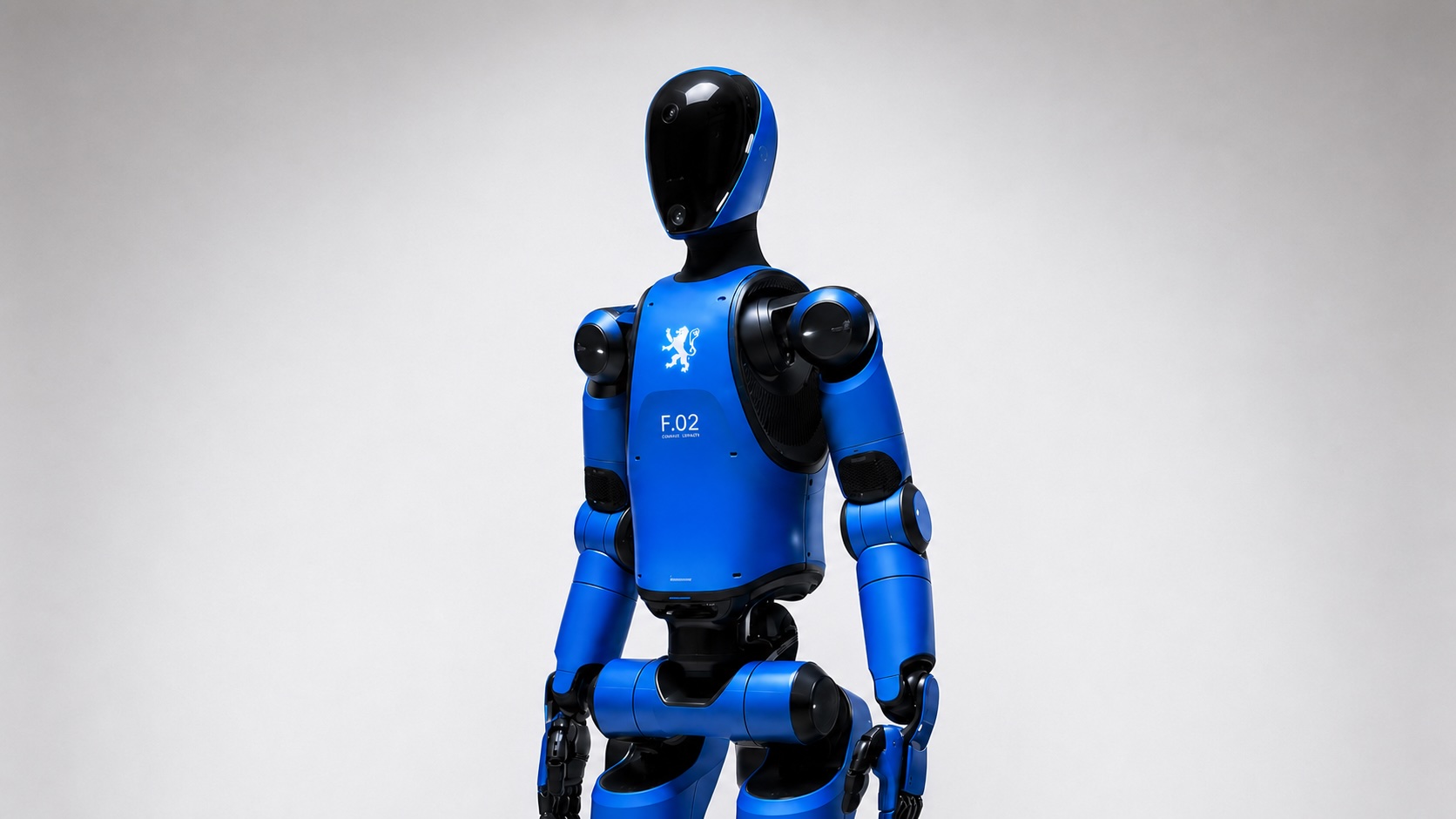
Humanoid robotics has crossed a line, but not the one the market keeps advertising.
The real change is not that a robot can walk on stage, wave, dance, fold one shirt, or carry a tote for a camera. The real change is that the humanoid is becoming an industrial instrument. It can now be placed inside selected human-designed work cells, trained from human demonstrations, connected to a warehouse or factory workflow, monitored by software, and made useful for a narrow job without rebuilding the entire site around it. That is new. It is also much smaller than the claim that general-purpose robot workers have arrived.
The factory is the first home for the humanoid because the factory is where the task, floor, lighting, tools, schedule, supervisor, and economic account can be constrained. The home is visually attractive and commercially enormous, but it is a hostile robotics environment: unstructured, legally sensitive, low-utilization, emotionally loaded, and full of edge cases. A warehouse tote, sheet-metal fixture, kitting station, or inspection routine is less glamorous. It is also how the field becomes real.
Abstract
This paper maps humanoid robotics progress through May 7, 2026. It covers safety standards, labor and market evidence, the major company programs, the technical stack behind recent progress, the strongest public deployments, the economics of industrial and consumer adoption, and the timelines that are defensible.
The thesis is narrow. Humanoid robots are not yet general labor. They are beginning to become useful in bounded industrial tasks where a human-scale mobile manipulator can reuse human infrastructure and where the deployment can absorb safety engineering, supervision, and workflow integration. The strongest public cases are Agility Robotics with GXO in logistics, Figure with BMW in automotive production, BMW's later Leipzig humanoid pilot, and Boston Dynamics' shift from research Atlas to an enterprise industrial Atlas. Tesla, Apptronik, 1X, Sanctuary, Unitree, Fourier, UBTECH, NEURA, XPENG, and others show serious hardware and AI momentum, but most public evidence remains a mixture of demos, pilots, vendor-reported milestones, and forecasts.
The article distinguishes five categories throughout:
| Category | Meaning | How to read it |
|---|---|---|
| Deployed work | Robot used in a customer operation or production environment | Strongest evidence, still needs scope and productivity caveats |
| Pilot | Customer or partner testing robot on selected tasks | Evidence of interest, not proof of broad adoption |
| Demo | Controlled demonstration by vendor or lab | Evidence of capability, not operations |
| Vendor claim | Company-reported specs, runtime, payload, task success, roadmap | Useful but should be labelled |
| Forecast | Analyst or company projection | Evidence of expectations, not outcome |
The Thesis
The useful humanoid arrives first as a factory instrument, not a domestic companion.
That sentence is the simplest way to avoid both bad readings of the field. The skeptical reading says humanoids are just internet theater. That is now wrong. GXO and Agility announced a multi-year Robot-as-a-Service deployment of Digit in logistics operations in June 2024, after a late-2023 proof-of-concept pilot, and described it as the first formal commercial deployment and first RaaS deployment of humanoid robots.1GXO Logistics. GXO Signs Industry-First Multi-Year Agreement with Agility Robotics. 27 June 2024. https://investors.gxo.com/news-releases/news-release-details/gxo-signs-industry-first-multi-year-agreement-agility-robotics/ BMW tested Figure 02 in Plant Spartanburg in 2024, placing sheet-metal parts into fixtures in a real production environment.2BMW Group. Humanoid Robots for BMW Group Plant Spartanburg. 11 September 2024. https://www.bmwgroup.com/en/news/general/2024/humanoid-robots.html Figure later reported 1,250+ runtime hours, 90,000+ parts loaded, and contribution to 30,000+ BMW X3 vehicles, while BMW's 2026 Leipzig announcement repeated the Spartanburg results and named safety barriers, partitions, and 5G improvements as lessons.3Figure AI. F.02 Contributed to the Production of 30,000 Cars at BMW. 19 November 2025. https://www.figure.ai/news/production-at-bmw 4BMW Group. Leipzig debut: BMW Group introduces humanoid robots - a first in Germany. 9 March 2026. https://www.bmwgroup.com/en/news/general/2026/humanoid-robot-in-leipzig.html
The optimistic reading says general-purpose workers are here. That is also wrong. The evidence is concentrated in narrow jobs. The same public cases that prove progress also prove constraint: totes, fixtures, repetitive material handling, parts presentation, inspection assistance, line-side logistics. These are not full human jobs. They are task islands.
The right frame is industrialization. Humanoids are entering the same long path that industrial arms, automated guided vehicles, autonomous mobile robots, and collaborative robots followed: constrained task first, safety case second, fleet tooling third, generality last.
Why The Form Factor Became Plausible
The humanoid body is not automatically optimal. Wheels beat legs on flat floors. A fixed arm beats a humanoid at a repeatable station. A conveyor beats both when the flow is known. The reason humanoids matter is not that nature chose two legs. It is that the built environment chose people.
Factories, warehouses, stores, hospitals, hotels, and homes are full of human-scale artifacts: handles, shelves, carts, bins, stairs, ladders, doors, totes, workbenches, light switches, inspection angles, and informal clearances. A robot that can walk through those spaces and use roughly human reach can sometimes avoid a capital project. It can be introduced as labor-like capacity rather than as a rebuilt automation cell.
That is the strategic bet. It only works when three things are true at the same time:
| Condition | Why it matters | Failure mode |
|---|---|---|
| Human-scale mobility is valuable | The site was built around people, not machines | Wheels or fixed automation are cheaper |
| Manipulation is simple enough | The robot can repeat a bounded action reliably | Hands, perception, or fixtures fail |
| The safety case is bounded | The robot operates inside a known envelope | Human proximity, falling, force, or unexpected motion blocks deployment |
Boston Dynamics states the industrial version of Atlas is intended for enterprise applications and material handling, with workflow integrations, fleet software, self-charging or battery-swap behavior, and specifications such as 56 degrees of freedom, 1.9 m height, 90 kg weight, 4-hour battery life, and 30 kg sustained capacity.5Boston Dynamics. Atlas product page. https://bostondynamics.com/atlas/ That is not a household pitch. It is an enterprise automation pitch.
The same industrial logic shows up in Apptronik and Jabil's 2025 collaboration. The announced Apollo pilot targets inspection, sorting, kitting, line-side delivery, fixture placement, and sub-assembly inside Jabil manufacturing operations, including lines that will build Apollo robots.6Jabil. Apptronik and Jabil Collaborate to Scale Production of Apollo Humanoid Robots. 25 February 2025. https://www.jabil.com/news/apptronik-jabil-collaborate.html Figure's BMW task is sheet-metal loading.3Figure AI. F.02 Contributed to the Production of 30,000 Cars at BMW. 19 November 2025. https://www.figure.ai/news/production-at-bmw GXO and Agility's public deployment is logistics handling.1GXO Logistics. GXO Signs Industry-First Multi-Year Agreement with Agility Robotics. 27 June 2024. https://investors.gxo.com/news-releases/news-release-details/gxo-signs-industry-first-multi-year-agreement-agility-robotics/ UBTECH positions Walker S and Walker S1 for vehicle manufacturing assembly lines, semantic navigation, LLM task planning, whole-body motion control, and coordination with AMRs and AGVs.7UBTECH Robotics. Walker S1 humanoid robot product page. https://www.ubtrobot.com/en/humanoid/products/WalkerS1/
This convergence matters more than any single demo. The first industrial humanoid jobs look boring because the useful work is boring.
What Changed Technically
The change since 2022 is not one breakthrough. It is a stack.
Electric Bodies And Better Actuation
The field moved from heroic hydraulics and lab-only machines toward electric, maintainable, manufacturable platforms. Boston Dynamics retired hydraulic Atlas and reset the program around a fully electric humanoid in 2024, then framed the 2026 Atlas as an industrial product path.8Boston Dynamics. Atlas' Evolution From Research Robot to Industrial Humanoid. https://bostondynamics.com/blog/atlas-evolution-from-research-robot-to-industrial-humanoid/ Unitree's G1 compressed the research-platform price point dramatically, listing a price from $16,000, about 35 kg mass, 23 to 43 joint motors, and optional dexterous hands.9Unitree Robotics. Unitree G1 humanoid robot product page. https://www.unitree-robot.com/mobile/g1 Fourier's GR-2 announcement emphasized upgraded actuators, a 12-DoF dexterous hand with tactile sensors, and development across locomotion, manipulation, cognition, bionic design, user experience, and commercial viability.10Fourier Co. Ltd. Fourier Unveils the Next-Generation Humanoid Robot GR-2. 30 September 2024. https://www.prnewswire.com/news-releases/fourier-unveils-the-next-generation-humanoid-robot-gr-2-302262068.html
Actuation is not just torque. A worker-proximate robot needs force control, backdrivability or compliance, shock tolerance, low noise, serviceability, thermal performance, and predictable failure modes. The technical lineage reaches back decades to series elastic actuator work, which placed elasticity between motor and load to improve force control and impact tolerance.11Pratt, G. A. and Williamson, M. M. Series Elastic Actuators. IEEE/RSJ IROS, 1995. https://ieeexplore.ieee.org/document/525827 Modern humanoids vary widely in architecture, but the same design tradeoff remains: the joint has to be powerful enough to move a useful body, precise enough to manipulate, soft enough to survive contact, and cheap enough to manufacture.
Teleoperation And Data
The less visible unlock is data capture. Humanoid autonomy is starved for real demonstrations. The web solved language pretraining because text already existed. Robot action data mostly does not. Someone or something has to generate it.
ALOHA showed that low-cost bimanual teleoperation plus Action Chunking with Transformers could learn fine manipulation tasks from small amounts of human demonstration, reporting 80-90 percent success on six real-world tasks from about ten minutes of demonstrations.12Zhao, T. Z., Kumar, V., Levine, S., and Finn, C. Learning Fine-Grained Bimanual Manipulation with Low-Cost Hardware. arXiv:2304.13705. https://arxiv.org/abs/2304.13705 Mobile ALOHA extended that idea to a mobile, whole-body teleoperation system and reported that co-training with static ALOHA data improved mobile manipulation success rates by up to 90 percent with 50 demonstrations per task.13Fu, Z., Zhao, T. Z., and Finn, C. Mobile ALOHA: Learning Bimanual Mobile Manipulation with Low-Cost Whole-Body Teleoperation. arXiv:2401.02117. https://arxiv.org/abs/2401.02117 Diffusion Policy then showed why generative action models matter for manipulation: the policy can represent multimodal action distributions and was reported to outperform prior robot-learning methods by an average 46.9 percent across manipulation benchmarks.14Chi, C. et al. Diffusion Policy: Visuomotor Policy Learning via Action Diffusion. RSS 2023. https://rss2023.github.io/rss2023-website/program/papers/026/
The industry read is simple: teleoperation is not a failure mode. It is the training interface. 1X's NEO product page is explicit that for chores NEO does not know, the owner can schedule a 1X Expert to guide it; the robot learns while getting the job done.151X Technologies. NEO Home Robot product page. https://www.1x.tech/neo Figure, 1X, Sanctuary, and others are not only building robots. They are building data engines.
Vision-Language-Action Models
The model stack changed the field's ambition. RT-1 showed a transformer policy trained on large real-world robot data for many tasks.16Brohan, A. et al. RT-1: Robotics Transformer for Real-World Control at Scale. arXiv:2212.06817. https://arxiv.org/abs/2212.06817 RT-2 co-fine-tuned vision-language models on robot trajectories and web-scale vision-language tasks, representing robot actions as tokens and reporting improved generalization and emergent semantic reasoning across thousands of trials.17Brohan, A. et al. RT-2: Vision-Language-Action Models Transfer Web Knowledge to Robotic Control. arXiv:2307.15818. https://arxiv.org/abs/2307.15818 Open X-Embodiment pooled data across 22 robots and 527 skills to test cross-embodiment transfer.18Open X-Embodiment Collaboration et al. Open X-Embodiment: Robotic Learning Datasets and RT-X Models. arXiv:2310.08864. https://arxiv.org/abs/2310.08864 OpenVLA made a 7B open-source VLA trained on 970,000 real-world robot demonstrations available for the research community.19Kim, M. J. et al. OpenVLA: An Open-Source Vision-Language-Action Model. arXiv:2406.09246. https://arxiv.org/abs/2406.09246
The important part is not that robots now "understand" the world like humans. They do not. The important part is that language, vision, and action are being trained in a shared representation. A command can connect to a scene, a scene can connect to an affordance, and an affordance can connect to a motor policy. SayCan made the grounding problem clear in 2022: a robot should not only parse what the user said; it must choose what it can actually do.20Ahn, M. et al. Do As I Can, Not As I Say: Grounding Language in Robotic Affordances. arXiv:2204.01691. https://arxiv.org/abs/2204.01691 PaLM-E pushed embodied multimodal language models by injecting continuous sensor modalities into a language model for grounded reasoning.21Driess, D. et al. PaLM-E: An Embodied Multimodal Language Model. arXiv:2303.03378. https://arxiv.org/abs/2303.03378
The 2025 systems industrialized that direction. Figure describes Helix as a generalist humanoid VLA model that unifies perception, language, and learned control, with full upper-body continuous control and multi-robot collaboration claims.22Figure AI. Helix: A Vision-Language-Action Model for Generalist Humanoid Control. 20 February 2025. https://www.figure.ai/news/helix Google DeepMind describes Gemini Robotics 1.5 as a VLA model that turns visual information and instructions into motor commands, paired with embodied reasoning models.23Google DeepMind. Gemini Robotics. https://deepmind.google/models/gemini-robotics/ Gemini Robotics On-Device targets local inference and adaptation from as few as 50 to 100 demonstrations.24Google DeepMind. Gemini Robotics On-Device brings AI to local robotic devices. 24 June 2025. https://deepmind.google/discover/blog/gemini-robotics-on-device-brings-ai-to-local-robotic-devices/ NVIDIA's GR00T program moved foundation-model tooling into humanoid robotics, with Project GR00T in 2024, GR00T N1 in 2025, GR00T-Dreams synthetic motion data, Isaac Lab, Jetson Thor, and a named ecosystem of humanoid developers.25NVIDIA. Project GR00T Foundation Model for Humanoid Robots and Isaac Robotics Platform Update. 18 March 2024. https://nvidianews.nvidia.com/news/foundation-model-isaac-robotics-platform 26NVIDIA. Isaac GR00T N1 open humanoid robot foundation model. 18 March 2025. https://nvidianews.nvidia.com/news/nvidia-isaac-gr00t-n1-open-humanoid-robot-foundation-model-simulation-frameworks 27NVIDIA. Cloud-to-Robot Computing Platforms for Physical AI. 18 May 2025. https://nvidianews.nvidia.com/news/nvidia-powers-humanoid-robot-industry-with-cloud-to-robot-computing-platforms-for-physical-ai
That is a real shift. It is not enough.
The missing layer is still operational reliability. A robot that succeeds at a staged task 80 percent of the time is a research result. A robot that runs a paid shift has to handle lighting changes, minor fixture variations, dropped parts, bad labels, human interruptions, floor debris, network loss, thermal limits, battery state, and a supervisor who has other work to do.
What Is Actually Deployed
The strongest public evidence clusters in two verticals: logistics and automotive manufacturing.
Logistics: Agility And GXO
GXO and Agility's 2024 agreement is the cleanest commercial marker because it has a customer, a facility, a stated RaaS structure, and a logistics use case.1GXO Logistics. GXO Signs Industry-First Multi-Year Agreement with Agility Robotics. 27 June 2024. https://investors.gxo.com/news-releases/news-release-details/gxo-signs-industry-first-multi-year-agreement-agility-robotics/ Agility later described Digit stepping into commercial operations at a GXO facility near Atlanta on June 5, 2024.28Agility Robotics. Digit Deployed at GXO in Historic Humanoid RaaS Agreement. 3 October 2024. https://www.agilityrobotics.com/content/digit-deployed-at-gxo-in-historic-humanoid-raas-agreement The robot is not replacing an entire warehouse worker. It is operating in a workflow where it can move totes or containers as part of a system that already includes conveyors, cobots, warehouse software, and human supervisors.
That distinction is important. Warehouses are already heavily automated, but mostly not with humanoids. The mature stack is conveyors, sorters, shuttles, AMRs, goods-to-person systems, robotic arms, scanners, and warehouse management software. A humanoid has to justify itself against that stack, not against a blank floor. The argument for Digit is that some work remains human-shaped even inside automated facilities: moving totes from one machine interface to another, operating around human aisles, and adapting to brownfield layouts without a full rebuild.
Automotive: BMW, Figure, Apptronik, UBTECH, XPENG, Boston Dynamics
Automotive is the other natural first market. The industry has engineering capacity, safety culture, repeatable fixtures, high labor and ergonomic costs, and a long history of robot integration.
BMW's Spartanburg trial with Figure 02 involved placing sheet-metal parts into special fixtures.2BMW Group. Humanoid Robots for BMW Group Plant Spartanburg. 11 September 2024. https://www.bmwgroup.com/en/news/general/2024/humanoid-robots.html Figure's 2025 report claimed the robot ran 10-hour weekday shifts, loaded 90,000+ parts, accumulated 1,250+ runtime hours, and contributed to 30,000+ BMW X3 vehicles.3Figure AI. F.02 Contributed to the Production of 30,000 Cars at BMW. 19 November 2025. https://www.figure.ai/news/production-at-bmw BMW's 2026 Leipzig article repeated those numbers and described a new AEON pilot in Germany, while also mentioning revised safety concepts with barriers and partitions plus improved 5G coverage as lessons from Spartanburg.4BMW Group. Leipzig debut: BMW Group introduces humanoid robots - a first in Germany. 9 March 2026. https://www.bmwgroup.com/en/news/general/2026/humanoid-robot-in-leipzig.html
That last clause is one of the most important in the whole field. The safety and connectivity work is not an afterthought. It is the deployment.
Apptronik and Mercedes-Benz announced a 2024 Apollo pilot in Mercedes manufacturing facilities.29Apptronik. Apptronik and Mercedes-Benz Enter Commercial Agreement. 15 March 2024. https://apptronik.com/news-collection/apptronik-and-mercedes-benz-enter-commercial-agreement Apptronik then partnered with Google DeepMind in late 2024 and Jabil in early 2025, with Jabil both manufacturing Apollo and testing it in its own operations.30Apptronik. Apptronik Partners with Google DeepMind Robotics. 19 December 2024. https://apptronik.com/news-collection/apptronik-partners-with-google-deepmind-robotics 6Jabil. Apptronik and Jabil Collaborate to Scale Production of Apollo Humanoid Robots. 25 February 2025. https://www.jabil.com/news/apptronik-jabil-collaborate.html UBTECH's Walker S and S1 programs show a parallel Chinese factory path, with company pages and Chinese reporting describing vehicle-assembly use, NIO and FAW-Volkswagen trials, and coordination with AMRs/AGVs.31UBTECH Robotics. Walker S industrial humanoid product page. https://www.ubtrobot.com/en/humanoid/products/walker-s 32Xinhua / China.org.cn. Chinese robotics firm, FAW-Volkswagen join hands to build humanoid robot-run car factory. 3 July 2024. https://www.china.org.cn/business/2024-07/03/content117288629.htm XPENG is integrating humanoid robotics into a broader "Physical AI" mobility story, with IRON announced in 2024 and a more anthropomorphic Next-Gen IRON shown in 2025 with stated 82 total DoF, 22-DoF hands, flexible skin, and a solid-state battery.33XPENG. XPENG Unveils Kunpeng Super Electric System and AI-Defined Mobility Innovations at XPENG AI Day. 6 November 2024. https://www.xpeng.com/news/019301d2135392fa562d8a0282200016 34XPENG. XPENG Shares Achievements in Physical AI Emergence. 5 November 2025. https://www.xpeng.com/pressroom/news/019a56f54fe99a2a0a8d8a0282e402b7
Boston Dynamics sits in a different category. Atlas is the most mature dynamic humanoid lineage, but its commercial proof has historically lagged its athletic demonstrations. The 2024 electric reset, TRI partnership, Large Behavior Model demonstrations, and 2026 production-ready industrial framing are all evidence of a serious transition from research platform to product.35Boston Dynamics. Boston Dynamics and Toyota Research Institute Announce Partnership. 16 October 2024. https://bostondynamics.com/news/boston-dynamics-toyota-research-institute-announce-partnership-to-advance-robotics-research/ 36Toyota USA Newsroom. AI-Powered Robot by Boston Dynamics and Toyota Research Institute Takes a Key Step Towards General-Purpose Humanoids. 20 August 2025. https://pressroom.toyota.com/ai-powered-robot-by-boston-dynamics-and-toyota-research-institute-takes-a-key-step-towards-general-purpose-humano... 8Boston Dynamics. Atlas' Evolution From Research Robot to Industrial Humanoid. https://bostondynamics.com/blog/atlas-evolution-from-research-robot-to-industrial-humanoid/ It is still a company-reported transition until customer operations disclose results.
The Companies, Read Correctly
The public field is easier to understand as a map of strategies rather than a leaderboard.
| Company | Public strategy | Strongest evidence | Current caveat |
|---|---|---|---|
| Agility Robotics | Logistics-first bipedal mobile manipulation | GXO multi-year RaaS deployment | Narrow workflow, undisclosed fleet/productivity |
| Figure | Automotive and logistics humanoids plus VLA | BMW Spartanburg results; Helix technical work | Vendor-reported metrics |
| Boston Dynamics | Enterprise industrial Atlas | Electric Atlas, TRI/LBM, Hyundai ecosystem | Product transition still early |
| Apptronik | Apollo for manufacturing/logistics, scaled by partners | Mercedes, Google DeepMind, Jabil, major funding | Pilots before broad commercialization |
| Tesla | Vertically integrated Optimus for internal factories first | Optimus demos and manufacturing ambition | Public independent deployment evidence remains limited |
| 1X | Home-first soft humanoid with expert teleoperation | NEO product page, early access roadmap | Consumer safety/privacy/autonomy are hardest |
| Sanctuary | General-purpose industrial humanoids and data capture | Phoenix generations and Carbon architecture | Public customer outcome data limited |
| Unitree | Low-cost research/developer humanoids | G1 price/spec accessibility | Platform for R&D more than labor |
| Fourier | Research, rehab, and assistance lineage | GR-1/GR-2 humanoid platform progression | Enterprise evidence limited |
| UBTECH | Chinese industrial humanoid deployments | Walker S/S1 automotive factory positioning | Efficiency and scale still unclear |
| NEURA | European cognitive humanoid platform | 4NE1 product specs and sensor-skin positioning | Product proof still needs field evidence |
| XPENG | Physical AI ecosystem spanning vehicles, robots, flight | IRON roadmap and VLA 2.0 announcements | Highly roadmap-driven |
Tesla deserves special handling because its public ambition shapes the market but its public evidence is still mostly demos. The 2022 Optimus reveal established the program; the 2023 Gen 2 demo claimed a 10 kg weight reduction, 30 percent faster walking, 11-DoF hands, and tactile sensing on all fingers.37Tesla. AI Day 2022 presentation, Optimus segment. https://www.youtube.com/watch?v=ODSJsviDSU 38Ars Technica summary of Tesla Optimus Gen 2 demo claims. 13 December 2023. https://arstechnica.com/information-technology/2023/12/teslas-latest-humanoid-robot-optimus-gen-2-can-handle-eggs-without-cracking-them/ Those are meaningful hardware milestones. They are not evidence of paid work at scale. Until Tesla publishes audited internal factory deployment data, Optimus should be read as a high-potential vertically integrated program with weak public operational evidence.
1X deserves the opposite warning. It is one of the few companies pushing directly into the home. NEO's page describes a soft body, tendon-driven actuation, 842 Wh battery, 4-hour runtime, 22 dB noise, mobile app, voice interface, remote control, and scheduled Expert Mode.151X Technologies. NEO Home Robot product page. https://www.1x.tech/neo The candor about Expert Mode is strategically important. It implies a future where early home robots are partly autonomous appliances, partly teleoperated services, and partly data collection endpoints. That may be a plausible path. It also raises the hardest privacy, safety, liability, and trust questions in the sector.
The Safety Problem
Humanoid robot safety is not solved by saying "collaborative robot." A humanoid is mobile, balancing, multi-joint, often battery powered, sometimes carrying loads, sometimes using hands, sometimes near people, and sometimes making decisions from learned models. It inherits hazards from industrial robots, mobile robots, service robots, powered machinery, batteries, and software-intensive autonomous products.
ISO 13482 covers personal care robots such as mobile servant robots, physical assistant robots, and person carriers, and explicitly covers human-robot physical contact applications while excluding industrial robots, medical devices, toys, military robots, and robots traveling faster than 20 km/h.39International Organization for Standardization. ISO 13482:2014, Robots and robotic devices - Safety requirements for personal care robots. https://www.iso.org/standard/53820.html ISO/TS 15066 covers collaborative industrial robot systems and supplements ISO 10218-1 and ISO 10218-2, but it applies to industrial robot systems, not non-industrial robots.40International Organization for Standardization. ISO/TS 15066:2016, Robots and robotic devices - Collaborative robots. https://www.iso.org/standard/62996.html ANSI/A3 R15.06-2025 nationally adopts ISO 10218-1:2025 and ISO 10218-2:2025 for industrial robot safety, replacing the 2012 edition.41ANSI Webstore. ANSI/A3 R15.06-2025, Industrial Robots and Robot Systems - Safety Requirements. https://webstore.ansi.org/standards/ria/ansia3r15062025
The result is not a blank slate. It is a patchwork.
For a humanoid in a plant, the relevant safety case includes:
| Layer | Typical evidence |
|---|---|
| Robot design | limits on speed, force, torque, temperature, sharp edges, pinch points, battery safety |
| Control system | safety-rated stop, reduced-speed modes, fault detection, watchdogs, mode management |
| Mobile behavior | maps, routes, obstacle detection, speed zones, dock behavior, fall/recovery handling |
| Manipulation | grasp force, payload limits, dropped-object analysis, tool/end-effector safety |
| Work cell | barriers, scanners, signage, lighting, floor quality, exclusion zones |
| Human interface | training, alarms, status lights, handover procedures, supervisor authority |
| Autonomy | operational design domain, validation data, task bounds, software update controls |
| Operations | logs, incident response, maintenance, lockout, change management |
OSHA and NIOSH make the same point from the worker side: robot safety is a workplace system, not just a product feature.42Occupational Safety and Health Administration. Robotics safety resources. https://www.osha.gov/robotics 43NIOSH. Center for Occupational Robotics Research. https://www.cdc.gov/niosh/robotics/ NIST's robot test-method work is a useful counterweight to demo culture because it asks what can be measured: navigation, perception, docking, payloads, and repeatable performance.44National Institute of Standards and Technology. Mobile robot test methods and standards development resources. https://www.nist.gov/el/intelligent-systems-division-73500/robotic-systems-smart-manufacturing-program/mobile-robots UL 4600's safety-case orientation is relevant because autonomous products require explicit assumptions, evidence, and lifecycle control.45UL Standards & Engagement. UL 4600, Standard for Safety for the Evaluation of Autonomous Products. https://ulse.org/ul-standards/safety/autonomous-products
The practical implication is severe. A humanoid company cannot ship "general purpose" into a factory and leave the safety case to aspiration. It must ship a bounded operating design domain. The robot's real product is not the body. It is the envelope inside which the body is allowed to act.
The Economics
Humanoid economics are often described as wage replacement. That framing is too weak.
BLS reports that hand laborers and material movers held about 7.0 million U.S. jobs in 2024, with about 1,008,300 projected annual openings from 2024 to 2034 and a median annual wage of 46,620.46U.S. Bureau of Labor Statistics. Material Moving Machine Operators, Occupational Outlook Handbook. https://www.bls.gov/ooh/transportation-and-material-moving/material-moving-machine-operators.htm Those numbers explain why investors and manufacturers care. They do not prove the robot business case.
A robot has a cost stack:
| Cost line | Why it matters |
|---|---|
| Hardware lease or depreciation | capital cost must spread across enough useful hours |
| Integration | the first deployment includes engineering, fixtures, software, and workflow changes |
| Safety | barriers, scanners, procedures, training, validation, signage, and audits |
| Supervision | one human may monitor multiple robots, but exceptions consume attention |
| Maintenance | hands, joints, skins, batteries, sensors, and grippers wear |
| Downtime | production value depends on uptime, not demo quality |
| Data and task engineering | new tasks require demonstrations, labeling, validation, or simulation |
| Site operations | charging, staging, cleaning, spare parts, software updates |
The strongest near-term economics are not "one robot equals one worker." They are:
- one supervisor can cover multiple bounded robot tasks
- robots take ergonomically awkward, repetitive work out of human routines
- existing human infrastructure can be reused instead of rebuilt
- robot work can run during constrained shifts or between human tasks
- the deployment produces logs, measurements, and repeatable process evidence
- the same platform can move between related tasks after integration
This is why the first public tasks are not glamorous. A robot loading sheet metal or moving totes can be slow and still useful if the task is disliked, repetitive, hard to staff, or blocks a higher-value human. A home robot folding laundry has to navigate privacy, object diversity, legal liability, low utilization, and consumer expectations. Industrial users tolerate a supervised tool. Consumers expect a servant.
Forecasts, With Caveats
The market forecasts are large because the labor pool is large and the imagined endpoint is enormous. Goldman Sachs Research forecast a 5 trillion by 2050, more than one billion humanoids, and about 90 percent of units in industrial and commercial uses; it also expects adoption to be slow until the mid-2030s and faster in the late 2030s and 2040s.47Morgan Stanley. Humanoids: A $5 Trillion Market. 14 May 2025. https://www.morganstanley.com/insights/articles/humanoid-robot-market-5-trillion-by-2050
The Morgan Stanley caveat is the important part. Slow until the mid-2030s is a very different thesis from "robots next year." It is consistent with a deployment path where 2024-2027 is dominated by pilots and narrow production cells, 2027-2032 by early fleets in logistics and manufacturing, and the 2030s by broader industrial adoption if safety, cost, and uptime improve.
The Goldman number is useful as a pressure gauge. It says capital believes a market can form. It does not say the market has formed.
Industrial Versus Consumer
The industry-vs-consumer distinction is the most important adoption filter.
Industrial environments are easier for four reasons:
| Industrial advantage | Consumer problem |
|---|---|
| Tasks can be standardized | Homes are different room by room |
| Safety can be engineered into cells | Homes contain children, pets, guests, clutter, stairs, liquids, knives, and heat |
| Utilization can be high | Household robots may sit idle for long periods |
| Users accept training and supervision | Consumers expect intuitive autonomy |
This does not mean home robots are impossible. It means early home robots are likely to be supervised, limited, and service-like. 1X's Expert Mode is a plausible acknowledgement of that.151X Technologies. NEO Home Robot product page. https://www.1x.tech/neo NEO may perform some basic tasks autonomously while escalating unknown chores to a remote expert. That hybrid model could generate data and deliver value. It also shifts the question from "can the robot do it?" to "who is watching through the cameras, who is liable, what is stored, how is consent managed, and what happens when the robot is wrong?"
Industrial buyers already know how to buy machines with manuals, procedures, risk assessments, service contracts, and planned downtime. Consumers do not.
What Is Still Missing
Five bottlenecks decide the field.
1. Hands
Hands are the hardest visible subsystem. Humanoid companies publish DoF counts because DoF is easy to count. Useful dexterity is harder. A factory hand has to survive impacts, dust, oil, sharp edges, misgrasps, repetitive cycles, and maintenance windows. A home hand has to handle cloth, dishes, toys, food, drawers, and fragile objects. Tactile sensing matters, but sensors also add cost, fragility, wiring, calibration, and failure modes. The winning hand may not look human. It will look maintainable.
2. Uptime
A demo can restart. A shift cannot. Uptime is a full-stack property: joints, batteries, thermal design, perception, network, task policy, end effector, dock, error recovery, and human support. BMW's mention of safety barriers, partitions, and 5G improvements after Spartanburg is a small public glimpse of the real integration work.4BMW Group. Leipzig debut: BMW Group introduces humanoid robots - a first in Germany. 9 March 2026. https://www.bmwgroup.com/en/news/general/2026/humanoid-robot-in-leipzig.html
3. Autonomy Boundaries
VLA models improve generalization, but robots still need operational limits. The robot should know when it does not know. The deployment should know when to stop it. The supervisor should know what happened. This is why safety-case thinking and logs matter as much as model size.45UL Standards & Engagement. UL 4600, Standard for Safety for the Evaluation of Autonomous Products. https://ulse.org/ul-standards/safety/autonomous-products
4. Cost
Unitree's G1 is important because a $16,000 starting price changes research access.9Unitree Robotics. Unitree G1 humanoid robot product page. https://www.unitree-robot.com/mobile/g1 It does not set the price of industrial labor. Industrial humanoids need reliability, payload, safety-rated systems, support, fleet software, compliance, and customer integration. Those are expensive. The meaningful price is cost per successful task-hour, not sticker price.
5. Evaluation
Humanoid demos are easy to misunderstand. A useful evaluation should report task definition, autonomy level, teleoperation involvement, number of trials, success rate, cycle time, uptime, interventions per hour, payload, human proximity, safety controls, and site conditions. NIST-style test methods and customer production logs are more valuable than another video.44National Institute of Standards and Technology. Mobile robot test methods and standards development resources. https://www.nist.gov/el/intelligent-systems-division-73500/robotic-systems-smart-manufacturing-program/mobile-robots
Adoption Timelines
The defensible timeline is conservative:
| Period | Likely state | What would change the outlook |
|---|---|---|
| 2024-2027 | Pilots, vendor demos, first paid industrial cells, developer platforms | Public fleet metrics from GXO, BMW, Hyundai, Jabil, or similar customers |
| 2027-2032 | Narrow industrial fleets in logistics, automotive, electronics, warehouses | Robots demonstrate high uptime, low intervention rates, and task transfer across sites |
| 2032-2040 | Broader commercial adoption if safety and economics hold | Standardized certification, lower hardware cost, better hands, mature service networks |
| 2040+ | Consumer and eldercare may become meaningful markets | Privacy, liability, home safety, and general manipulation must be solved |
This is not a prediction that nothing happens until 2030. It is a prediction that useful adoption is narrow before it is broad. A few thousand or tens of thousands of industrial humanoids could be consequential without validating a billion-unit future.
What To Watch
Watch the boring metrics.
- Hours per robot per week in customer operations
- Interventions per operating hour
- Task cycle time versus human baseline
- Mean time between failures
- Hand and actuator replacement interval
- Safety incidents and near misses
- Number of distinct tasks per site
- Number of sites per customer
- Ratio of supervisors to robots
- Gross margin on RaaS or lease deployments
- Repeat orders after pilots
The first company to publish these numbers credibly will do more for the field than the next company to publish a video.
The Honest Summary
Humanoid robotics is now real enough to matter and immature enough to punish sloppy thinking.
The progress is real: electric bodies, cheaper research platforms, better actuators, teleoperation data, imitation learning, diffusion policies, VLA models, simulation tooling, and early industrial deployments have moved the field out of pure theater. GXO/Agility and BMW/Figure are not science fiction. Boston Dynamics, Apptronik, UBTECH, XPENG, 1X, Unitree, Fourier, NEURA, Sanctuary, Tesla, and NVIDIA are not casual participants.
The limits are also real. Most public evidence is still demos, pilots, vendor-reported metrics, or forecasts. Standards do not yet collapse cleanly into one humanoid safety regime. Hands are fragile. Autonomy is bounded. Uptime is unproven. Economics depend on the whole deployment stack. Consumer homes are harder than factories.
The field's next milestone is not a more human-looking walk. It is a boring shift report: ten robots, two sites, three tasks, hundreds of hours, low intervention rates, no safety incidents, repeat customer order, positive unit economics.
That is when humanoid robotics stops being a spectacle and becomes capacity.
Last revised 2026-05-07. Private source cards, image provenance, notes, and the written eval live in the article workspace and are excluded from public asset sync.
Footnotes
-
GXO Logistics. GXO Signs Industry-First Multi-Year Agreement with Agility Robotics. 27 June 2024. https://investors.gxo.com/news-releases/news-release-details/gxo-signs-industry-first-multi-year-agreement-agility-robotics/ ↩ ↩2 ↩3
-
BMW Group. Humanoid Robots for BMW Group Plant Spartanburg. 11 September 2024. https://www.bmwgroup.com/en/news/general/2024/humanoid-robots.html ↩ ↩2
-
Figure AI. F.02 Contributed to the Production of 30,000 Cars at BMW. 19 November 2025. https://www.figure.ai/news/production-at-bmw ↩ ↩2 ↩3
-
BMW Group. Leipzig debut: BMW Group introduces humanoid robots - a first in Germany. 9 March 2026. https://www.bmwgroup.com/en/news/general/2026/humanoid-robot-in-leipzig.html ↩ ↩2 ↩3
-
Boston Dynamics. Atlas product page. https://bostondynamics.com/atlas/ ↩
-
Jabil. Apptronik and Jabil Collaborate to Scale Production of Apollo Humanoid Robots. 25 February 2025. https://www.jabil.com/news/apptronik-jabil-collaborate.html ↩ ↩2
-
UBTECH Robotics. Walker S1 humanoid robot product page. https://www.ubtrobot.com/en/humanoid/products/WalkerS1/ ↩
-
Boston Dynamics. Atlas' Evolution From Research Robot to Industrial Humanoid. https://bostondynamics.com/blog/atlas-evolution-from-research-robot-to-industrial-humanoid/ ↩ ↩2
-
Unitree Robotics. Unitree G1 humanoid robot product page. https://www.unitree-robot.com/mobile/g1 ↩ ↩2
-
Fourier Co. Ltd. Fourier Unveils the Next-Generation Humanoid Robot GR-2. 30 September 2024. https://www.prnewswire.com/news-releases/fourier-unveils-the-next-generation-humanoid-robot-gr-2-302262068.html ↩
-
Pratt, G. A. and Williamson, M. M. Series Elastic Actuators. IEEE/RSJ IROS, 1995. https://ieeexplore.ieee.org/document/525827 ↩
-
Zhao, T. Z., Kumar, V., Levine, S., and Finn, C. Learning Fine-Grained Bimanual Manipulation with Low-Cost Hardware. arXiv:2304.13705. https://arxiv.org/abs/2304.13705 ↩
-
Fu, Z., Zhao, T. Z., and Finn, C. Mobile ALOHA: Learning Bimanual Mobile Manipulation with Low-Cost Whole-Body Teleoperation. arXiv:2401.02117. https://arxiv.org/abs/2401.02117 ↩
-
Chi, C. et al. Diffusion Policy: Visuomotor Policy Learning via Action Diffusion. RSS 2023. https://rss2023.github.io/rss2023-website/program/papers/026/ ↩
-
1X Technologies. NEO Home Robot product page. https://www.1x.tech/neo ↩ ↩2 ↩3
-
Brohan, A. et al. RT-1: Robotics Transformer for Real-World Control at Scale. arXiv:2212.06817. https://arxiv.org/abs/2212.06817 ↩
-
Brohan, A. et al. RT-2: Vision-Language-Action Models Transfer Web Knowledge to Robotic Control. arXiv:2307.15818. https://arxiv.org/abs/2307.15818 ↩
-
Open X-Embodiment Collaboration et al. Open X-Embodiment: Robotic Learning Datasets and RT-X Models. arXiv:2310.08864. https://arxiv.org/abs/2310.08864 ↩
-
Kim, M. J. et al. OpenVLA: An Open-Source Vision-Language-Action Model. arXiv:2406.09246. https://arxiv.org/abs/2406.09246 ↩
-
Ahn, M. et al. Do As I Can, Not As I Say: Grounding Language in Robotic Affordances. arXiv:2204.01691. https://arxiv.org/abs/2204.01691 ↩
-
Driess, D. et al. PaLM-E: An Embodied Multimodal Language Model. arXiv:2303.03378. https://arxiv.org/abs/2303.03378 ↩
-
Figure AI. Helix: A Vision-Language-Action Model for Generalist Humanoid Control. 20 February 2025. https://www.figure.ai/news/helix ↩
-
Google DeepMind. Gemini Robotics. https://deepmind.google/models/gemini-robotics/ ↩
-
Google DeepMind. Gemini Robotics On-Device brings AI to local robotic devices. 24 June 2025. https://deepmind.google/discover/blog/gemini-robotics-on-device-brings-ai-to-local-robotic-devices/ ↩
-
NVIDIA. Project GR00T Foundation Model for Humanoid Robots and Isaac Robotics Platform Update. 18 March 2024. https://nvidianews.nvidia.com/news/foundation-model-isaac-robotics-platform ↩
-
NVIDIA. Isaac GR00T N1 open humanoid robot foundation model. 18 March 2025. https://nvidianews.nvidia.com/news/nvidia-isaac-gr00t-n1-open-humanoid-robot-foundation-model-simulation-frameworks ↩
-
NVIDIA. Cloud-to-Robot Computing Platforms for Physical AI. 18 May 2025. https://nvidianews.nvidia.com/news/nvidia-powers-humanoid-robot-industry-with-cloud-to-robot-computing-platforms-for-physical-ai ↩
-
Agility Robotics. Digit Deployed at GXO in Historic Humanoid RaaS Agreement. 3 October 2024. https://www.agilityrobotics.com/content/digit-deployed-at-gxo-in-historic-humanoid-raas-agreement ↩
-
Apptronik. Apptronik and Mercedes-Benz Enter Commercial Agreement. 15 March 2024. https://apptronik.com/news-collection/apptronik-and-mercedes-benz-enter-commercial-agreement ↩
-
Apptronik. Apptronik Partners with Google DeepMind Robotics. 19 December 2024. https://apptronik.com/news-collection/apptronik-partners-with-google-deepmind-robotics ↩
-
UBTECH Robotics. Walker S industrial humanoid product page. https://www.ubtrobot.com/en/humanoid/products/walker-s ↩
-
Xinhua / China.org.cn. Chinese robotics firm, FAW-Volkswagen join hands to build humanoid robot-run car factory. 3 July 2024. https://www.china.org.cn/business/2024-07/03/content_117288629.htm ↩
-
XPENG. XPENG Unveils Kunpeng Super Electric System and AI-Defined Mobility Innovations at XPENG AI Day. 6 November 2024. https://www.xpeng.com/news/019301d2135392fa562d8a0282200016 ↩
-
XPENG. XPENG Shares Achievements in Physical AI Emergence. 5 November 2025. https://www.xpeng.com/pressroom/news/019a56f54fe99a2a0a8d8a0282e402b7 ↩
-
Boston Dynamics. Boston Dynamics and Toyota Research Institute Announce Partnership. 16 October 2024. https://bostondynamics.com/news/boston-dynamics-toyota-research-institute-announce-partnership-to-advance-robotics-research/ ↩
-
Toyota USA Newsroom. AI-Powered Robot by Boston Dynamics and Toyota Research Institute Takes a Key Step Towards General-Purpose Humanoids. 20 August 2025. https://pressroom.toyota.com/ai-powered-robot-by-boston-dynamics-and-toyota-research-institute-takes-a-key-step-towards-general-purpose-humanoids/ ↩
-
Tesla. AI Day 2022 presentation, Optimus segment. https://www.youtube.com/watch?v=ODSJsviD_SU ↩
-
Ars Technica summary of Tesla Optimus Gen 2 demo claims. 13 December 2023. https://arstechnica.com/information-technology/2023/12/teslas-latest-humanoid-robot-optimus-gen-2-can-handle-eggs-without-cracking-them/ ↩
-
International Organization for Standardization. ISO 13482:2014, Robots and robotic devices - Safety requirements for personal care robots. https://www.iso.org/standard/53820.html ↩
-
International Organization for Standardization. ISO/TS 15066:2016, Robots and robotic devices - Collaborative robots. https://www.iso.org/standard/62996.html ↩
-
ANSI Webstore. ANSI/A3 R15.06-2025, Industrial Robots and Robot Systems - Safety Requirements. https://webstore.ansi.org/standards/ria/ansia3r15062025 ↩
-
Occupational Safety and Health Administration. Robotics safety resources. https://www.osha.gov/robotics ↩
-
NIOSH. Center for Occupational Robotics Research. https://www.cdc.gov/niosh/robotics/ ↩
-
National Institute of Standards and Technology. Mobile robot test methods and standards development resources. https://www.nist.gov/el/intelligent-systems-division-73500/robotic-systems-smart-manufacturing-program/mobile-robots ↩ ↩2
-
UL Standards & Engagement. UL 4600, Standard for Safety for the Evaluation of Autonomous Products. https://ulse.org/ul-standards/safety/autonomous-products ↩ ↩2
-
U.S. Bureau of Labor Statistics. Material Moving Machine Operators, Occupational Outlook Handbook. https://www.bls.gov/ooh/transportation-and-material-moving/material-moving-machine-operators.htm ↩
-
Morgan Stanley. Humanoids: A $5 Trillion Market. 14 May 2025. https://www.morganstanley.com/insights/articles/humanoid-robot-market-5-trillion-by-2050 ↩