
01
The instrument earned a systems programme.
One demanding layered-input case reached exact geometry and passed the instrument's internal checks, justifying a controlled workstation programme.
The result is stronger than a rendered demonstration. The stored brief, actual user message, thread, calls, accepted transactions, exact bodies, feature identities, measurements, validation, STEP, GLB, timing endpoints, and digests were retained. A controlled-access evidence packet binds 28 files.
It is not yet a productivity comparison, a manufacturing release, or a physical-part result. The next decision is therefore to improve the workstation and run controlled comparative and physical tests—not to present the system as a finished engineering product.
02
Conversation directs the work. Exact CAD owns the model.
The language model sequences typed operations. It does not own geometry, history, validation, or release authority.
Authority chain
Operator brief → persistent thread and turn → typed CAD request → schema and transaction → exact B-rep state → validation and immutable version → internally checked STEP and GLB → observer viewport.
Each accepted mutation creates a new exact version. A rejected mutation leaves the prior state authoritative and preserves the failure. The browser displays a derived GLB and cannot modify the model. Starting or branching a design isolates both conversation and exact state.
Modified-body copies receive deterministic body-scoped feature IDs. That allowed the three copied brackets to retain traceable correspondence with the six canonical features without identifier collisions.
03
The final case started after the last source change and restart.
The stored design brief specified two equal 30 mm legs, 40 mm width, 3 mm flange solids, selected inside and outside R3 edge features, four 4.5 mm through-holes, 5 mm edge offsets, four independent solids, and rotations of 0, 90, 180, and 270 degrees about world +Z. It also fixed the XY build plate at Z=0, required 15 mm minimum adjacent bounding-box clearance, and required the aggregate X and Y centre to equal zero.
The brief was injected through the developer-instruction layer. The actual user message asked the system to read exact state, restate intent and unknowns, and create the first justified geometry. No source or schema change occurred during the turn. The final source digest covers the exact-CAD Python package, not the entire cockpit or prompt-delivery path.
Passing required four bodies and four solids, equal exact volume, matching feature sets, correct bounds and spacing, zero failed calls or rejected CAD events, canonical replay, valid topology, same-stack STEP reimport, and GLB parsing.
04
Version 13 contains four exact bracket solids.
Each body has an exact B-rep volume of 6,649.148246 mm³. The aggregate envelope is 95 × 85 × 30 mm.
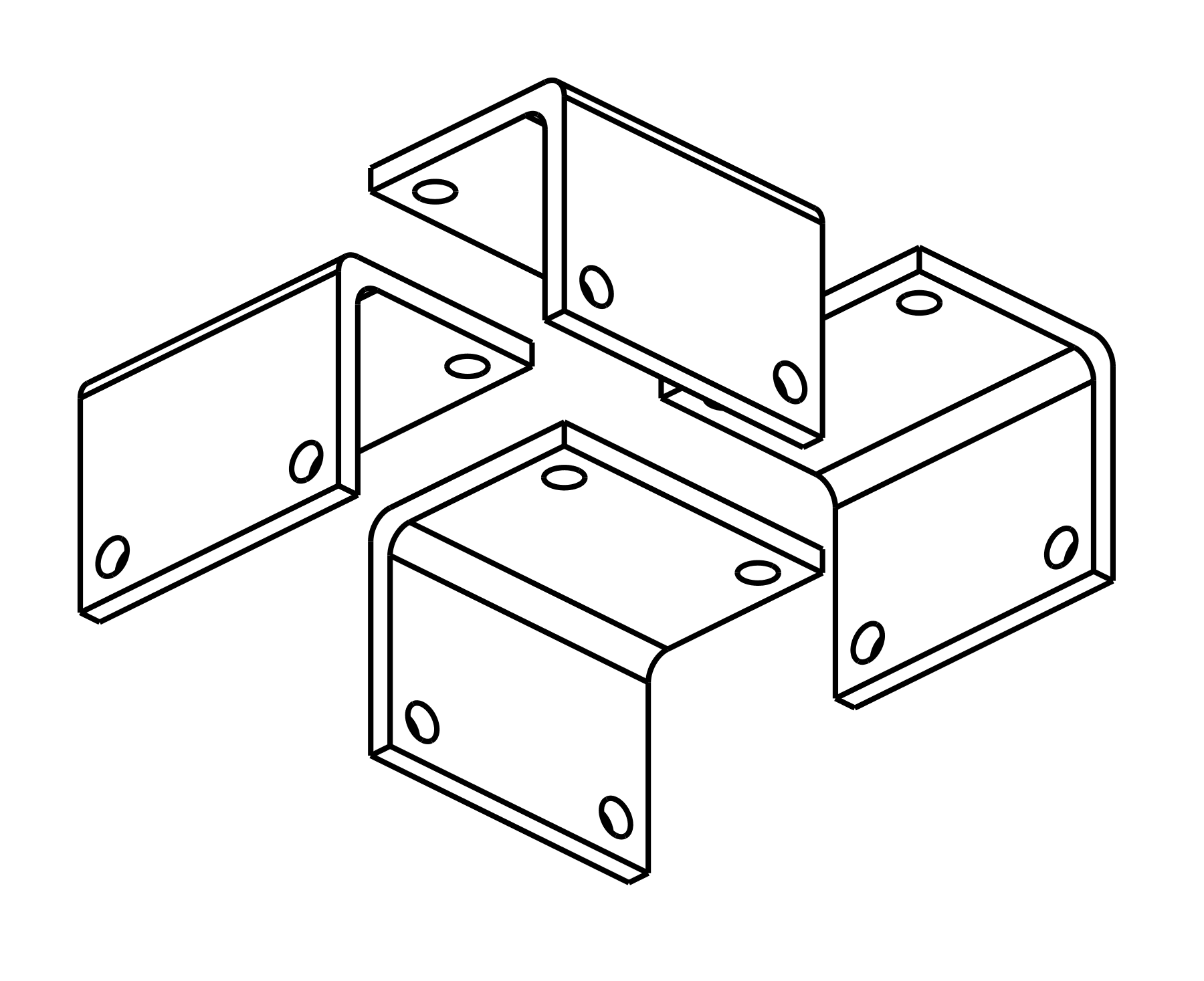
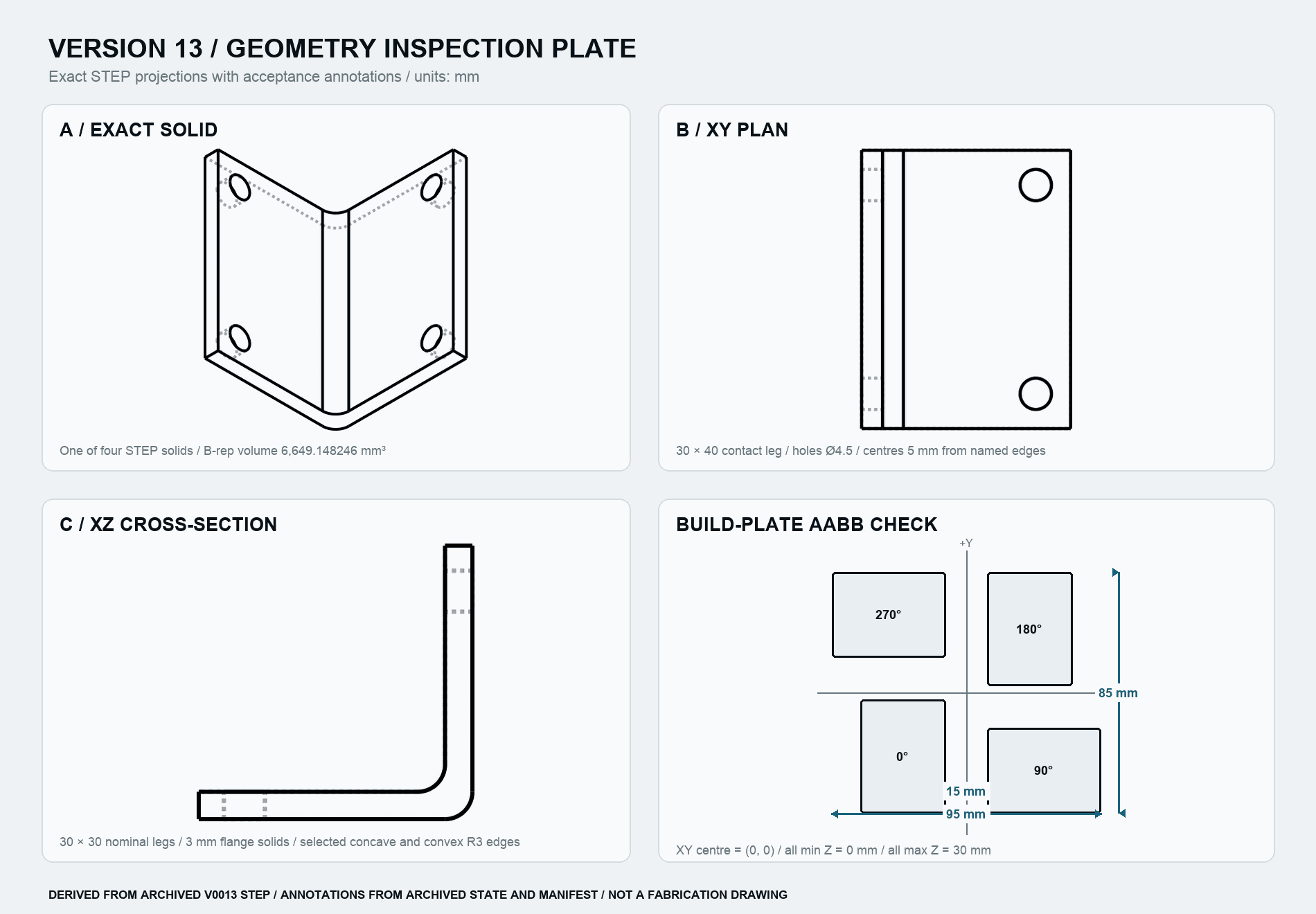
| Body | Minimum XYZ | Maximum XYZ |
|---|---|---|
| bracket_0 | −37.5, −42.5, 0 | −7.5, −2.5, 30 |
| bracket_90 | 7.5, −42.5, 0 | 47.5, −12.5, 30 |
| bracket_180 | 7.5, 2.5, 0 | 37.5, 42.5, 30 |
| bracket_270 | −47.5, 12.5, 0 | −7.5, 42.5, 30 |
Every minimum Z is 0 mm and every maximum Z is 30 mm. The X-centre calculation is (−47.5 + 47.5) / 2 = 0 mm; the Y-centre calculation is (−42.5 + 42.5) / 2 = 0 mm. Minimum adjacent bounding-box clearance is 15 mm.
05
The archive contains two app-server durations.
The completed-turn payload reports 144.859 seconds. Captured start and completion notification timestamps span 144.811 seconds. The 48 ms difference is retained rather than silently reconciled.
| Interval | Observed duration |
|---|---|
| Completed-turn payload | 144.859 s |
| Notification timestamp span | 144.811 s |
| Operator stopwatch | 126 s / unsynchronised endpoints |
| Turn start → first accepted CAD event | 6.374 s |
| First event → final geometry mutation | 107.292 s |
| Final mutation → turn complete | 31.145 s |
| Sum of service-reported call durations | 5.268 s |
This is one observation, not an estimate of expected performance. No conventional CAD baseline, task sample, independent operator, or variance estimate exists yet. The case documents one end-to-end transaction; it does not prove a time saving.
06
No single validation check carries the claim.
Schema checks constrain requests. Transactions protect prior canonical state. OCCT checks exact topology. Measurement compares bodies, solids, bounds, and B-rep volume. Replay rebuilds accepted operations. STEP reimport checks an AP214 artifact inside the same CadQuery/OCCT stack used for construction and export. GLB parsing checks the viewport artifact after mapping it back into the Z-up CAD world. SHA-256 digests bind the retained records and files.
| Check | Observed result |
|---|---|
| Calls / CAD events | 31 completed, 0 failed / 14 accepted, 0 rejected |
| Replay / topology | Passed / passed |
| STEP creation manifest | AP214; 4 solids; zero reported volume delta; 0.000233223 mm bound delta |
| GLB creation manifest | 4 bodies, 4 solids, 56 geometry nodes; 0.079099 mm³ volume delta; 0.000233 mm bound delta |
| Final regeneration check | Both bound deltas reported as 0.0 mm; regenerated digests matched |
These checks show internal consistency among the accepted exact model and its derived artifacts under the frozen rules. No second CAD system has accepted the STEP file. The thresholds are 0.005 mm and 0.001 mm³ for STEP, 0.25 mm for GLB bounds, and per-body GLB volume tolerance of max(0.1 mm³, 10⁻⁴ relative).
07
The broad claim is still deliberately open.
The builder was the sole operator. The task was explicit, unblinded, and aligned with the available vocabulary. The bracket is simple. One model, machine, kernel configuration, and run were tested. A skilled CAD user, macro, or parameterized template may be faster.
The case did not test sketches, constraints, assemblies, tolerance stacks, material choice, loads, drawings, slicers, printer profiles, physical manufacture, dimensional inspection, field use, security, or buyer value. A direct route from accepted CAD to a printed part is an application hypothesis until release, machine execution, the actual article, and inspection are recorded.
Public hashes support continuity only for a reviewer who also has the bytes. A 28-file controlled-access committee packet now retains the raw run, artifacts, source, locks, reconstructed input layers, and post-hoc tool-schema snapshot. Public replication and external reproduction remain open.
08
Build the workstation around engineering states.
Improve the interface, then extend design intent, process preparation, physical evidence, and comparative evaluation in that order.
- Make conversation, state inspection, feature selection, measurement, branching, review, and recovery faster and clearer.
- Add constraints, dimensions, datums, tolerances, drawings, assemblies, interference, and revision comparison.
- Add explicit slicer and printer profiles for build volume, orientation, packing, support, material, time, and cost.
- Keep checked geometry, reviewed release, machine job, physical article, inspection, and field disposition as distinct states.
- Run paired tasks with qualified operators and a named conventional CAD baseline.
- Manufacture and inspect low-risk articles, then repeat on materially different geometry.
Total cost must include inference, engineering review, kernel and dependency maintenance, storage, workstation support, drawings, machine or supplier time, consumables, inspection, rework, security, liability, and migration. Generation speed is only one term.
09
The venture hypothesis is an auditable engineering workstation.
The initial buyer hypothesis is a small engineering team that repeatedly makes fixtures, brackets, enclosures, adapters, and revisions but cannot justify fragmented specialist tooling and manual evidence assembly. Additive-manufacturing teams may provide a measurable first application because the loop from requirement to inspected article is short.
Promotion requires independent multi-task evidence, a credible baseline after review and rework cost, manufactured and inspected articles, a buyer with a budget and acceptance rule, security and isolation controls, known printer/material/supplier limits, lifecycle economics, and bounded design and release liability.
Commercial invalidator
If review and support consume the saved effort, users do not adopt the workflow, buyers will not pay the full operating cost, or liability cannot be bounded, the venture path narrows or stops.
10
Primary technical references
- Embodied CAD, 2026 preprint
Typed geometric operations, exact parametric B-rep execution, and solver feedback.
- TOOLCAD, Findings of ACL 2026
Tool-using language models interacting with a CAD engine through an agentic workflow.
- CAD-Refiner, CVPR 2026
Unified CAD generation, iterative editing, and geometry-aware checking.
- ArtisanCAD, 2026 preprint
Executable CAD intermediate representation, MCP bindings, and CATIA B-rep execution.
- CAD-Assistant, ICCV 2025
Tool-augmented iterative CAD task solving in FreeCAD.
- Text2CAD, NeurIPS 2024
Natural-language descriptions to sequential parametric CAD commands.
- CAD-Llama, CVPR 2025
Language-model generation of parametric 3D CAD.
- Open CASCADE Technology
Exact solid modelling, application data, history, and exchange.
- MCP tool specification
Discoverable tools, JSON Schema inputs, and structured outputs.
- ISO 10303-242:2025
Prospective managed-model context; the tested file declares ISO 10303-214.
11
Read Working Paper 03.
The full paper contains the formal authority and transaction model, related work, separated input layers, run reconstruction, geometry and feature evidence, timing analysis, invalidators, systems roadmap, venture gates, artifact ledger, and prospective comparative protocol.
Public review draft / not peer reviewed